Blog

  • FRM Syllabus and Exam Pattern Level 1 and Level 2 Explained

    FRM Syllabus and Exam Pattern Level 1 and Level 2 Explained

    One of the biggest challenges for FRM aspirants is understanding the syllabus and exam structure. Many students feel overwhelmed because they are not sure what to study, how deep to go, and what the exam actually tests.

    In reality, once you understand the structure clearly, FRM becomes much more manageable.

    In this guide, we will break down the FRM syllabus and exam pattern for both Level 1 and Level 2 with practical clarity.


    Overview of FRM Exam Structure

    FRM is divided into two levels

    Level 1 focuses on concepts and fundamentals
    Level 2 focuses on application and real world scenarios

    Both levels must be cleared to complete the FRM program.


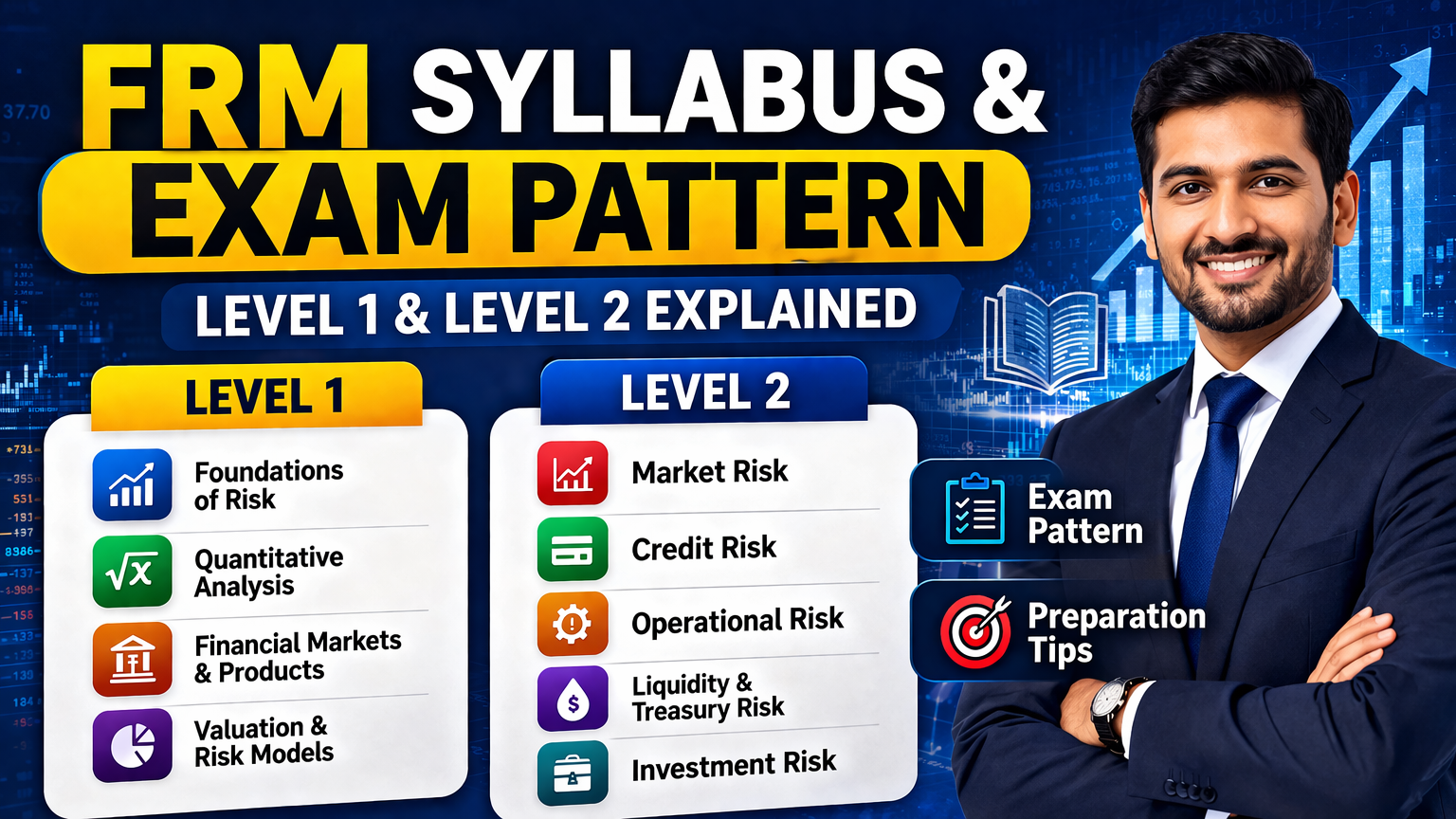
    FRM Level 1 Syllabus

    Level 1 builds your foundation in risk management. It focuses on understanding tools, concepts, and financial markets.


    1 Foundations of Risk Management

    This section introduces the core concepts of risk.

    You learn

    Types of financial risks
    Role of risk management in organizations
    Basel regulations basics

    Example

    Understanding how banks measure and manage risk exposure in lending.


    2 Quantitative Analysis

    This is one of the most important sections.

    You learn

    Probability concepts
    Statistical measures
    Regression analysis
    Time value of money

    Example

    Calculating probability of default or expected loss using statistical models.


    3 Financial Markets and Products

    This section helps you understand how financial instruments work.

    You learn

    Bonds
    Derivatives
    Options and futures
    Interest rates

    Example

    Understanding how bond prices change with interest rates.


    4 Valuation and Risk Models

    This section connects theory with application.

    You learn

    Value at Risk
    Risk measurement models
    Portfolio risk

    Example

    Estimating how much money a portfolio could lose under worst case scenarios.


    Level 1 Weightage (Approx)

    Foundations of risk management
    Quantitative analysis
    Financial markets
    Valuation models

    Quantitative and valuation topics usually carry significant weight.


    FRM Level 2 Syllabus

    Level 2 is more practical and focuses on real world application of risk concepts.


    1 Market Risk Measurement and Management

    You learn

    Interest rate risk
    Equity risk
    Currency risk
    Stress testing

    Example

    Analyzing how a portfolio reacts to market crashes.


    2 Credit Risk Measurement and Management

    This is highly relevant for banking roles.

    You learn

    Credit rating models
    Default risk
    Credit derivatives

    Example

    Evaluating whether a company is likely to default on its loan.


    3 Operational Risk and Resilience

    You learn

    Business risks
    Fraud risk
    System failures
    Risk mitigation strategies

    Example

    Managing risks related to internal processes or cyber threats.


    4 Liquidity and Treasury Risk

    You learn

    Liquidity management
    Funding risk
    Cash flow management

    Example

    Ensuring a bank has enough cash to meet withdrawal demands.


    5 Risk Management and Investment Management

    This section connects risk with investment decisions.

    You learn

    Portfolio risk
    Asset management
    Hedging strategies


    Level 2 Weightage (Approx)

    Market risk
    Credit risk
    Operational risk
    Liquidity risk
    Investment risk

    Level 2 focuses more on practical scenarios and case based understanding.


    FRM Exam Pattern

    Understanding the pattern is equally important.


    Level 1 Exam Pattern

    100 multiple choice questions
    Duration around 4 hours

    Focus on concepts and calculations


    Level 2 Exam Pattern

    80 multiple choice questions
    Duration around 4 hours

    Focus on application and interpretation


    Difficulty Level of FRM Exams

    FRM is considered challenging because

    Questions test concepts deeply
    Application based thinking is required
    Time management is important

    Example

    Instead of asking definitions, the exam may present a scenario and ask you to apply a concept.


    How to Approach the Syllabus

    Many students make the mistake of studying randomly.

    Here is a smarter approach.


    Step 1 Start with Foundations

    Build strong basics before moving to advanced topics.


    Step 2 Focus on Quantitative Concepts

    Quantitative analysis is the backbone of FRM.

    Spend extra time here.


    Step 3 Practice Questions Regularly

    FRM is application based.

    Solving questions is more important than just reading theory.


    Step 4 Revise Multiple Times

    Concepts require revision to become clear.


    Real Life Study Strategy Example

    Let us take an example.

    A student studies for 4 months.

    Month 1
    Foundations and basic concepts

    Month 2
    Quantitative analysis

    Month 3
    Markets and valuation

    Month 4
    Revision and mock tests

    This structured approach improves chances of success.


    Common Mistakes Students Make

    Ignoring quantitative topics
    Focusing only on theory
    Not practicing enough questions
    Skipping revision

    Avoiding these mistakes can significantly improve performance.


    Final Thoughts

    The FRM syllabus is comprehensive but highly practical. It is designed to prepare candidates for real world risk management roles.

    Level 1 builds your foundation, while Level 2 develops your ability to apply concepts in real scenarios.

    Once you understand the structure and follow a disciplined study plan, FRM becomes much more manageable.

    The key is consistency, practice, and clarity of concepts.
  • FRM Eligibility, Fees and Registration Process Explained

    FRM Eligibility, Fees and Registration Process Explained

    If you are planning to pursue FRM, one of the first questions that comes to mind is

    👉 Am I eligible and how much will it cost

    The good news is that FRM is one of the most accessible global certifications in finance. However, understanding the fees, registration process, and requirements properly can save you both time and money.

    In this guide, we will break everything down step by step with practical clarity.


    FRM Eligibility Criteria

    One of the biggest advantages of FRM is that there are no strict eligibility requirements to appear for the exam.

    This means

    You do not need a specific degree
    You do not need minimum marks
    You do not need prior work experience

    Anyone can register and take the FRM exams.


    But There is One Important Condition

    While there is no eligibility to appear, to officially become an FRM certified professional, you must

    Pass FRM Level 1 and Level 2
    Have two years of relevant work experience in risk related roles

    Example

    Ravi clears both FRM exams while still in college. He cannot use the FRM designation immediately.

    After gaining 2 years of experience in a risk or finance role, he becomes a certified FRM.


    What Counts as Relevant Work Experience

    GARP accepts experience in roles related to risk and finance.

    Examples include

    Risk analyst
    Credit analyst
    Market risk roles
    Investment risk roles
    Financial analyst roles

    Even some consulting or analytics roles can qualify if they involve risk related work.


    FRM Fees Breakdown

    FRM is an international certification, so the fees are charged in USD.

    There are two main components.


    1 Enrollment Fee

    This is a one time fee paid when you register for FRM for the first time.

    Approximate cost
    400 USD

    You do not need to pay this again for Level 2.


    2 Exam Fee

    This fee is paid for each level.

    The cost depends on when you register.

    Early registration
    Around 600 USD

    Standard registration
    Around 800 USD


    Total Cost Estimate

    Let us calculate a realistic scenario.

    Enrollment fee
    400 USD

    Level 1 exam fee
    700 USD

    Level 2 exam fee
    700 USD

    Total
    Approximately 1800 USD

    Additional costs may include

    Study material
    Coaching classes
    Mock tests


    How to Save Money on FRM

    Many students end up paying more simply because they register late.

    Smart Strategy

    Always register during early window
    Plan your exam date in advance
    Avoid rescheduling

    Example

    A student who registers early for both levels can save around 200 to 400 USD compared to late registration.


    FRM Registration Process Step by Step

    Let us simplify the entire process.


    Step 1 Create an Account on GARP Website

    Visit the official GARP website and create your account.

    You will need

    Basic personal details
    Email ID
    Contact information


    Step 2 Choose Exam Level

    You can register for

    Level 1 only
    Both Level 1 and Level 2 (not recommended for beginners)

    Most candidates start with Level 1.


    Step 3 Select Exam Window

    FRM exams are conducted multiple times a year.

    Choose a window that gives you enough preparation time.


    Step 4 Make Payment

    Pay the enrollment fee and exam fee online.

    Payment options include

    Credit card
    Debit card


    Step 5 Schedule Exam Slot

    After registration, you need to book your exam slot.

    Choose

    Preferred date
    Preferred exam center


    Important Registration Tips

    Do not wait until the last date
    Choose exam window based on preparation time
    Double check details before payment
    Keep payment confirmation records


    When Should You Register for FRM

    Timing plays a very important role.

    Ideal Approach

    Register 4 to 6 months before the exam
    Start preparation immediately after registration

    Example

    If you plan to appear in November, register by May or June.

    This gives you enough time to complete syllabus and revision.


    Common Mistakes to Avoid

    Many candidates make avoidable mistakes during registration.

    Registering late and paying higher fees
    Choosing exam date without preparation plan
    Ignoring exam slot booking
    Not understanding refund policies

    Avoiding these mistakes can make your FRM journey smoother.


    Real Life Scenario

    Let us compare two students.

    Amit registers early, pays lower fees, and prepares for 5 months. He clears Level 1 in first attempt.

    Rohit delays registration, pays higher fees, rushes preparation, and struggles in the exam.

    The difference is planning.


    Final Thoughts

    FRM is one of the most accessible and valuable certifications in finance. The lack of strict eligibility makes it open to students and professionals from diverse backgrounds.

    However, understanding the fee structure and registration process is crucial to avoid unnecessary costs and mistakes.

    With proper planning, early registration, and a clear preparation strategy, you can start your FRM journey smoothly.

  • What is FRM Certification and Who Should Do It

    What is FRM Certification and Who Should Do It

    Choosing the right finance certification can shape your entire career. Many students and professionals often hear about FRM but are unsure whether it is the right choice for them.

    If you are someone interested in finance, risk, banking, or analytics, understanding FRM can help you make a clear career decision.

    In this guide, we will break down what FRM is, what you actually learn, and who should seriously consider pursuing it.


    What is FRM Certification

    FRM stands for Financial Risk Manager. It is a globally recognized certification offered by GARP, which is the Global Association of Risk Professionals.

    The certification focuses on understanding and managing different types of financial risks that organizations face every day.

    These include

    Market risk
    Credit risk
    Operational risk
    Liquidity risk

    In simple terms, FRM professionals help companies answer one critical question

    👉 What can go wrong financially and how do we manage it


    Understanding FRM with a Real Life Example

    Let us simplify this.

    Imagine a bank gives a loan of 10 lakh to a customer.

    There is always a risk that the customer might not repay the loan. This is called credit risk.

    An FRM professional helps the bank

    Evaluate whether the borrower is risky
    Estimate the probability of default
    Design strategies to reduce losses

    Similarly

    If a company invests in the stock market, it faces market risk due to price fluctuations.

    If a company operates internationally, it faces currency risk.

    FRM professionals analyze these risks and help organizations make safer financial decisions.


    What You Actually Learn in FRM

    FRM is not just theory. It is highly practical and industry focused.

    You learn

    How financial markets work
    How risk is measured using quantitative tools
    How to use models to predict losses
    How banks and institutions manage risk

    Example

    You may learn concepts like

    Value at Risk
    Probability models
    Portfolio risk analysis

    These are tools used by professionals working in banks and investment firms.


    Why FRM is Gaining Popularity

    The demand for risk professionals has increased significantly in recent years.

    After global financial crises, companies and regulators have become more focused on risk management.

    Today, every financial institution needs professionals who can

    Identify risks
    Measure risks
    Control risks

    This has made FRM one of the most valuable certifications in finance.


    Who Should Do FRM

    FRM is not for everyone. It is best suited for people who are interested in analytical and risk based roles.

    Let us understand this clearly.


    1 Finance Students

    If you are a BCom, BBA, or MBA student and want to specialize in finance, FRM can give you a strong edge.

    Example

    A BCom student who completes FRM can target roles like

    Risk analyst
    Credit analyst
    Financial analyst

    instead of general accounting roles.


    2 Students Interested in Banking Careers

    Banks deal heavily with risk. Whether it is lending money or managing investments, risk is always involved.

    FRM helps you enter roles such as

    Credit risk analyst
    Market risk analyst
    Risk manager


    3 Working Professionals in Finance

    If you are already working in finance and want to move into higher paying or specialized roles, FRM can help.

    Example

    An operations executive in a bank can transition into a risk role after completing FRM.


    4 People Interested in Analytics and Quant Roles

    FRM involves quantitative concepts such as probability, statistics, and financial models.

    If you enjoy working with numbers and analysis, FRM is a strong fit.


    Who Should Not Do FRM

    It is equally important to understand who should avoid FRM.

    FRM may not be suitable if

    You dislike quantitative concepts
    You prefer marketing or sales roles
    You are not interested in finance

    FRM requires analytical thinking and consistent effort.


    Skills Required for FRM

    To succeed in FRM, certain skills are helpful.

    Basic understanding of finance
    Comfort with numbers and calculations
    Analytical thinking
    Discipline and consistency

    You do not need to be a math expert, but you should be comfortable with basic quantitative concepts.


    FRM vs Other Finance Certifications

    Many students compare FRM with other certifications.

    FRM focuses on risk management
    CFA focuses on investment management
    MBA finance provides broader business exposure

    Example

    If your goal is portfolio management or equity research, CFA is better
    If your goal is risk management or banking roles, FRM is better


    Real Life Career Scenario

    Let us compare two students.

    Rahul completes a general degree without specialization. He gets a basic finance job with limited growth.

    Aman completes FRM along with his graduation. He gets a role as a risk analyst in a bank with higher growth potential.

    The difference is specialization.

    FRM gives you a clear niche in finance.


    Advantages of FRM Certification

    Global recognition
    High demand in banking and finance
    Specialized skillset
    Better career opportunities
    Strong salary growth potential


    Final Thoughts

    FRM certification is one of the best options for individuals who want to build a career in financial risk management.

    It is especially valuable for students and professionals who want to stand out in the competitive finance industry.

    However, the key is clarity. FRM is not just about passing exams. It is about building expertise in risk, which is one of the most critical areas in finance today.

    If you are interested in finance, enjoy analytical thinking, and want a specialized career path, FRM can be a powerful choice.

  • FRM Certification Complete Guide: Eligibility, Fees, Syllabus, Jobs and Salary

    FRM Certification Complete Guide: Eligibility, Fees, Syllabus, Jobs and Salary

    Financial risk is at the core of every financial decision. From banks and investment firms to fintech companies, managing risk has become one of the most critical functions in the financial industry. This is where the FRM certification comes in.

    The Financial Risk Manager designation is one of the most respected certifications globally for professionals looking to build a career in risk management.

    In this complete guide, you will understand everything about FRM including eligibility, exam structure, fees, preparation strategy, career opportunities, and salary prospects.


    What is FRM Certification

    FRM stands for Financial Risk Manager. It is a globally recognized certification offered by GARP (Global Association of Risk Professionals).

    The certification focuses on understanding and managing different types of financial risks such as

    Market risk
    Credit risk
    Operational risk
    Liquidity risk

    FRM is considered the gold standard for professionals working in

    Risk management
    Banking
    Investment firms
    Consulting
    Fintech


    Why FRM is Important in Today’s Financial World

    Financial markets are becoming increasingly complex. Institutions are exposed to various risks due to market volatility, economic changes, and regulatory requirements.

    For example

    A bank lending money faces credit risk if borrowers default
    An investment firm faces market risk due to price fluctuations
    A company operating globally faces currency risk

    FRM professionals are trained to identify, measure, and manage these risks effectively.

    This makes FRM highly valuable in today’s finance industry.


    Who Should Do FRM

    FRM is ideal for individuals who want to build a career in finance with a focus on risk.

    It is suitable for

    Finance students
    Commerce graduates
    MBA finance students
    Banking professionals
    Investment analysts
    Risk professionals

    Example

    A BCom student interested in finance but unsure about specialization can choose FRM to enter high demand roles like risk analyst or credit analyst.


    FRM Eligibility Criteria

    One of the biggest advantages of FRM is that there are no strict eligibility requirements to appear for the exam.

    Anyone can register and take the exam.

    However, to earn the FRM designation, candidates must

    Pass both Level 1 and Level 2 exams
    Have two years of relevant work experience in risk related roles

    This makes FRM accessible to both students and working professionals.


    FRM Exam Structure

    The FRM program consists of two levels.

    FRM Level 1

    Focuses on fundamental concepts and tools used in risk management.

    Key subjects include

    Foundations of risk management
    Quantitative analysis
    Financial markets and products
    Valuation and risk models

    Level 1 tests your understanding of concepts and basic calculations.


    FRM Level 2

    Focuses on practical application of risk management concepts.

    Key subjects include

    Market risk measurement
    Credit risk measurement
    Operational risk
    Liquidity risk
    Risk management and investment management

    Level 2 is more practical and application based.


    FRM Exam Pattern

    Both levels are computer based exams.

    Level 1
    100 multiple choice questions
    Duration around 4 hours

    Level 2
    80 multiple choice questions
    Duration around 4 hours

    The exams are known for being conceptually challenging rather than just theoretical.


    FRM Fees Breakdown

    FRM certification involves several costs.

    Enrollment fee one time
    Exam fee per level

    Example Cost Structure

    Enrollment fee: around 400 USD
    Exam fee: 600 to 800 USD depending on registration timing

    Early registration is cheaper compared to standard registration.

    Additional costs may include study materials and coaching.


    FRM Syllabus Overview

    The FRM syllabus is designed to provide both theoretical knowledge and practical skills.

    Level 1 Weightage

    Foundations of risk management
    Quantitative analysis
    Financial markets and products
    Valuation and risk models

    Level 2 Weightage

    Market risk
    Credit risk
    Operational risk
    Liquidity risk
    Investment risk

    The syllabus is updated regularly to reflect industry changes.


    How to Prepare for FRM

    FRM requires a structured preparation approach.

    Step 1 Understand the Syllabus

    Go through the entire syllabus before starting preparation.

    Step 2 Choose Study Materials

    Common resources include

    GARP official books
    Kaplan Schweser
    Practice question banks

    Step 3 Create a Study Plan

    Example

    Study 2 to 3 hours daily
    Complete syllabus in 3 to 4 months
    Revise for 1 month

    Step 4 Practice Questions

    FRM exams focus heavily on application. Solving practice questions is essential.

    Step 5 Take Mock Tests

    Mock tests help improve time management and exam confidence.


    Career Opportunities After FRM

    FRM opens doors to several high demand roles.

    Common job roles include

    Risk analyst
    Credit analyst
    Market risk analyst
    Operational risk manager
    Investment risk analyst

    Example

    An FRM candidate working in a bank may analyze loan portfolios to assess credit risk and reduce potential losses.


    Top Companies Hiring FRM Professionals

    FRM professionals are hired by

    Investment banks
    Commercial banks
    Consulting firms
    Asset management companies
    Fintech companies

    Examples include

    JP Morgan
    Goldman Sachs
    Morgan Stanley
    Deloitte
    KPMG


    Salary After FRM

    FRM professionals are well compensated due to their specialized skills.

    India Salary Range

    Entry level
    6 to 12 lakh per year

    Mid level
    12 to 25 lakh per year

    Senior roles
    25 lakh and above

    Global Salary

    Significantly higher depending on experience and location.


    FRM vs CFA vs MBA Finance

    Many students get confused between these options.

    FRM focuses on risk management
    CFA focuses on investment management
    MBA finance provides broader business knowledge

    Example

    If your goal is portfolio management choose CFA
    If your goal is risk management choose FRM


    Advantages of FRM

    Globally recognized certification
    High demand skillset
    Specialization in risk
    Career growth opportunities
    Relevant for banking and finance


    Challenges of FRM

    Conceptually difficult exams
    Requires strong quantitative skills
    Requires consistent preparation


    Final Thoughts

    FRM certification is one of the best choices for individuals looking to build a career in financial risk management. It offers strong career opportunities, global recognition, and specialized knowledge in a high demand field.

    While the journey requires dedication and discipline, the long term benefits make it a valuable investment in your career.

    If you are interested in finance and want to work in roles that influence critical financial decisions, FRM can be a powerful step forward.

  • Module 12: Practice and Exam Preparation

    The final stage of CFA Level 1 preparation focuses on applying the knowledge gained from all previous modules and improving exam performance through practice and revision.

    While understanding concepts is important, success in the CFA exam requires the ability to solve questions efficiently under time pressure. This module helps students strengthen their problem solving skills, identify weak areas, and develop a structured approach to the exam.

    By the end of this module, students should feel confident in applying concepts from the entire CFA Level 1 curriculum.


    12.1 Practice Question Sessions

    Practice questions help students reinforce concepts and improve their ability to apply theoretical knowledge to real exam situations.

    Each topic in the CFA curriculum should be followed by targeted practice questions covering key concepts and calculation based problems.

    Practice sessions should include questions from areas such as:

    • Ethics and Professional Standards
    • Quantitative Methods
    • Economics
    • Financial Statement Analysis
    • Corporate Issuers
    • Equity Investments
    • Fixed Income
    • Derivatives
    • Alternative Investments
    • Portfolio Management

    Solving a large number of questions helps students:

    • understand exam patterns
    • improve calculation speed
    • identify frequently tested concepts
    • strengthen problem solving skills

    Students are encouraged to review explanations for both correct and incorrect answers to deepen their understanding.


    12.2 Full Length Mock Exams

    Mock exams simulate the real CFA examination environment and help students prepare for the actual test.

    A full length mock exam allows students to practice managing time and handling exam pressure.

    Benefits of mock exams include:

    Real Exam Experience
    Students become familiar with the structure and format of the CFA exam.

    Time Management
    Students learn how to allocate time efficiently across questions.

    Confidence Building
    Regular practice improves confidence before the final exam.

    Students should attempt several mock exams during the final phase of preparation.

    After completing each mock exam, students should carefully review their answers to identify mistakes and knowledge gaps.


    12.3 Performance Analysis

    Performance analysis helps students understand their strengths and weaknesses across different topics.

    After each practice test or mock exam, students should evaluate their performance by analyzing:

    Topic wise scores
    Identifying which subjects require additional focus.

    Accuracy rate
    Understanding whether mistakes are due to conceptual misunderstanding or calculation errors.

    Time management
    Evaluating whether enough time is allocated to each question.

    This analysis allows students to adjust their study plan and focus on areas that require improvement.


    12.4 Revision Strategy

    Revision is an essential part of CFA preparation because the curriculum covers a wide range of topics.

    An effective revision strategy should include:

    Topic wise review
    Revisit key concepts and formulas from each module.

    Summary notes
    Use concise notes to quickly review important topics.

    Practice questions
    Reinforce learning through additional problem solving.

    Mock exam review
    Analyze mistakes from previous tests and ensure concepts are clearly understood.

    Students should allocate sufficient time for revision before the exam to consolidate their understanding.


    12.5 Exam Day Preparation

    Proper preparation on exam day can significantly improve performance and reduce stress.

    Students should follow several best practices on the day of the exam.

    Arrive Early
    Arrive at the exam center well before the scheduled start time.

    Carry Required Documents
    Ensure that all required identification and exam materials are ready.

    Manage Time Carefully
    Allocate time efficiently across questions and avoid spending too long on difficult questions.

    Stay Calm and Focused
    Maintaining concentration and confidence helps improve decision making during the exam.

    Review Answers if Time Allows
    If time remains, review flagged questions before submitting the exam.


    Importance of Final Preparation

    The final preparation phase is crucial because it allows students to consolidate knowledge, refine exam strategies, and build confidence before the exam.

    Effective preparation during this stage can significantly increase the chances of passing the CFA Level 1 exam.

    Through consistent practice, structured revision, and careful exam strategy, students can approach the exam with confidence and maximize their performance.

  • How to Track Expenses Effectively and Take Control of Your Money

    How to Track Expenses Effectively and Take Control of Your Money

    Many people feel that they do not earn enough money. However, in many cases the real problem is not income but lack of awareness about spending habits. Small daily expenses often go unnoticed and gradually consume a large portion of monthly income.

    Expense tracking is one of the most powerful habits in personal finance because it helps you understand exactly where your money is going. Once you become aware of your spending patterns, it becomes much easier to reduce unnecessary expenses and increase savings.

    In this guide, we will explore why expense tracking is important, how to do it effectively, and practical methods anyone can use.


    Why Expense Tracking is Important

    Expense tracking creates financial awareness. Without tracking expenses, it is easy to underestimate how much money is spent each month.

    Consider this simple example.

    Aman spends money on the following daily habits.

    Morning coffee: 150
    Lunch outside office: 250
    Evening snacks: 100

    Total daily spending: 500

    Monthly spending on these small expenses

    500 x 30 days = 15000

    Aman initially believed he was spending only around 6000 to 7000 on food outside, but tracking revealed the actual amount was more than double.

    Expense tracking helps individuals

    Identify unnecessary spending
    Improve budgeting accuracy
    Increase savings potential
    Develop better financial discipline


    Record Every Expense

    The first rule of expense tracking is simple: record every expense, even the small ones.

    Many people only track large expenses like rent or loan payments while ignoring small purchases such as snacks, coffee, or ride sharing. These small expenses often accumulate into significant amounts.

    For example

    Coffee purchases: 3000 per month
    Food delivery: 5000 per month
    Online subscriptions: 2000 per month

    Total unnoticed spending: 10000 per month

    By recording every transaction, you gain complete visibility into your financial behavior.


    Categorize Your Expenses

    Once expenses are recorded, the next step is grouping them into categories. Categorization helps you understand which areas consume the largest portion of your income.

    Common expense categories include

    Housing
    Food and groceries
    Transportation
    Utilities
    Entertainment
    Shopping
    Savings and investments

    Example Expense Breakdown

    Neha tracks her monthly spending.

    Rent: 18000
    Groceries: 6000
    Transportation: 3500
    Dining out: 4500
    Shopping: 4000
    Entertainment subscriptions: 2000
    Utilities: 2000

    Total monthly spending: 40000

    By reviewing this breakdown, Neha realizes that dining out and shopping together cost nearly 8500 per month, which she can partially reduce.


    Identify Spending Patterns

    Tracking expenses for one or two months often reveals surprising patterns.

    You may discover habits such as

    Frequent online shopping
    Excessive food delivery
    Unused subscriptions
    Impulse purchases

    Recognizing these patterns is the first step toward improving financial discipline.

    Example

    Rahul subscribes to multiple online services.

    Streaming service 1: 500
    Streaming service 2: 600
    Music subscription: 150
    Fitness app: 400

    Total monthly subscription cost: 1650

    After reviewing his expenses, Rahul decides to cancel two subscriptions he rarely uses, saving nearly 900 per month.


    Use Technology to Simplify Expense Tracking

    Tracking expenses manually can sometimes feel time consuming. Fortunately, several tools make the process easier.

    Common methods include

    Mobile budgeting apps
    Bank spending analysis tools
    Spreadsheet tracking
    Expense management apps

    These tools automatically categorize spending and provide visual insights into financial habits.

    For example, some apps display charts showing how much money is spent on food, transportation, or entertainment.

    This visual representation helps individuals identify problem areas quickly.


    Review Expenses Regularly

    Tracking expenses is only useful if the data is reviewed regularly.

    A good practice is to review spending

    Weekly for short term awareness
    Monthly for financial planning

    Regular reviews help identify overspending early and allow adjustments before the month ends.

    Example

    If Priya notices that she has already spent 80 percent of her entertainment budget by the middle of the month, she can reduce spending for the remaining weeks.

    This proactive approach prevents budget overruns.


    Set Spending Limits

    Once you understand your spending patterns, the next step is setting limits for each category.

    For example

    Dining out budget: 3000
    Shopping budget: 2500
    Entertainment budget: 2000

    Setting limits helps maintain financial balance while still allowing enjoyable spending.


    The Psychological Benefit of Expense Tracking

    Expense tracking not only improves financial awareness but also changes spending behavior.

    When individuals actively record their purchases, they become more mindful about spending decisions.

    For example, before making an impulse purchase, a person may ask

    Do I really need this item
    Is this purchase aligned with my budget
    Could this money be saved or invested instead

    This simple habit encourages more thoughtful financial decisions.


    Real Life Scenario

    Consider two individuals with similar incomes.

    Ankit does not track his expenses. At the end of every month, he struggles to understand where his money went and often has little savings.

    Meera tracks all her expenses. She identifies unnecessary spending and gradually reduces it. Over time, she manages to save and invest nearly 15000 per month.

    After several years, Meera builds a strong investment portfolio, while Ankit continues living paycheck to paycheck.

    The difference between them is not income but financial awareness.


    Final Thoughts

    Expense tracking is one of the simplest yet most powerful financial habits anyone can develop. It provides clarity, control, and confidence in managing money.

    By recording expenses, categorizing spending, and reviewing financial habits regularly, individuals can significantly improve their financial health.

    When combined with budgeting, saving, and investing, expense tracking becomes a foundation for long term financial success.

    Taking control of your money begins with understanding how you spend it.

  • Module 11: Portfolio Management

    Portfolio management is the process of selecting and managing a collection of investments in order to achieve specific financial objectives. The primary goal of portfolio management is to balance risk and return based on an investor’s risk tolerance, investment horizon, and financial goals.

    Rather than investing in a single asset, investors combine multiple assets such as stocks, bonds, and other securities to create a diversified portfolio. A well constructed portfolio helps reduce overall risk while maintaining the potential for attractive returns.

    Portfolio management involves analyzing market conditions, selecting appropriate investments, monitoring portfolio performance, and adjusting asset allocations when necessary.

    This module introduces the key concepts used in portfolio construction and risk management.


    11.1 Risk Measurement

    Risk refers to the uncertainty associated with investment returns. In financial markets, returns are not guaranteed, and investors face the possibility of losing part or all of their investment.

    Understanding and measuring risk is an essential part of portfolio management.


    Types of Investment Risk

    Systematic Risk

    Systematic risk affects the entire market and cannot be eliminated through diversification.

    Examples include:

    • economic recessions
    • inflation
    • interest rate changes
    • geopolitical events

    Because systematic risk affects all securities, investors cannot avoid it by simply holding multiple assets.


    Unsystematic Risk

    Unsystematic risk is specific to a particular company or industry.

    Examples include:

    • poor management decisions
    • company specific financial problems
    • product failures

    Unlike systematic risk, unsystematic risk can be reduced through diversification.


    Standard Deviation as a Risk Measure

    One common measure of investment risk is standard deviation, which indicates how much investment returns vary from the average return.

    Higher standard deviation indicates greater volatility and higher risk.

    Lower standard deviation indicates more stable returns.

    Portfolio managers use historical return data to estimate the volatility of different investments.


    11.2 Diversification

    Diversification is the practice of spreading investments across multiple assets in order to reduce overall portfolio risk.

    By combining different securities, investors can reduce the impact of poor performance from any single investment.

    Diversification works best when investments have low or negative correlation with each other.

    For example, combining stocks from different industries or regions may reduce overall portfolio volatility.


    Benefits of Diversification

    Diversification provides several important advantages.

    Risk Reduction
    Losses in one investment may be offset by gains in another.

    Stability
    Diversified portfolios tend to experience less extreme fluctuations in value.

    Improved Risk Return Tradeoff
    Investors may achieve higher expected returns without proportionally increasing risk.


    11.3 Efficient Frontier

    The efficient frontier is a concept from modern portfolio theory that represents the set of portfolios offering the highest expected return for a given level of risk.

    Each portfolio on the efficient frontier is considered optimal because it provides the best possible return for the amount of risk taken.

    Portfolios that lie below the efficient frontier are considered inefficient because investors could achieve higher returns with the same level of risk.

    Portfolio managers use this concept to identify the most efficient combination of assets.


    Risk Return Tradeoff

    Investors generally expect higher returns when they take on higher levels of risk.

    The efficient frontier illustrates this relationship between risk and return.

    Low risk portfolios typically include a larger proportion of bonds and fixed income securities.

    High risk portfolios typically contain a larger allocation to equities and growth assets.


    11.4 Asset Allocation

    Asset allocation refers to the process of distributing investments across different asset classes such as stocks, bonds, real estate, and alternative investments.

    Asset allocation is one of the most important decisions in portfolio management because it largely determines the portfolio’s risk and return characteristics.


    Strategic Asset Allocation

    Strategic asset allocation involves setting long term target weights for different asset classes based on an investor’s financial goals and risk tolerance.

    For example, a long term investor might allocate:

    • 60 percent to equities
    • 30 percent to bonds
    • 10 percent to alternative assets

    These allocations are maintained over time through periodic rebalancing.


    Tactical Asset Allocation

    Tactical asset allocation involves making short term adjustments to portfolio weights in response to market conditions.

    For example, a portfolio manager may temporarily increase exposure to equities if economic conditions are expected to improve.


    Rebalancing

    Over time, market movements can cause portfolio weights to deviate from target allocations.

    Rebalancing involves adjusting the portfolio by buying or selling assets to restore the desired allocation.

    Regular rebalancing helps maintain the intended risk level of the portfolio.


    Importance of Portfolio Management

    Portfolio management is essential for achieving long term investment success.

    Effective portfolio management helps investors:

    • manage investment risk
    • diversify across asset classes
    • achieve financial goals
    • respond to changing market conditions

    Professional portfolio managers continuously monitor portfolios and adjust investment strategies to maintain an optimal balance between risk and return.

  • Module 10: Alternative Investments

    Alternative investments refer to asset classes that fall outside traditional investments such as stocks and bonds. These investments provide additional opportunities for diversification and may offer higher potential returns compared to traditional assets.

    Alternative assets are often used by institutional investors, hedge funds, and portfolio managers to improve portfolio performance and reduce overall risk.

    Unlike publicly traded securities, many alternative investments are less liquid and may require a longer investment horizon. However, they can provide benefits such as inflation protection, diversification, and access to unique investment opportunities.

    This module introduces major alternative asset classes including private equity, hedge funds, real estate investments, and commodities.


    10.1 Private Equity

    Private equity refers to investments made in companies that are not publicly traded on stock exchanges.

    Private equity firms raise capital from investors and use that capital to acquire, invest in, or restructure private companies with the goal of improving their performance and eventually selling them at a profit.

    Private equity investments usually involve a long term commitment and are typically accessible only to institutional investors and high net worth individuals.


    Types of Private Equity Investments

    Venture Capital

    Venture capital involves investing in early stage companies with high growth potential.

    These companies are often in technology, healthcare, or innovative industries.

    Although venture capital investments can generate significant returns, they also involve high risk because many startups fail.


    Growth Capital

    Growth capital is provided to companies that are already established but require funding to expand their operations.

    This funding may be used for:

    • entering new markets
    • launching new products
    • increasing production capacity

    Leveraged Buyouts

    Leveraged buyouts involve acquiring a company using a large amount of borrowed money.

    The acquiring firm uses the target company’s future cash flows to repay the debt used in the acquisition.

    Private equity firms often restructure acquired companies to improve efficiency and profitability.


    10.2 Hedge Funds

    Hedge funds are investment funds that use advanced strategies to generate returns for their investors.

    Unlike traditional mutual funds, hedge funds have greater flexibility in their investment strategies.

    Hedge funds typically accept investments from institutional investors and high net worth individuals.


    Characteristics of Hedge Funds

    Hedge funds are known for several key features.

    Active Management
    Fund managers actively trade securities to exploit market opportunities.

    Flexible Strategies
    Hedge funds can invest in a wide range of assets including stocks, bonds, derivatives, and currencies.

    Performance Based Fees
    Hedge fund managers often earn a management fee plus a performance fee based on investment returns.


    Common Hedge Fund Strategies

    Long Short Equity
    Managers take long positions in undervalued stocks and short positions in overvalued stocks.

    Global Macro
    Investments are based on macroeconomic trends such as interest rates, currency movements, and economic growth.

    Event Driven
    Investments focus on corporate events such as mergers, acquisitions, or restructurings.


    10.3 Real Estate Investments

    Real estate is a major alternative asset class that involves investing in physical property or property related financial instruments.

    Investors can earn returns through rental income and property price appreciation.

    Real estate investments can be made in different forms.


    Direct Real Estate Investment

    Investors purchase physical properties such as:

    • residential buildings
    • commercial properties
    • office spaces
    • industrial facilities

    Income is generated from rental payments and increases in property value.


    Real Estate Investment Trusts (REITs)

    Real Estate Investment Trusts allow investors to invest in real estate through publicly traded securities.

    REITs pool funds from multiple investors and use the capital to purchase income generating properties.

    Benefits of REITs include:

    • liquidity compared to direct property ownership
    • regular dividend income
    • diversification across multiple properties

    Advantages of Real Estate Investments

    Real estate provides several benefits to investors.

    Income generation
    Properties generate rental income.

    Inflation protection
    Property values often rise during inflationary periods.

    Diversification
    Real estate returns often have low correlation with stock markets.


    10.4 Commodities

    Commodities are physical goods that are traded in global markets. These goods are often raw materials used in production and manufacturing.

    Examples of commodities include:

    • gold
    • oil
    • natural gas
    • agricultural products such as wheat and corn

    Commodity prices are influenced by supply and demand conditions, geopolitical events, and economic cycles.


    Types of Commodities

    Energy Commodities

    Energy commodities include oil, natural gas, and other fuels used for power generation and transportation.

    These commodities are heavily influenced by global economic activity and geopolitical developments.


    Metals

    Metals include precious metals such as gold and silver as well as industrial metals such as copper and aluminum.

    Precious metals are often used as safe haven investments during periods of economic uncertainty.


    Agricultural Commodities

    Agricultural commodities include crops such as wheat, corn, soybeans, and coffee.

    Prices of agricultural commodities depend on weather conditions, global demand, and farming production levels.


    Commodity Investment Methods

    Investors can gain exposure to commodities through:

    • futures contracts
    • exchange traded funds
    • commodity focused mutual funds

    Importance of Alternative Investments

    Alternative investments are important because they help improve portfolio diversification and may enhance long term returns.

    Benefits of alternative investments include:

    Diversification
    Alternative assets often have lower correlation with stocks and bonds.

    Inflation Protection
    Certain assets such as commodities and real estate tend to perform well during inflationary periods.

    Higher Return Potential
    Some alternative investments offer higher expected returns compared to traditional assets.

    However, alternative investments may also involve higher risk, lower liquidity, and longer investment horizons.

  • Investing for Beginners: How to Start Building Wealth With Practical Examples

    Investing for Beginners: How to Start Building Wealth With Practical Examples

    Many people believe investing is only for financial experts or wealthy individuals. In reality, investing is one of the most important tools for building long term wealth and achieving financial independence.

    Saving money alone may help preserve wealth, but investing allows your money to grow over time. With inflation continuously reducing the purchasing power of money, investing has become essential for anyone who wants to build financial security.

    In this guide, we will explain what investing is, why it matters, and how beginners can start investing confidently.


    What is Investing

    Investing means putting your money into assets that have the potential to generate returns over time. Instead of keeping all your money in a savings account, investing allows your money to grow through interest, dividends, or capital appreciation.

    Common investment options include

    Stocks
    Mutual funds
    Bonds
    Index funds
    Real estate

    Each investment type carries a different level of risk and potential return.


    Why Investing is Important

    One of the biggest financial risks people face is inflation. Inflation gradually increases the cost of goods and services over time.

    For example, if inflation averages around 6 percent annually, something that costs 100 today may cost about 179 in ten years.

    If your money remains in a low interest savings account earning only 3 percent annually, its real value decreases over time.

    Investing helps overcome inflation by generating higher returns.

    Key benefits of investing include

    Wealth creation over time
    Protection against inflation
    Achieving long term financial goals
    Generating passive income


    Understanding the Power of Compounding

    One of the most powerful concepts in investing is compounding. Compounding occurs when the returns generated by your investments begin to generate additional returns.

    Over time, this creates exponential growth.

    Example

    Consider two individuals, Riya and Neha.

    Riya starts investing 5000 per month at age 25.
    Neha starts investing 5000 per month at age 35.

    Assuming an average return of 12 percent annually

    Riya invests for 35 years.
    Neha invests for 25 years.

    Even though Riya only started 10 years earlier, her investment portfolio becomes significantly larger due to the extra compounding time.

    This example highlights why starting early is one of the most important factors in successful investing.


    Common Investment Options for Beginners

    Beginners often feel confused because there are many different investment options available. Understanding the basics of each asset class helps make informed decisions.

    Stocks

    Stocks represent ownership in a company. When you buy shares of a company, you become a partial owner of that business.

    Investors make money through

    Price appreciation when stock prices increase
    Dividends paid by companies

    Example

    If you purchase shares of a company at 500 and the price increases to 800, you gain 300 per share.

    However, stock prices can fluctuate significantly, making them relatively higher risk investments.


    Mutual Funds

    Mutual funds pool money from many investors and invest in a diversified portfolio of stocks or bonds.

    Professional fund managers manage these funds.

    Benefits include

    Diversification
    Professional management
    Lower risk compared to individual stocks

    Example

    Instead of investing in a single company, a mutual fund may invest in 40 to 60 companies, reducing overall risk.


    Index Funds

    Index funds are a type of mutual fund designed to track the performance of a market index such as the Nifty 50 or Sensex.

    These funds typically have lower management fees and offer broad market exposure.

    Many long term investors prefer index funds because they provide consistent market returns with lower costs.


    Bonds

    Bonds are fixed income investments where investors lend money to governments or companies in exchange for regular interest payments.

    Compared to stocks, bonds are generally considered lower risk but also offer lower returns.


    Real Estate

    Real estate involves investing in property such as residential apartments, commercial buildings, or land.

    Investors generate returns through

    Rental income
    Property price appreciation

    However, real estate typically requires larger capital investments compared to other assets.


    How Beginners Can Start Investing

    Starting the investment journey does not require large amounts of money. Even small amounts invested consistently can grow significantly over time.

    Here are some practical steps beginners can follow.

    Build an Emergency Fund

    Before investing, it is important to have an emergency fund covering at least three to six months of living expenses. This ensures that investments do not need to be sold during unexpected situations.


    Define Financial Goals

    Different financial goals require different investment strategies.

    Short term goals may include

    Travel
    Buying a car
    Home renovation

    Long term goals may include

    Retirement planning
    Child education
    Wealth creation

    Understanding goals helps determine the right investment horizon.


    Start With Simple Investments

    For beginners, starting with simple investment options such as mutual funds or index funds can be a good strategy.

    These options provide diversification and professional management.


    Invest Regularly

    Regular investing through systematic investment plans helps build wealth gradually.

    Example

    Monthly investment: 5000
    Annual return assumption: 12 percent

    After 20 years, this investment could grow to approximately 50 lakh due to compounding.

    Consistency matters more than the investment amount.


    Common Investing Mistakes to Avoid

    Many beginner investors make mistakes that affect long term returns.

    Some common mistakes include

    Trying to time the market
    Investing without proper research
    Panic selling during market declines
    Investing based on rumors or speculation

    Successful investing requires patience and long term thinking.


    The Importance of Diversification

    Diversification means spreading investments across different asset classes to reduce risk.

    For example, an investor may allocate funds across

    Stocks
    Mutual funds
    Bonds
    Real estate

    Diversification helps reduce the impact of losses from any single investment.


    Final Thoughts

    Investing is one of the most effective ways to build wealth and achieve financial independence. While the investment world may seem complex initially, beginners can start with simple strategies and gradually expand their knowledge.

    The most important factors for successful investing are

    Starting early
    Investing consistently
    Maintaining a long term perspective

    Even small investments made regularly can grow into significant wealth over time.

    Investing is not about quick profits but about building a strong financial future through patience and discipline.

  • Module 9: Derivatives

    Derivatives are financial contracts whose value is derived from the value of an underlying asset. The underlying asset may be a stock, bond, commodity, currency, interest rate, or market index.

    Derivatives are widely used by investors, corporations, and financial institutions for several purposes, including:

    • Managing financial risk
    • Hedging against price fluctuations
    • Speculating on future price movements
    • Improving portfolio efficiency

    Although derivatives can help reduce risk when used properly, they can also increase risk if used for speculative purposes.

    This module introduces the major types of derivative instruments and explains how they are used in financial markets.


    9.1 Forward Contracts

    A forward contract is a private agreement between two parties to buy or sell an asset at a predetermined price on a future date.

    Forward contracts are customized agreements negotiated directly between two parties, usually in over the counter markets.

    Key characteristics of forward contracts include:

    • privately negotiated contracts
    • customized terms
    • settlement at a future date
    • obligation for both parties to complete the transaction

    Example

    Suppose a company expects to purchase oil in six months and fears that oil prices may increase. The company can enter a forward contract to lock in a purchase price today.

    If oil prices rise, the company benefits because it will still purchase oil at the agreed price.

    Forward contracts are commonly used for:

    • currency risk management
    • commodity price hedging
    • interest rate risk management

    9.2 Futures Contracts

    Futures contracts are similar to forward contracts but are standardized and traded on organized exchanges.

    Unlike forwards, futures contracts have standardized terms such as:

    • contract size
    • expiration date
    • settlement procedures

    Futures contracts are traded on exchanges such as:

    • Chicago Mercantile Exchange
    • Intercontinental Exchange

    Key features of futures contracts include:

    Standardization
    Contract terms are standardized to facilitate trading.

    Exchange Trading
    Futures contracts are traded on organized exchanges.

    Daily Settlement
    Profits and losses are settled daily through a process called marking to market.

    Margin Requirements
    Investors must deposit an initial margin to trade futures contracts.

    Futures contracts are widely used by investors to hedge price risks or speculate on market movements.


    9.3 Options

    Options are derivative contracts that give the holder the right, but not the obligation, to buy or sell an underlying asset at a specified price before or on a certain date.

    The price at which the asset can be bought or sold is known as the exercise price or strike price.

    Options are divided into two main types.


    Call Options

    A call option gives the holder the right to buy an underlying asset at the strike price.

    Investors buy call options when they expect the price of the underlying asset to increase.

    Example

    If an investor purchases a call option on a stock with a strike price of 100 and the market price rises to 120, the investor can buy the stock at 100 and potentially profit.


    Put Options

    A put option gives the holder the right to sell an underlying asset at the strike price.

    Investors buy put options when they expect the price of the underlying asset to decrease.

    Example

    If an investor holds a put option with a strike price of 100 and the market price falls to 80, the investor can sell the asset at 100 and profit from the price decline.


    Option Premium

    The option premium is the price paid by the buyer to acquire the option contract.

    The premium depends on several factors including:

    • price of the underlying asset
    • time remaining until expiration
    • market volatility
    • interest rates

    9.4 Swaps

    A swap is a derivative contract in which two parties exchange financial cash flows based on predetermined conditions.

    Swaps are typically used by corporations and financial institutions to manage interest rate or currency risks.


    Interest Rate Swaps

    An interest rate swap involves exchanging fixed interest payments for floating interest payments.

    Example

    One company may have a loan with a variable interest rate but prefers fixed payments. Another company may have a fixed rate loan but prefers variable payments.

    By entering an interest rate swap, the two parties exchange payment obligations.

    This arrangement allows both parties to better manage their interest rate exposure.

    Interest rate swaps are commonly used by:

    • banks
    • corporations
    • institutional investors

    9.5 Derivative Pricing Basics

    Derivative pricing involves determining the fair value of derivative contracts based on the price of the underlying asset and other factors.

    Several factors influence derivative prices.


    Underlying Asset Price

    The price of the underlying asset directly affects the value of the derivative.

    For example, if the price of a stock rises, the value of call options on that stock generally increases.


    Time to Expiration

    The amount of time remaining before a derivative contract expires affects its value.

    Longer expiration periods generally increase the value of options because there is more time for favorable price movements.


    Volatility

    Volatility measures how much the price of an asset fluctuates over time.

    Higher volatility increases the value of options because it increases the likelihood of profitable price movements.


    Interest Rates

    Interest rates can also affect derivative prices.

    Changes in interest rates influence the cost of carrying positions and the present value of future cash flows.


    Importance of Derivatives in Financial Markets

    Derivatives play an important role in modern financial markets because they help participants manage risk and improve market efficiency.

    Key benefits include:

    Risk Management
    Companies and investors can hedge against unfavorable price movements.

    Price Discovery
    Derivative markets provide information about expected future prices.

    Portfolio Management
    Investors can use derivatives to adjust portfolio risk exposure.

    However, derivatives also carry risks if used improperly, particularly when leverage is involved.