Co-investment is a common idea in private equity, venture capital, real estate, infrastructure, and other private market deals.
The concept is quite simple. A main investor finds and leads an investment opportunity, and other investors join that same deal directly. Those investors are called co-investors.
So, instead of only putting money into a fund, the investor also gets a chance to invest in a specific company or project alongside the main fund manager.
What Co-Investment Means
Co-investment means investing side by side with a lead investor.
The lead investor usually does most of the work. It finds the opportunity, studies the business, negotiates the deal, and manages the investment after the money is invested.
Once the deal is ready, the lead investor may invite some of its large investors to participate directly.
For example, a private equity fund may invest in a company. Along with the fund, a pension fund or family office may also invest directly in the same company.
That direct investment is called co-investment.
Simple Example
Assume a private equity fund wants to invest ₹500 crore in a healthcare company.
The fund decides to invest ₹350 crore from its own fund pool.
For the remaining ₹150 crore, it invites two existing investors to join the deal.
A pension fund invests ₹75 crore. A family office invests ₹75 crore.
In this case, the pension fund and the family office are co-investors.
They are not only investing through the private equity fund. They are putting money directly into that particular healthcare company.
Real Life Context
Let us say a hospital chain wants to expand into more cities.
A private equity fund likes the business because healthcare demand is rising, the company has good cash flows, and there is room for expansion.
But the investment amount is large. The fund may not want to put the full amount from its own pool because that would create too much exposure to one company.
So, it invites a few trusted investors to invest along with it.
This helps everyone in a different way.
The hospital chain gets the capital it needs.
The private equity fund completes a large deal without taking the entire exposure alone.
The co-investors get direct access to a specific company instead of getting exposure only through the main fund.
This is why co-investment is common in private market transactions.
Why Investors Like Co-Investment
Investors like co-investment because it gives them more direct exposure.
In a normal fund investment, an investor gives money to the fund manager, and the fund manager decides where that money will be invested.
In co-investment, the investor can look at one particular deal and decide whether they want to participate.
Another reason is fees.
Co-investments may have lower fees compared to regular fund investments. Sometimes the management fee or carried interest may be lower on the co-investment portion.
This can improve the final return if the investment performs well.
Why Fund Managers Offer It
Fund managers offer co-investment because it helps them manage large deals.
Sometimes the opportunity is attractive, but the deal size is too big for the fund to handle alone.
Sometimes the fund wants to avoid putting too much capital into one company.
Co-investment also helps fund managers build better relationships with large investors. If investors get access to good deals, they may be more likely to support the managers future funds.
Risks Involved
Co-investment can be useful, but it also has risk.
The biggest risk is concentration. A co-investment is usually linked to one company, one asset, or one project. If that deal performs badly, the investor may face a direct loss.
There is also limited diversification compared to a fund.
Another issue is time. Co-investment decisions often have to be made quickly. Not every investor has a full team to analyse the deal properly within a short period.
So, even if the opportunity is coming from a good fund manager, the co-investor should still review the deal carefully.
Co-Investment vs Fund Investment
A fund investment is broader. The investor puts money into a fund, and the fund invests across many companies or assets.
A co-investment is more specific. The investor puts money into one selected deal alongside the fund manager.
Fund investment gives diversification.
Co-investment gives direct exposure to a particular opportunity.
Both can be useful, but they are not the same.
Final Thoughts
Co-investment means joining a deal directly with a lead investor.
It gives investors access to selected private market opportunities and may also reduce fees in some cases. For fund managers, it helps complete bigger transactions and manage exposure.
The simple way to understand it is this:
Co-investment is not just investing in a fund. It is investing directly in a specific deal along with the main investor.
An indifference curve is an important concept in economics. It helps us understand how a consumer chooses between two goods when both provide satisfaction.
In simple words, an indifference curve shows different combinations of two goods that give the same level of satisfaction to a consumer.
The consumer is indifferent between those combinations because each combination gives equal utility.
What is an Indifference Curve?
An indifference curve is a graph that shows different bundles of two goods that provide the same satisfaction.
For example, assume a student likes both pizza and burgers.
The student may be equally satisfied with:
2 pizzas and 4 burgers 3 pizzas and 2 burgers 4 pizzas and 1 burger
If all these combinations give the same satisfaction, they can be shown on the same indifference curve.
The student does not prefer one combination over the other. That is why it is called an indifference curve.
Simple Example
Suppose a consumer has two goods: tea and coffee.
The consumer may feel equally satisfied with the following combinations:
Combination
Cups of Tea
Cups of Coffee
A
1
6
B
2
4
C
3
3
D
4
2
Each combination gives the same satisfaction to the consumer.
If the consumer gets more tea, they are willing to give up some coffee and still remain equally satisfied.
This trade-off between two goods is the main idea behind an indifference curve.
Real Life Context
Think of a person planning monthly food spending.
They like eating out and also ordering food at home. Both give satisfaction, but the person has limited money.
One month, the person may choose to eat out 4 times and order food 2 times.
Another month, they may eat out 2 times and order food 5 times.
If both options give the same satisfaction, the person is indifferent between them.
This is how an indifference curve works in real life. It shows how people make choices when they have to balance one good against another.
Why an Indifference Curve Slopes Downward
An indifference curve usually slopes downward from left to right.
This means that if a consumer gets more of one good, they must give up some amount of the other good to remain at the same satisfaction level.
For example, if a person gets more coffee, they may be willing to consume less tea.
If they get more of both tea and coffee, satisfaction will increase, and they will move to a higher indifference curve.
Marginal Rate of Substitution
The slope of an indifference curve is called the Marginal Rate of Substitution, or MRS.
MRS shows how much of one good a consumer is willing to give up to get one more unit of another good while keeping satisfaction the same.
For example, if a consumer is willing to give up 2 cups of tea for 1 extra cup of coffee, the MRS is 2.
As the consumer gets more coffee, they may become less willing to give up tea. This is why indifference curves are usually convex to the origin.
Important Features of Indifference Curves
Indifference curves have a few important features.
First, they slope downward because consumers trade one good for another.
Second, they are convex to the origin because the willingness to substitute one good for another usually falls as the consumer gets more of one good.
Third, a higher indifference curve shows a higher level of satisfaction.
Fourth, two indifference curves do not intersect because one combination cannot represent two different levels of satisfaction at the same time.
Indifference Curve and Budget Constraint
An indifference curve shows what a consumer wants.
A budget constraint shows what a consumer can afford.
The best choice happens where the consumer reaches the highest possible indifference curve within the budget limit.
In real life, people do not only choose what they like. They also choose what they can afford.
For example, a student may like both movies and eating out. But with a fixed monthly budget, the student must decide the best combination of both.
Final Thoughts
An indifference curve explains consumer choice in a simple way.
It shows how a person balances two goods that provide satisfaction. It also helps explain trade-offs, preferences, and decision-making under limited resources.
The easiest way to remember it is this:
An indifference curve shows different combinations of two goods that give the same satisfaction to a consumer.
When investors build a portfolio, they usually do not put all their money in one risky asset. Some money may go into a risk-free investment, and the remaining amount may go into a risky portfolio.
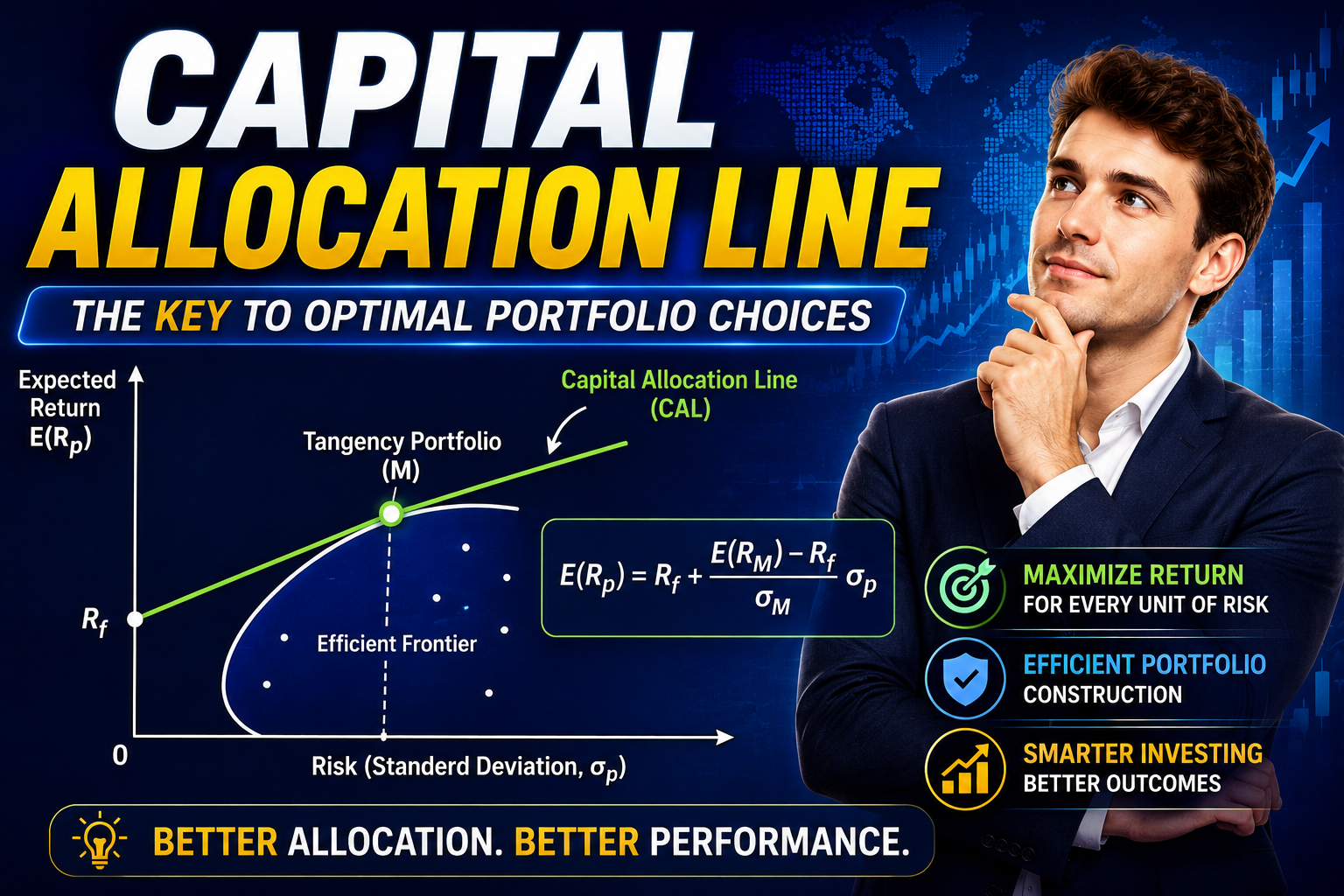
The Capital Allocation Line, or CAL, helps us understand this relationship between risk and return.
In simple terms, the Capital Allocation Line shows the different combinations of a risk-free asset and a risky portfolio.
What is the Capital Allocation Line?
The Capital Allocation Line is a straight line that shows how expected return changes when an investor combines a risk-free asset with a risky portfolio.
A risk-free asset gives a fixed return with almost no uncertainty. Treasury bills are often used as an example of a risk-free asset.
A risky portfolio may include stocks, equity mutual funds, bonds, or a mix of risky investments.
The investor can decide how much money to put in the risk-free asset and how much to put in the risky portfolio.
That decision will decide the expected return and risk of the final portfolio.
Portfolio risk will come only from the risky portfolio because the risk-free asset has no standard deviation.
Portfolio risk:
= 60 percent × 20 percent = 12 percent
So, this investor has created a portfolio with an expected return of 9.8 percent and risk of 12 percent.
This point lies on the Capital Allocation Line.
Real Life Context
Think of a person who has just started investing.
They do not want to take very high risk, so they keep part of their money in a fixed-income product or Treasury bill type investment. The remaining part goes into an equity portfolio.
If the investor is conservative, they may keep more money in the risk-free asset and less in equities.
For example:
70 percent in risk-free investment 30 percent in risky portfolio
This will reduce risk, but expected return will also be lower.
On the other hand, an aggressive investor may invest more in the risky portfolio.
For example:
20 percent in risk-free investment 80 percent in risky portfolio
This can increase expected return, but the portfolio will also become more volatile.
The Capital Allocation Line simply shows these choices in a clear way.
What the Slope of CAL Shows
The slope of the Capital Allocation Line shows the extra return earned for taking extra risk.
This is also called the reward-to-variability ratio.
If the slope is steep, it means the investor is getting more return for each unit of risk.
If the slope is flat, it means the additional return for taking risk is not very attractive.
So, investors generally prefer a Capital Allocation Line with a higher slope.
Formula of Capital Allocation Line
The expected return of the complete portfolio can be written as:
The Capital Allocation Line is useful because it shows how investors can adjust their portfolio based on their risk preference.
A cautious investor may choose a point closer to the risk-free asset.
A risk-taking investor may choose a point closer to the risky portfolio.
A very aggressive investor may even borrow at the risk-free rate and invest more than 100 percent in the risky portfolio. This increases both expected return and risk.
This is why CAL is an important concept in portfolio management.
CAL vs CML
Students often confuse the Capital Allocation Line with the Capital Market Line.
The Capital Allocation Line can be drawn using any risky portfolio and a risk-free asset.
The Capital Market Line is a special case where the risky portfolio is the market portfolio.
So, every Capital Market Line is a Capital Allocation Line, but every Capital Allocation Line is not necessarily the Capital Market Line.
Final Thoughts
The Capital Allocation Line helps investors understand the trade-off between risk and return.
It shows what happens when money is divided between a risk-free asset and a risky portfolio.
The simple way to remember it is this:
The Capital Allocation Line shows how an investor can move from safety to higher return by increasing exposure to the risky portfolio.
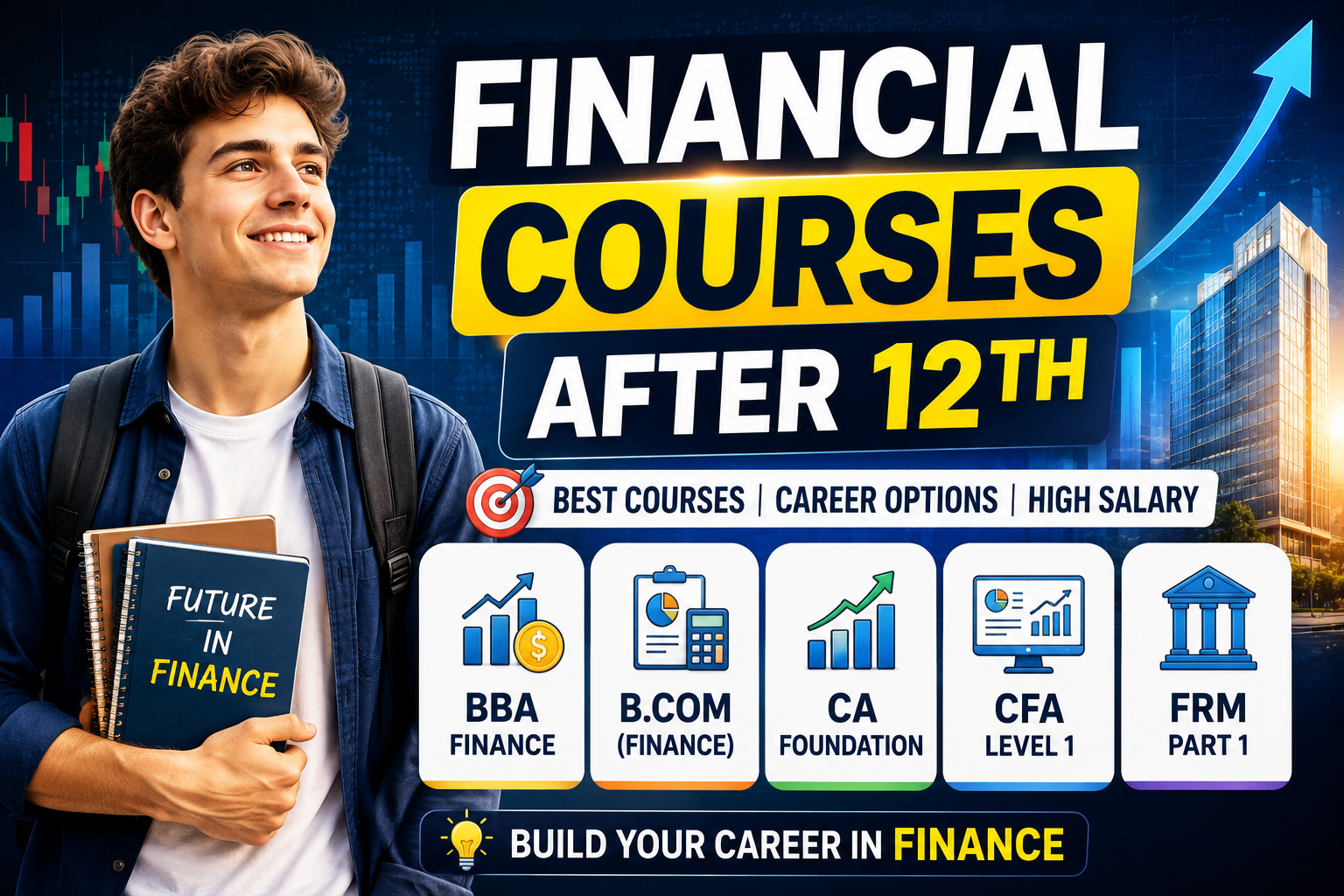
Explore the best finance courses after 12th, career opportunities, salary prospects, professional certifications, and the right path to build a successful career in finance.
Financial Courses After 12th: Quick Answer
Students who have completed Class 12 can pursue various finance-related courses such as:
Bachelor of Commerce (B.Com)
BBA in Finance
Bachelor of Economics
Chartered Accountancy (CA)
Company Secretary (CS)
Cost and Management Accounting (CMA)
Chartered Financial Analyst (CFA)
Financial Risk Manager (FRM)
Investment Banking Courses
Financial Modeling Programs
Banking and Insurance Courses
FinTech Certifications
The best course depends on your career goals, interests, and whether you want to work in accounting, investments, banking, risk management, or corporate finance.
Why Choose a Career in Finance After 12th?
The finance industry is one of the fastest-growing sectors globally. Every organization, from startups to multinational corporations, requires finance professionals to manage investments, risks, budgeting, compliance, and strategic decision-making.
Benefits of Choosing Finance as a Career
High earning potential
Diverse career opportunities
Global career mobility
Strong demand across industries
Opportunities in banking, consulting, investment management, and corporate finance
Continuous professional growth
With increasing financial awareness and digital transformation, finance professionals are becoming more valuable than ever.
Top Financial Courses After 12th
1. Chartered Financial Analyst (CFA)
The CFA Program is one of the most respected investment management qualifications globally.
CFA focuses on practical finance skills and is highly valued by investment firms worldwide.
2. Financial Risk Manager (FRM)
FRM is the leading certification for risk management professionals.
Key Highlights
Particulars
Details
Duration
1-2 Years
Focus Area
Risk Management
Global Recognition
High
Governing Body
GARP
Career Opportunities
Risk Analyst
Credit Risk Manager
Market Risk Analyst
Treasury Professional
Risk Consultant
Why Consider FRM?
With increasing market volatility and regulatory requirements, risk management professionals are in strong demand globally.
3. Chartered Accountancy (CA)
CA remains one of India’s most prestigious professional qualifications.
Key Highlights
Conducted by ICAI
Strong accounting and taxation focus
Excellent career prospects
High professional credibility
Career Opportunities
Chartered Accountant
Auditor
Tax Consultant
Finance Manager
CFO
4. Cost and Management Accounting (CMA)
CMA focuses on cost control, budgeting, performance management, and strategic decision-making.
Career Opportunities
Cost Accountant
Financial Controller
Business Analyst
Budget Analyst
5. Company Secretary (CS)
CS professionals specialize in corporate governance, compliance, and legal affairs.
Career Opportunities
Company Secretary
Compliance Officer
Corporate Governance Professional
Legal and Regulatory Advisor
6. BBA in Finance
A Bachelor of Business Administration with a finance specialization provides strong business and finance fundamentals.
Subjects Covered
Financial Management
Corporate Finance
Investment Analysis
Banking Operations
Business Analytics
Career Opportunities
Financial Analyst
Banking Executive
Business Analyst
Corporate Finance Associate
7. B.Com (Finance)
One of the most popular undergraduate finance degrees in India.
Subjects Covered
Accounting
Taxation
Economics
Auditing
Financial Management
Career Opportunities
Accountant
Financial Analyst
Banking Professional
Finance Executive
8. Bachelor of Economics
Economics provides analytical skills valuable for finance, policy, and consulting roles.
Career Opportunities
Economist
Research Analyst
Financial Analyst
Policy Consultant
9. Investment Banking Courses
Students interested in mergers, acquisitions, valuation, and corporate finance often pursue investment banking certifications.
Skills Covered
Financial Modeling
Company Valuation
Excel for Finance
Mergers & Acquisitions
Equity Research
10. FinTech Courses
The rise of technology has created new opportunities in financial services.
Topics Covered
Blockchain
Digital Payments
Financial Analytics
Artificial Intelligence in Finance
Data Analytics
Career Opportunities
FinTech Analyst
Product Manager
Financial Data Analyst
Digital Banking Professional
Best Financial Courses Based on Career Goals
If You Want to Work in Investment Banking
Recommended Path:
B.Com or BBA Finance
CFA
Financial Modeling Training
If You Want to Become a Risk Management Professional
Recommended Path:
Graduation
FRM Certification
If You Want a Career in Accounting and Taxation
Recommended Path:
CA
CMA
If You Want Corporate Governance Roles
Recommended Path:
CS
Law or Corporate Finance Specialization
If You Want Banking Careers
Recommended Path:
B.Com or BBA
Banking Certifications
CFA or FRM (Optional)
Can You Start CFA or FRM After 12th?
CFA Eligibility
Students can begin planning for CFA after Class 12, though formal eligibility requirements apply for registration and progression through the program.
FRM Eligibility
There are no strict educational eligibility restrictions for the FRM exams, making it an attractive option for students interested in risk management early in their careers.
Many students begin their finance journey after 12th and prepare for CFA or FRM alongside graduation.
Salary After Financial Courses
Career Path
Average Starting Salary
Financial Analyst
₹4-8 LPA
Risk Analyst
₹5-10 LPA
Investment Banking Analyst
₹8-20 LPA
Chartered Accountant
₹7-15 LPA
Equity Research Analyst
₹6-12 LPA
Wealth Manager
₹5-12 LPA
Actual salaries vary based on skills, location, employer, certifications, and market conditions.
How to Choose the Right Financial Course After 12th?
Ask yourself the following questions:
Do you enjoy numbers and analysis?
Consider:
CFA
FRM
Economics
Financial Modeling
Interested in accounting and taxation?
Consider:
CA
CMA
Interested in corporate law and governance?
Consider:
CS
Want a broad business education?
Consider:
BBA Finance
B.Com Finance
Interested in technology and finance?
Consider:
FinTech Programs
Data Analytics Certifications
Why Professional Certifications Matter in Finance
While undergraduate degrees provide foundational knowledge, professional certifications help candidates stand out in competitive job markets.
Employers increasingly value certifications because they demonstrate:
Specialized expertise
Practical skills
Industry commitment
Global standards of knowledge
Among finance certifications, CFA and FRM are particularly recognized by multinational employers, banks, consulting firms, and investment institutions worldwide.
Frequently Asked Questions (FAQs)
Which is the best financial course after 12th?
The best course depends on your career goals. CFA is highly regarded for investment careers, FRM for risk management, CA for accounting and taxation, and BBA Finance for broad business exposure.
Can I pursue CFA after 12th?
Students can start planning and preparing early, but should review current CFA Institute eligibility requirements regarding registration and progression.
Is FRM a good career option?
Yes. FRM is one of the most respected risk management certifications globally and is highly valued by banks, consulting firms, and financial institutions.
Which finance course offers the highest salary?
Investment banking, CFA-related roles, and specialized finance positions often offer some of the highest compensation packages, though salaries depend on experience and skills.
What is better: CA or CFA?
CA focuses on accounting, taxation, and auditing, while CFA focuses on investments, portfolio management, and financial analysis. The better option depends on your career interests.
Final Thoughts
Choosing the right financial course after 12th can significantly shape your career trajectory. Whether your goal is investment banking, risk management, accounting, corporate finance, or FinTech, there are multiple pathways available.
Students seeking global opportunities often consider certifications such as CFA and FRM alongside their graduation. Those interested in accounting and compliance may prefer CA, CMA, or CS.
The key is to align your education with your long-term career goals, develop practical skills, and stay updated with industry trends. A well-planned finance career can offer excellent growth, strong earning potential, and opportunities across global markets.
Meta Title: Can AI Replace Finance? Understanding the Future of Finance and AI Meta Description: Can AI replace finance professionals? Explore how AI is transforming finance, what jobs are changing, and why human expertise remains essential in the future of finance.
Can AI Replace Finance?
Artificial Intelligence (AI) is transforming industries worldwide, and finance is no exception. From automated trading algorithms to AI-powered credit assessments, technology is reshaping how financial institutions operate.
This raises an important question:
Can AI replace finance?
The short answer is no, but it will significantly transform finance.
AI can automate repetitive tasks, improve decision-making, and process massive amounts of data faster than humans. However, finance is much more than calculations and data analysis. It involves judgment, ethics, relationship management, strategic thinking, and regulatory interpretation, areas where human expertise remains indispensable.
In this article, we will explore how AI is changing finance, what roles may be affected, and why finance professionals continue to play a critical role in the future.
Quick Answer: Can AI Replace Finance?
AI cannot fully replace finance professionals because finance requires human judgment, strategic decision-making, ethical considerations, and relationship management.
However, AI can automate routine financial tasks such as:
Data analysis
Financial reporting
Risk monitoring
Fraud detection
Portfolio rebalancing
Credit scoring
The future is likely to involve AI-assisted finance professionals rather than AI replacing finance entirely.
Why Is AI Becoming Important in Finance?
The financial industry generates enormous amounts of data every second.
Banks, investment firms, insurance companies, and corporations use AI because it can:
Analyze millions of transactions instantly
Detect fraud patterns
Predict market trends
Improve operational efficiency
Reduce human errors
Enhance customer experiences
According to industry reports, global spending on AI in financial services continues to grow as organizations seek greater efficiency and competitive advantage.
How AI Is Already Transforming Finance
1. Automated Financial Analysis
AI systems can quickly analyze:
Financial statements
Company earnings reports
Market data
Economic indicators
Tasks that previously required hours of manual effort can now be completed in minutes.
Example
An equity analyst may use AI tools to screen thousands of companies based on valuation, profitability, and growth metrics before conducting deeper analysis.
2. Algorithmic Trading
Many investment firms already use AI-driven trading systems.
These systems can:
Analyze market movements
Identify opportunities
Execute trades automatically
Manage portfolios in real time
High-frequency trading firms rely heavily on machine learning algorithms to make decisions within milliseconds.
3. Fraud Detection
Banks use AI to monitor transactions continuously.
AI can identify:
Unusual spending patterns
Suspicious transfers
Identity theft attempts
Credit card fraud
This capability helps institutions reduce losses and improve security.
4. Credit Risk Assessment
Traditional lending models relied heavily on historical financial data.
AI enhances credit evaluation by analyzing:
Transaction history
Payment behavior
Spending patterns
Alternative financial data
This enables more accurate lending decisions.
5. Customer Service and Financial Advisory
AI-powered chatbots and robo-advisors now assist customers with:
Basic financial queries
Portfolio recommendations
Account management
Investment tracking
Many fintech companies use AI to deliver low-cost financial advice.
Which Finance Jobs Could Be Affected by AI?
AI is most effective at automating repetitive and rule-based tasks.
Roles with Higher Automation Risk
Data entry operators
Bookkeeping assistants
Basic reporting analysts
Transaction processing staff
Compliance documentation specialists
Many routine tasks within these roles can already be automated.
Which Finance Jobs Are Difficult for AI to Replace?
Certain finance careers require skills that AI currently cannot replicate effectively.
Investment Banking
Investment bankers must:
Negotiate deals
Build client relationships
Understand strategic objectives
Manage stakeholder interests
These responsibilities require human interaction and judgment.
Financial Risk Management
Risk professionals evaluate:
Emerging risks
Regulatory changes
Economic uncertainty
Geopolitical developments
While AI can provide insights, final risk decisions require human expertise.
Corporate Finance Leadership
Chief Financial Officers (CFOs) and finance leaders make decisions involving:
Capital allocation
Strategic planning
Business growth
Organizational priorities
These decisions depend on experience, leadership, and business understanding.
Wealth Management
Clients often seek financial advisors for:
Trust
Personalized guidance
Emotional reassurance
Long-term planning
Human relationships remain central to wealth management.
AI vs Human Finance Professionals
Capability
AI
Human Professionals
Data Processing
Excellent
Limited
Speed
Very High
Moderate
Pattern Recognition
Excellent
Good
Strategic Thinking
Limited
Excellent
Ethical Judgment
Weak
Strong
Relationship Building
Weak
Excellent
Negotiation
Weak
Strong
Adaptability to New Situations
Limited
High
The comparison clearly shows that AI excels at analysis while humans excel at decision-making and relationships.
The Rise of AI-Augmented Finance Professionals
The most likely future is not AI replacing finance professionals.
Instead, it is:
Finance Professionals + AI
Professionals who effectively use AI tools can:
Analyze data faster
Improve productivity
Generate better insights
Make more informed decisions
This combination creates a powerful competitive advantage.
Will AI Replace Financial Analysts?
One of the most searched questions today is:
Will AI replace financial analysts?
The answer is partially.
AI can automate:
Data collection
Financial modeling
Screening processes
Routine reporting
However, analysts still provide:
Industry insights
Business understanding
Management evaluation
Investment recommendations
The role will evolve rather than disappear.
What Skills Finance Professionals Need in the AI Era
To remain valuable, finance professionals should focus on developing skills that complement AI.
Technical Skills
Financial modeling
Data analytics
Python and SQL basics
AI literacy
Business intelligence tools
Strategic Skills
Critical thinking
Decision-making
Problem-solving
Risk assessment
Human Skills
Communication
Leadership
Negotiation
Relationship management
These skills will become even more important as automation increases.
How Certifications Like FRM and CFA Remain Relevant
Professional certifications continue to provide value because they focus on:
Financial judgment
Risk management
Ethics
Strategic analysis
Investment decision-making
FRM (Financial Risk Manager)
FRM professionals specialize in:
Market risk
Credit risk
Operational risk
Enterprise risk management
AI can assist risk analysis, but risk ownership remains a human responsibility.
CFA (Chartered Financial Analyst)
CFA charterholders focus on:
Investment analysis
Portfolio management
Asset valuation
Ethical decision-making
These areas require expertise beyond automated calculations.
Common Questions About AI and Finance
Can AI completely replace finance professionals?
No. AI can automate tasks but cannot fully replace human judgment, ethics, leadership, and relationship management.
Will AI eliminate finance jobs?
Some routine roles may decline, but new opportunities will emerge in financial analytics, AI governance, fintech, and risk management.
Is finance still a good career in the age of AI?
Yes. Finance remains a strong career path, especially for professionals who learn to work alongside AI technologies.
Which finance careers are safest from AI disruption?
Roles involving strategy, risk management, client advisory, investment decision-making, and leadership are less vulnerable to automation.
Should finance students learn AI?
Absolutely. Understanding AI tools and data analytics can significantly enhance career prospects.
The Final Verdict: Can AI Replace Finance?
AI will transform finance, but it will not replace finance professionals entirely.
Artificial intelligence excels at processing information, identifying patterns, and automating repetitive tasks. However, finance requires much more than calculations. Strategic thinking, ethical judgment, client relationships, leadership, and decision-making remain deeply human responsibilities.
The future belongs to professionals who combine financial expertise with technological literacy.
Rather than asking whether AI will replace finance, a better question is:
How can finance professionals use AI to become more effective, productive, and valuable?
Those who embrace this combination will lead the next generation of finance careers.
Key Takeaways
AI is transforming finance but not replacing it entirely.
Routine and repetitive finance tasks are increasingly automated.
Human judgment remains critical in investment, risk, and strategic decisions.
Finance professionals who learn AI tools gain a significant advantage.
Certifications such as FRM and CFA remain highly relevant.
The future of finance is collaboration between humans and AI, not competition.
If you are preparing for the Chartered Financial Analyst (CFA) program, one common question is:
Does JP Morgan hire CFA Level 1 candidates?
The short answer is Yes. JP Morgan hires candidates who have cleared CFA Level 1, especially for roles in investment banking support, asset management, risk management, research, wealth management, corporate banking, and financial analysis. However, CFA Level 1 alone is not a guaranteed entry ticket. JP Morgan evaluates a combination of education, technical skills, work experience, and overall fit for the role.
In this guide, we will explain how JP Morgan views the CFA qualification, which roles are suitable for CFA Level 1 candidates, hiring requirements, salary expectations, and how you can improve your chances of getting selected.
Quick Answer: Does JP Morgan Hire CFA Level 1 Candidates?
Yes, JP Morgan hires candidates who have:
Cleared CFA Level 1
Registered for CFA Level 2
Pursuing the CFA Program
Completed all three CFA levels
Strong finance and analytical skills
Many job descriptions at JP Morgan specifically mention:
CFA, FRM, MBA Finance, CA, or progress toward professional certifications as preferred qualifications.
Therefore, clearing CFA Level 1 can strengthen your profile significantly, especially when combined with relevant education and practical skills.
Why Does JP Morgan Value CFA Candidates?
JP Morgan is one of the world’s largest financial institutions with operations across:
Investment Banking
Asset Management
Wealth Management
Markets and Trading
Corporate Banking
Risk Management
Research
Treasury Services
The CFA curriculum develops expertise in:
Financial Statement Analysis
Equity Valuation
Fixed Income
Portfolio Management
Ethics and Professional Standards
Alternative Investments
Quantitative Methods
These topics align closely with the skills required in many JP Morgan finance roles.
Key Benefits of CFA for JP Morgan Recruiters
CFA Skill
Relevance at JP Morgan
Financial Analysis
Investment and corporate finance roles
Valuation
Equity research and investment banking
Risk Assessment
Risk management teams
Portfolio Management
Asset and wealth management
Ethics
Client-facing and fiduciary responsibilities
Quantitative Analysis
Markets and trading support
Which JP Morgan Roles Hire CFA Level 1 Candidates?
1. Investment Banking Analyst Support Roles
These roles involve:
Financial modeling
Valuation analysis
Pitch books
Market research
Industry analysis
While front-office investment banking is highly competitive, CFA Level 1 can improve your profile for analyst and support functions.
2. Equity Research Analyst
Research teams often prefer candidates who have:
Strong accounting knowledge
Valuation skills
Industry research capabilities
CFA Level 1 demonstrates foundational expertise in these areas.
3. Asset Management Analyst
JP Morgan Asset Management is one of the largest investment management businesses globally.
Common responsibilities include:
Portfolio monitoring
Performance analysis
Investment research
Market analysis
CFA candidates are highly valued in this domain.
4. Wealth Management Associate
Wealth management professionals help clients manage investments and financial goals.
CFA knowledge is useful for:
Asset allocation
Portfolio construction
Investment recommendations
Risk profiling
5. Risk Management Analyst
Risk teams assess:
Market risk
Credit risk
Liquidity risk
Operational risk
CFA Level 1 provides a strong foundation in risk concepts.
6. Corporate Banking Analyst
Corporate banking teams work with large businesses and institutions.
Key tasks include:
Financial statement analysis
Credit assessment
Industry research
Relationship management
CFA candidates often stand out for these positions.
Can Freshers with CFA Level 1 Get Into JP Morgan?
Yes, but with the right profile.
JP Morgan regularly hires fresh graduates through:
Campus recruitment
Internship programs
Analyst programs
Graduate hiring initiatives
For freshers, CFA Level 1 can act as a differentiator.
Ideal Fresher Profile
B.Com
BBA
BMS
BA Economics
MBA Finance
CA Inter
Strong academic record
CFA Level 1 cleared
Excel and financial modeling skills
Does CFA Level 1 Guarantee a Job at JP Morgan?
No.
CFA Level 1 improves employability but does not guarantee selection.
JP Morgan evaluates candidates based on:
Technical Skills
Financial analysis
Valuation
Accounting
Excel
Power BI
Financial modeling
Communication Skills
Presentation ability
Business communication
Client interaction
Problem-Solving Ability
Case studies
Analytical reasoning
Commercial awareness
Relevant Experience
Internships
Finance projects
Research assignments
The strongest candidates combine CFA knowledge with practical skills and experience.
Skills That Increase Your Chances Beyond CFA Level 1
If your goal is JP Morgan, focus on building:
Financial Modeling
Learn:
DCF Valuation
Comparable Company Analysis
Precedent Transactions
Three-Statement Modeling
Excel
Master:
Pivot Tables
XLOOKUP
INDEX-MATCH
Financial Functions
Dashboarding
Power BI
Increasingly valuable for:
Data analysis
Reporting
Business intelligence
Python for Finance
Useful for:
Quantitative analysis
Automation
Data analytics
Bloomberg Knowledge
Helpful for:
Research
Market analysis
Investment roles
JP Morgan Salary for CFA Level 1 Candidates in India
Compensation varies by role, location, and experience.
Approximate Salary Ranges
Role
Estimated Annual Salary
Analyst
₹6–12 LPA
Research Analyst
₹7–14 LPA
Risk Analyst
₹7–15 LPA
Asset Management Analyst
₹8–18 LPA
Associate
₹12–25+ LPA
Actual compensation depends on skills, business division, and market conditions.
How to Prepare for JP Morgan Recruitment
Step 1: Clear CFA Level 1
Build a strong understanding of:
Ethics
FRA
Quantitative Methods
Equity
Fixed Income
Step 2: Gain Practical Skills
Focus on:
Excel
Financial Modeling
Valuation
Power BI
Step 3: Build Relevant Experience
Through:
Internships
Live projects
Equity research assignments
Corporate finance projects
Step 4: Network Effectively
Use:
LinkedIn
CFA Society events
Finance conferences
Alumni networks
Step 5: Prepare for Interviews
Common topics include:
Accounting basics
Valuation concepts
Financial markets
Current economic trends
Behavioral questions
Frequently Asked Questions (FAQs)
Does JP Morgan hire candidates with only CFA Level 1?
Yes. Many JP Morgan roles consider candidates who have cleared CFA Level 1, especially when supported by strong academics and relevant skills.
Is CFA Level 1 enough for investment banking at JP Morgan?
Not usually. Investment banking roles typically require strong financial modeling, valuation expertise, internships, and excellent communication skills in addition to CFA knowledge.
Can a fresher with CFA Level 1 get a job at JP Morgan?
Yes. Freshers can apply for analyst programs, internships, and entry-level finance roles where CFA Level 1 can strengthen their profile.
Which JP Morgan departments prefer CFA candidates?
Asset Management, Equity Research, Wealth Management, Risk Management, Corporate Banking, and Investment Banking Support frequently value CFA candidates.
Does JP Morgan prefer CFA or MBA?
It depends on the role. Many teams value both qualifications, and candidates with either CFA, MBA Finance, or a combination often compete successfully.
Final Verdict: Does JP Morgan Hire CFA Level 1 Candidates?
Yes, JP Morgan does hire CFA Level 1 candidates. Clearing CFA Level 1 demonstrates commitment to finance, analytical ability, and investment knowledge. However, success in JP Morgan recruitment depends on more than certification alone.
Candidates who combine CFA Level 1 with:
Strong academics
Financial modeling skills
Excel proficiency
Relevant internships
Effective communication
typically have the strongest chances of securing interviews and job offers.
For aspiring finance professionals, CFA Level 1 can be an excellent stepping stone toward building a career at JP Morgan and other leading global financial institutions.
Meta Title: Can FRM Earn 1 Crore? Salary, Career Path, and Growth Opportunities in India
Meta Description: Can an FRM earn 1 crore salary in India? Explore FRM salary growth, top career paths, industries, global opportunities, and practical strategies to reach a 1 crore package.
Keywords: Can FRM earn 1 crore, FRM salary in India, FRM career growth, FRM highest salary, Financial Risk Manager salary, FRM jobs India, FRM package in India, FRM vs CFA salary
Can FRM Earn 1 Crore?
Yes, an FRM professional can earn 1 crore or more annually, but it usually depends on experience, role, industry, global exposure, technical skills, and leadership responsibilities.
Fresh FRM candidates generally start with salaries between ₹6 LPA and ₹15 LPA in India. However, experienced professionals working in investment banking, risk consulting, treasury, quantitative finance, market risk, or global financial institutions can cross ₹1 crore compensation over time.
The Financial Risk Manager (FRM) certification by GARP is globally respected and highly valued in the banking and finance industry. As financial markets become more complex, companies increasingly rely on skilled risk professionals to manage credit risk, market risk, operational risk, liquidity risk, and regulatory compliance.
In this detailed guide, we will explore:
Whether FRM professionals can realistically earn 1 crore
Average FRM salaries in India and abroad
Career paths that lead to high compensation
Industries that pay the highest salaries
Skills needed beyond FRM
How long it takes to reach the 1 crore level
Common myths around FRM salaries
Quick Answer: Can FRM Earn 1 Crore in India?
Short Answer
Yes. FRM professionals can earn ₹1 crore or more annually if they:
Gain 8–15 years of quality experience
Work in high paying domains like investment banking or quantitative risk
Build strong technical and analytical skills
Move into leadership or international roles
Work with top firms such as JPMorgan, Goldman Sachs, Morgan Stanley, Barclays, HSBC, Big 4 firms, hedge funds, or fintech companies
However, FRM alone does not guarantee a 1 crore salary.
Your compensation depends on:
Factor
Impact on Salary
Experience
Very High
Technical Skills
High
Industry
Very High
Location
High
Networking
Moderate
Leadership Skills
High
Global Exposure
Very High
What is FRM?
FRM stands for Financial Risk Manager.
It is a globally recognized certification offered by GARP (Global Association of Risk Professionals). The program focuses on risk management in financial institutions and covers:
Market Risk
Credit Risk
Operational Risk
Liquidity Risk
Quantitative Analysis
Financial Markets
Valuation Models
Risk Models
Basel Regulations
Current Issues in Risk Management
The certification is highly respected in:
Banks
Investment banks
Asset management companies
Insurance firms
Consulting firms
Fintech companies
Treasury divisions
Risk advisory firms
Average FRM Salary in India
The salary of an FRM professional depends heavily on experience and skill level.
FRM Salary by Experience
Experience Level
Average Salary Range
Fresher
₹6 LPA – ₹12 LPA
2–5 Years
₹12 LPA – ₹25 LPA
5–8 Years
₹25 LPA – ₹45 LPA
8–12 Years
₹45 LPA – ₹80 LPA
Senior Leadership
₹1 Crore+
These figures can vary based on:
City
Company
Technical expertise
Domain specialization
International opportunities
Professionals in Mumbai, Bengaluru, Gurgaon, Singapore, Dubai, London, and New York often earn significantly higher compensation.
Which FRM Roles Can Reach 1 Crore Salary?
Not all FRM roles pay equally.
Some domains offer much faster salary growth.
1. Investment Banking Risk Management
Investment banks pay some of the highest salaries in the finance industry.
Typical roles include:
Market Risk Analyst
Counterparty Risk Analyst
Credit Risk Specialist
XVA Analyst
Risk Strategist
Top employers:
Goldman Sachs
JPMorgan
Morgan Stanley
Deutsche Bank
Barclays
UBS
Experienced professionals in these firms can earn:
₹50 lakh to ₹1 crore+
Additional bonuses and stock compensation
2. Quantitative Risk Analyst
Quant roles combine finance, statistics, coding, and mathematical modeling.
Skills needed:
Python
SQL
R
Machine Learning
Financial Modeling
Statistics
VBA
Quant professionals with FRM certification are highly valued.
Senior quantitative analysts often cross the 1 crore compensation level, especially in:
Hedge funds
Proprietary trading firms
Global banks
Fintech firms
3. Treasury and ALM Roles
Treasury professionals manage:
Liquidity
Interest rate risk
Funding
Asset Liability Management (ALM)
Large banks and NBFCs offer excellent compensation in treasury divisions.
Senior treasury professionals often earn:
₹60 lakh to ₹1.5 crore
4. Risk Consulting
Big 4 firms and consulting companies hire FRM professionals for:
Basel implementation
Regulatory risk
Internal audit
Enterprise risk management
Stress testing
IFRS and compliance
Top firms:
Deloitte
EY
KPMG
PwC
Accenture
Leadership roles in consulting can cross 1 crore annually.
5. Chief Risk Officer (CRO)
This is one of the highest positions in the risk management domain.
CROs oversee enterprise wide risk strategies.
Compensation can range from:
₹1 crore to ₹5 crore+
However, this level usually requires:
15+ years experience
Leadership capability
Regulatory understanding
Business strategy exposure
Can FRM Fresher Earn 1 Crore?
No, not immediately.
FRM is not a shortcut to instant wealth.
Freshers usually start in analyst or associate roles. Compensation grows steadily with:
Experience
Promotions
Skill development
Performance
Networking
Domain specialization
A realistic timeline to reach 1 crore compensation is:
Career Stage
Timeline
Entry Level Analyst
0–3 Years
Mid Level Specialist
3–7 Years
Senior Risk Manager
7–12 Years
Leadership Role
10–15 Years
Skills Needed Beyond FRM to Earn 1 Crore
FRM alone is usually not enough.
High income professionals combine FRM with practical and technical expertise.
Most Valuable Skills
Technical Skills
Python
SQL
Power BI
Tableau
Excel Modeling
VBA
Financial Modeling
Data Analytics
Machine Learning
Finance Skills
Fixed Income
Derivatives
Treasury
Credit Analysis
Portfolio Management
Basel Regulations
Stress Testing
Soft Skills
Communication
Leadership
Stakeholder Management
Problem Solving
Presentation Skills
Professionals who combine finance and technology are often paid the highest salaries.
FRM Salary Abroad
Global opportunities can significantly increase earning potential.
Average FRM Salaries Internationally
Country
Average Salary
USA
$120,000 – $250,000
UK
£80,000 – £180,000
Singapore
SGD 120,000 – SGD 250,000
UAE
AED 250,000 – AED 600,000
Canada
CAD 100,000 – CAD 220,000
International exposure often accelerates the journey toward high compensation.
FRM vs CFA: Who Earns More?
This is one of the most searched questions online.
FRM vs CFA Salary Comparison
Parameter
FRM
CFA
Primary Domain
Risk Management
Investment Management
Core Focus
Risk Analysis
Portfolio and Equity Analysis
Highest Paying Roles
Quant Risk, Treasury, CRO
Portfolio Manager, Investment Banking
Technical Orientation
Higher
Moderate
Earning Potential
Very High
Very High
Both certifications can lead to crore level salaries.
The outcome depends more on:
Career choices
Skill stack
Experience
Networking
Industry exposure
Some professionals even pursue both FRM and CFA.
Industries That Pay FRM Professionals the Most
Highest Paying Industries
1. Investment Banking
High pressure but extremely rewarding compensation.
2. Hedge Funds
Very high bonuses and performance linked incentives.
3. Fintech
Rapidly growing demand for risk professionals.
4. Global Capability Centers (GCCs)
Many global banks hire risk teams in India.
5. Consulting Firms
Strong salary growth and leadership opportunities.
How to Increase Your FRM Salary Faster
If your goal is to reach a 1 crore package, follow a structured career strategy.
Practical Steps
Choose High Growth Domains
Focus on:
Market risk
Quantitative finance
Treasury
Credit modeling
Data analytics
Learn Coding
Gain Global Exposure
International projects increase salary potential.
Switch Strategically
Python and SQL are becoming essential.
Job changes every 2–4 years can accelerate growth.
Build Strong LinkedIn Presence
Networking creates opportunities.
Pursue Advanced Learning
Additional certifications can help:
CFA
CAIA
Financial Modeling
Data Science programs
Biggest Myths About FRM Salaries
Myth 1: FRM Guarantees High Salary
Reality:
Certification improves opportunities but does not guarantee income.
Myth 2: Only Investment Bankers Earn Big Money
Reality:
Risk consulting, treasury, fintech, and quant roles also pay extremely well.
Myth 3: FRM is Only for Banking
Reality:
FRM professionals work across:
Insurance
Consulting
Fintech
Asset management
Corporate finance
Regulators
Myth 4: Freshers Earn 50 LPA Immediately
Reality:
High salaries usually come after years of expertise and leadership growth.
Frequently Asked Questions
Can FRM professionals earn 1 crore in India?
Yes. Experienced FRM professionals working in investment banking, treasury, quantitative finance, or leadership roles can earn 1 crore or more annually.
What is the highest salary for FRM in India?
Senior FRM professionals in leadership or global banking roles can earn between ₹1 crore and ₹5 crore annually depending on experience and company.
How long does it take for an FRM to earn 1 crore?
It usually takes 8–15 years depending on career growth, domain specialization, technical skills, and industry.
Is FRM worth it in India?
Yes. FRM is valuable for careers in risk management, banking, treasury, consulting, and quantitative finance.
Which companies hire FRM professionals?
Top recruiters include:
JPMorgan
Goldman Sachs
Morgan Stanley
HSBC
Barclays
Deloitte
EY
KPMG
PwC
Is FRM better than MBA?
FRM and MBA serve different purposes.
FRM specializes in risk management while MBA focuses on broader business management.
Final Verdict: Can FRM Earn 1 Crore?
Yes, FRM professionals can absolutely earn 1 crore or more.
But the certification is only the beginning.
Your long term success depends on:
Experience
Technical expertise
Communication skills
Industry exposure
Strategic career choices
Leadership growth
The finance industry rewards professionals who continuously learn and adapt.
If you combine FRM with strong analytical skills, coding knowledge, and business understanding, the possibility of building a crore level career becomes very realistic.
For ambitious finance professionals, FRM can become a powerful gateway to global opportunities, high impact roles, and exceptional long term earning potential.
The Financial Risk Manager (FRM) certification is one of the most recognized qualifications in risk management. It is widely pursued by students and professionals aiming for careers in banking, risk consulting, treasury, investment management, and financial analytics.
As the FRM curriculum covers quantitative finance, market risk, credit risk, operational risk, and valuation concepts, many candidates in India look for structured coaching instead of relying entirely on self-study.
Online learning, recorded lectures, and flexible preparation schedules have also increased the demand for FRM coaching in India, especially among working professionals.
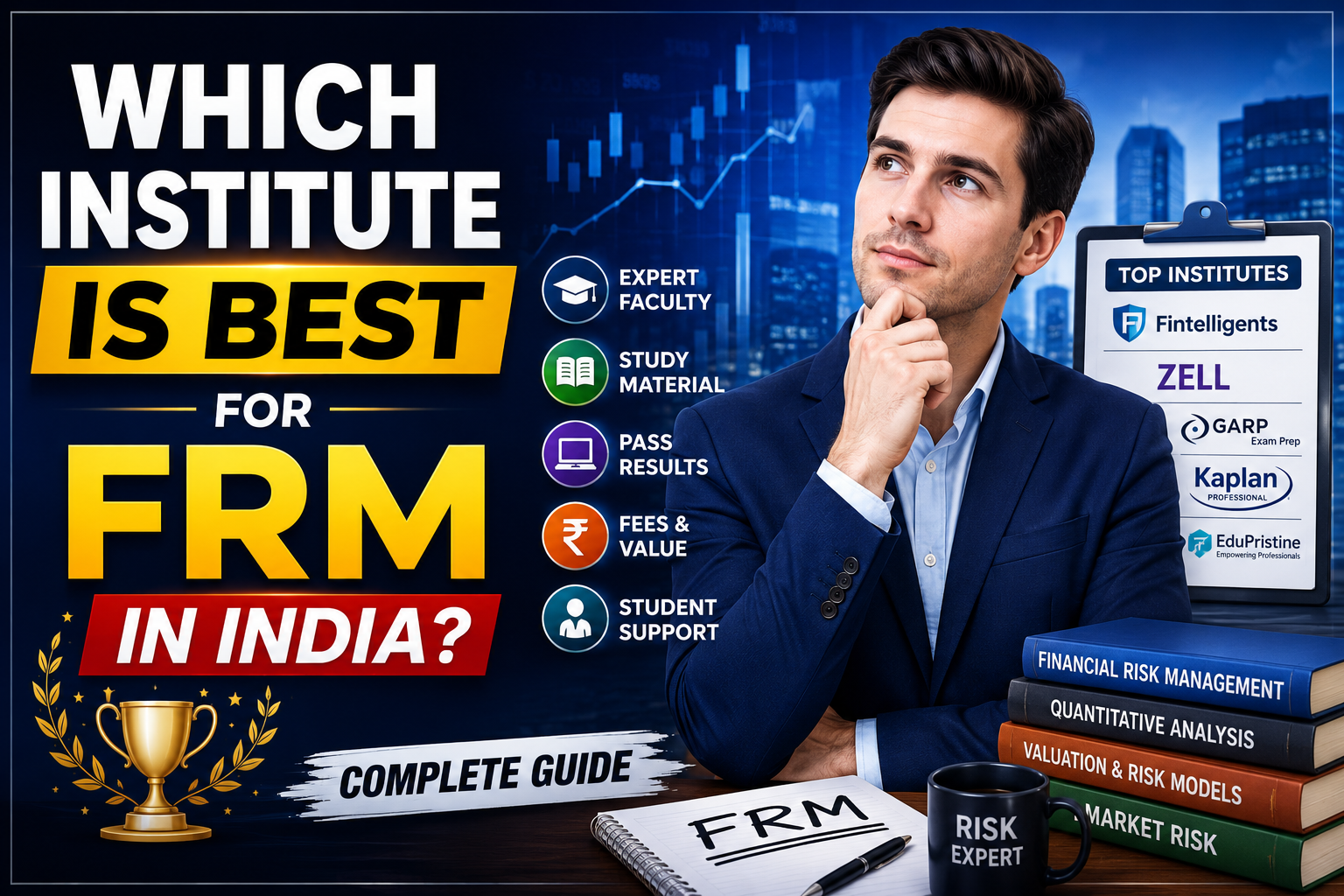
Quick Answer: Which institute is best for FRM in India?
The best FRM institute depends on your learning style, schedule, and preparation needs. Institutes that focus on concept clarity, structured learning, and disciplined preparation are generally preferred over purely shortcut-based approaches.
Key Takeaways
FRM preparation requires conceptual understanding more than memorization
Structured coaching can improve consistency and study discipline
Online FRM classes are increasingly popular in India
Working professionals usually benefit from flexible learning formats
Choosing the right institute depends on teaching style and curriculum depth
How to Choose the Best FRM Coaching in India
Before selecting an FRM coaching provider, candidates should evaluate a few important factors.
Faculty and Teaching Approach
The FRM syllabus is technical and application-oriented. Good faculty members simplify difficult topics rather than relying only on summarized notes.
Curriculum Depth
Some institutes focus heavily on shortcuts and revision, while others emphasize long-term understanding. A balanced approach is usually more effective.
Practice Support
Mock tests, question banks, and revision sessions help students understand exam patterns and improve confidence.
Flexibility for Students and Professionals
Recorded lectures, live online classes, and hybrid learning formats are valuable for candidates managing college or full-time jobs.
Top FRM Coaching Institutes in India
1. MidhaFin
Overview
MidhaFin is known for its structured and concept-driven approach to FRM preparation. The institute focuses on helping students build clarity in financial risk concepts instead of depending only on memorization techniques.
Strengths
Strong emphasis on concept clarity and structured progression
Suitable for beginners and working professionals
Balanced focus on theory, application, and discipline
Organized learning approach for long-term retention
Limitations
Requires consistent effort and engagement from students
May feel detailed for candidates looking only for quick revision
Best For
Students looking for disciplined preparation and deep conceptual understanding.
2. Quintedge
Overview
Quintedge offers FRM coaching with a focus on practical understanding and flexible online learning options. It is popular among candidates who prefer live interactive classes.
Strengths
Interactive online sessions
Good flexibility for working professionals
Focus on practical finance applications
Limitations
Pace may vary depending on batch size
Some students may prefer more extensive practice support
Best For
Working professionals looking for flexible online learning.
3. Fintree
Overview
Fintree is known for simplifying finance concepts through engaging teaching methods and concise explanations.
Strengths
Simplified explanation style
Student-friendly learning approach
Useful for beginners entering finance
Limitations
Less detailed for advanced quantitative topics
Faster pace in some sections
Best For
Students seeking simplified explanations and approachable teaching.
4. Bionic Turtle
Overview
Bionic Turtle is a globally recognized FRM preparation provider with strong technical and quantitative coverage.
Strengths
Detailed technical explanations
Strong quantitative practice support
Comprehensive study resources
Limitations
Can feel overwhelming for beginners
Requires high self-discipline
Best For
Advanced learners and candidates comfortable with self-study.
5. Kaplan Schweser
Overview
Kaplan Schweser provides FRM study material and exam-focused preparation resources used globally by finance students.
Strengths
Concise study notes
Strong revision-focused material
Structured exam-oriented preparation
Limitations
Less detailed conceptual explanation
Can feel condensed for first-time learners
Best For
Candidates looking for structured revision and summarized preparation.
Comparison Table: Best FRM Coaching Institutes in India
Institute
Teaching Style
Content Depth
Best For
MidhaFin
Concept-focused and structured
High
Beginners and working professionals
Quintedge
Interactive online learning
Moderate to High
Professionals seeking flexibility
Fintree
Simplified conceptual teaching
Moderate
Beginners
Bionic Turtle
Technical and detailed
Very High
Advanced learners
Kaplan Schweser
Exam-oriented summaries
Moderate
Revision-focused preparation
Real Student Scenario
Imagine a working professional preparing for FRM while managing a full-time job.
Without guidance, they may struggle with:
Maintaining consistency
Understanding quantitative concepts
Managing revision timelines
Structured coaching helps by providing:
Clear study plans
Organized topic coverage
Regular practice sessions
Better accountability
This often improves preparation efficiency and confidence.
Is FRM Coaching Necessary?
Short Answer
FRM coaching is not mandatory, but it can significantly improve preparation quality and consistency, especially for beginners and working professionals.
Why Coaching Helps
The FRM curriculum is broad and analytical. Coaching helps students:
Understand difficult concepts faster
Stay disciplined with preparation
Practice exam-oriented questions regularly
Build confidence through structured learning
Common Mistakes When Choosing FRM Coaching
Choosing Only Based on Fees
Lower cost does not always mean better value. Teaching quality and structure matter more.
Ignoring Teaching Style
Every student learns differently. Some prefer detailed conceptual teaching, while others prefer concise revision-based methods.
Not Checking Curriculum Coverage
A complete and updated curriculum is essential for effective preparation.
Following Popularity Alone
The most popular institute may not always match your learning needs or schedule.
FAQ Section
Which institute is best for FRM in India?
Institutes that focus on concept clarity, structured preparation, and flexibility are generally considered better for FRM preparation. The right choice depends on your background, schedule, and learning preferences.
Is online FRM coaching effective?
Yes, online FRM coaching is effective when it includes structured lectures, practice support, and regular revision resources. Many working professionals prefer online formats due to flexibility.
Can I clear FRM without coaching?
Yes, self-study is possible. However, many students choose coaching for guidance, structure, and improved consistency during preparation.
Which FRM coaching is best for working professionals?
Working professionals usually benefit from institutes offering recorded lectures, flexible schedules, and structured study plans.
Is FRM difficult for beginners?
FRM can be challenging for beginners because it includes quantitative and analytical concepts. Consistent study and conceptual clarity are important.
How long does FRM preparation take?
Preparation time depends on prior finance knowledge, study hours, and learning pace. Most candidates prepare over several months.
Final Thoughts
Choosing the best FRM coaching institute in India depends on your learning style, preparation discipline, and career goals. Some students prefer concise revision-focused learning, while others benefit more from structured and concept-driven teaching.
A coaching provider that balances clarity, consistency, and flexibility can make FRM preparation more manageable and effective over the long term.
The Financial Risk Manager (FRM) certification, offered by GARP, is one of the most respected credentials in risk management. It focuses on real-world financial risks such as market risk, credit risk, and operational risk, making it valuable for careers in banking, consulting, and financial services.
In the USA, many candidates look for FRM coaching to manage the depth and technical nature of the syllabus. While self-study is possible, it often becomes challenging due to time constraints, lack of structure, and difficulty in understanding complex topics.
What is the best GARP authorized FRM coaching in USA? The best FRM coaching in the USA depends on your learning style and schedule. Programs that combine structured learning, concept clarity, and flexible online access tend to be more effective for both students and working professionals.
2. Key Takeaways
FRM is concept-driven and requires structured preparation
Coaching helps improve consistency and understanding
Online FRM coaching is widely preferred in the USA
Working professionals benefit from flexible learning formats
Choosing coaching depends on clarity, depth, and teaching style
3. How to Choose the Best FRM Coaching in USA
Selecting the right FRM coaching is essential for efficient preparation. Here are the key factors:
Faculty Quality Instructors should simplify complex financial concepts and provide practical insights
Curriculum Depth The course must cover all FRM topics in detail, aligned with GARP guidelines
Concept Clarity vs Memorization FRM requires application, so clarity is more important than speed
Practice Material and Mock Tests Regular testing helps improve exam readiness and time management
Flexibility (Online vs Live vs Recorded) Most candidates in the USA prefer flexible formats due to work schedules
4. Top FRM Coaching Providers in USA
1. MidhaFin
Overview: MidhaFin offers structured FRM preparation with a strong focus on concept clarity and disciplined learning. Its approach is designed for candidates who prefer a systematic and consistent study process.
Strengths:
Strong emphasis on conceptual understanding
Structured study plan with clear progression
Suitable for beginners and working professionals
Balanced approach between theory and application
Limitations:
Requires consistent effort and time commitment
Not ideal for last-minute or shortcut-based preparation
2. Kaplan Schweser
Overview: Kaplan Schweser is a globally recognized provider offering FRM study materials and structured courses widely used in the USA.
Strengths:
Well-organized study notes and summaries
Strong exam-oriented approach
Established reputation in finance education
Limitations:
More summary-focused than concept-deep
May feel condensed for beginners
3. Bionic Turtle
Overview: Bionic Turtle is known for its in-depth FRM content and strong focus on quantitative and analytical topics.
Strengths:
Detailed explanations of complex topics
High-quality practice questions
Strong community support
Limitations:
Can be overwhelming for beginners
Requires self-discipline due to less structured flow
4. AnalystPrep
Overview: AnalystPrep offers flexible online FRM preparation with a focus on practice questions and mock exams.
Strengths:
Large question bank
Affordable and flexible access
Useful for revision
Limitations:
Limited conceptual teaching depth
Less structured guidance
5. Princeton Review (Select Programs)
Overview: Some programs under Princeton Review offer finance-related preparation with structured learning formats.
Strengths:
Structured teaching format
Known brand in education
Classroom-style guidance
Limitations:
Limited specialization in FRM
Not as focused on risk management depth
5. Comparison Table
Coaching Provider
Teaching Style
Content Depth
Best For
MidhaFin
Concept-focused
High
Beginners and working professionals
Kaplan Schweser
Summary-based
Moderate
Exam-focused learners
Bionic Turtle
Deep and technical
Very High
Advanced learners
AnalystPrep
Practice-heavy
Moderate
Revision and mock practice
Princeton Review
Structured classroom
Moderate
Students preferring guided setup
6. Real Student Scenario
A working professional in the USA preparing for FRM often faces:
Limited study time due to job commitments
Difficulty maintaining consistency
Challenges in understanding complex risk models
With structured coaching:
Study plans become clearer
Concepts are explained in simpler terms
Regular practice improves confidence
This leads to more efficient and focused preparation.
7. Why Coaching Matters for FRM
Is FRM coaching necessary?
FRM coaching is not mandatory, but it helps improve preparation efficiency. The certification requires strong conceptual understanding and consistent practice, which structured coaching can provide, especially for beginners and professionals managing time constraints.
Additional reasons:
FRM syllabus is analytical and detailed
Self-study lacks structured progression
Coaching provides discipline and guidance
8. Common Mistakes When Choosing FRM Coaching
Choosing coaching based only on price
Ignoring teaching methodology
Not checking depth of content
Following brand popularity instead of personal fit
9. FAQ Section
What is the best FRM coaching in USA? The best FRM coaching in the USA depends on your learning needs. Programs that offer structured learning, clear explanations, and flexible access tend to be more effective for most candidates.
Is FRM coaching necessary in USA? FRM coaching is optional, but many candidates prefer it due to the complexity of the syllabus and the need for consistent preparation.
Can I prepare for FRM while working full-time? Yes, many candidates prepare alongside jobs. Flexible coaching options such as recorded lectures and structured plans help manage time effectively.
Which FRM coaching is best for beginners? Beginners should choose coaching that focuses on concept clarity, structured progression, and simplified explanations.
How long does FRM preparation take? Preparation typically takes several months depending on prior knowledge and study time.
Is FRM difficult? FRM is considered challenging due to its focus on analytical and application-based learning rather than memorization.
Which FRM coaching is best for working professionals? Working professionals benefit from coaching that offers flexibility, structured schedules, and clear conceptual teaching.
The Financial Risk Manager (FRM) certification, offered by GARP (Global Association of Risk Professionals), is one of the most recognized credentials in risk management. It focuses on areas such as market risk, credit risk, and financial analysis.
Many students in India and globally prefer coaching from GARP-authorized providers because these institutes align their curriculum with official standards. Preparing for FRM independently can be challenging due to the depth of concepts and lack of structured guidance.
What is the best GARP authorized FRM coaching in India? The best GARP-authorized FRM coaching is one that combines structured learning, strong conceptual teaching, and flexible delivery formats. While authorization ensures alignment with GARP standards, effectiveness also depends on teaching quality and student fit.
2. Key Takeaways
GARP authorization indicates alignment with official FRM curriculum
Practice Material Mock tests and question banks are essential for exam readiness
Flexibility Online, live, and recorded classes help working professionals manage time
4. Top FRM Coaching Providers in India
1. MidhaFin
Overview: MidhaFin focuses on structured learning for FRM and other finance certifications, emphasizing discipline and conceptual understanding.
Strengths:
Strong focus on concept clarity and structured progression
Designed for consistent preparation over time
Suitable for beginners and working professionals
Balanced approach between theory and application
Limitations:
Requires regular commitment and consistency
Not designed for shortcut-based preparation
2. Kaplan Schweser
Overview: Kaplan Schweser is a globally recognized provider and an official GARP-approved preparation partner offering structured FRM courses.
Strengths:
GARP-authorized curriculum alignment
Comprehensive study notes and summaries
Strong exam-focused approach
Limitations:
Content can feel condensed for beginners
Limited personalization
3. Bionic Turtle
Overview: Bionic Turtle is a well-known FRM preparation provider offering deep conceptual coverage and detailed study materials.
Strengths:
Strong conceptual depth
High-quality question banks
Detailed explanations for complex topics
Limitations:
Can be overwhelming for beginners
Less structured learning path
4. AnalystPrep
Overview: AnalystPrep provides online FRM coaching with a strong focus on practice questions and performance tracking.
Strengths:
Large question bank
Flexible online access
Useful for revision and testing
Limitations:
Limited conceptual teaching depth
Less guided structure
5. EduPristine
Overview: EduPristine offers FRM coaching in India with both classroom and online options, focusing on structured learning.
Strengths:
Local support and guidance
Classroom and online formats available
Structured curriculum
Limitations:
Teaching quality may vary
Less flexibility compared to global online providers
5. Comparison Table
Coaching Provider
Teaching Style
Content Depth
Best For
MidhaFin
Concept-focused
High
Beginners and working professionals
Kaplan Schweser
Exam-focused
Moderate
Structured preparation
Bionic Turtle
Technical and detailed
Very High
Advanced learners
AnalystPrep
Practice-oriented
Moderate
Revision and testing
EduPristine
Structured classroom
Moderate
Students preferring guided setup
6. Real Student Scenario
A working professional preparing for FRM often struggles with limited study time and lack of consistency.
Without coaching, they may:
Jump between topics
Miss key concepts
Struggle with time management
With structured coaching:
They follow a clear study plan
Concepts are explained step by step
Regular practice improves confidence
This leads to more efficient and focused preparation.
7. Why Coaching Matters for FRM
Is FRM coaching necessary?
FRM coaching is not mandatory, but it helps many candidates manage the depth and complexity of the syllabus. Structured guidance improves consistency, understanding, and time efficiency, especially for beginners and working professionals.
Additional reasons:
FRM is concept-heavy and analytical
Self-study lacks structure for many learners
Coaching provides discipline and direction
8. Common Mistakes When Choosing FRM Coaching
Choosing based only on price
Ignoring teaching style and clarity
Not checking curriculum alignment
Following popularity instead of suitability
9. FAQ Section
What is GARP authorized FRM coaching? GARP-authorized coaching providers are officially recognized for aligning their curriculum with FRM standards. This ensures that the content is relevant and updated according to the exam requirements.
Is GARP authorized coaching better? Authorization ensures curriculum alignment, but teaching quality and structure are equally important. The best coaching combines both.
Can I clear FRM without coaching? Yes, but it requires strong discipline and access to quality material. Coaching helps simplify preparation and improve consistency.
Which FRM coaching is best for beginners? Beginners should choose coaching that focuses on concept clarity and structured progression rather than fast-paced coverage.
How long does FRM preparation take? Preparation duration varies depending on background and study time, but structured planning is key.
Is FRM difficult? FRM is considered challenging due to its analytical nature and focus on application-based learning.
Which FRM coaching is best for working professionals? Working professionals benefit from flexible options such as recorded lectures and structured study plans.