Blog

  • Module 9: Derivatives

    Derivatives in CFA Level 2 focus on advanced pricing models and valuation techniques.

    Unlike Level 1, which introduces basic derivative instruments, Level 2 requires candidates to:

    • understand pricing models
    • analyze derivative payoffs
    • value contracts using financial theory
    • apply derivatives in portfolio and risk management

    This module is important for careers in trading, risk management, and quantitative finance.


    9.1 Option Valuation

    Options are financial contracts that derive value from an underlying asset. In Level 2, the focus is on pricing models used to estimate the fair value of options.


    Binomial Model

    The binomial model values options by modeling possible future price movements of the underlying asset.

    It assumes that the price can move in two directions over each period:

    • upward movement
    • downward movement

    Key Features of Binomial Model

    Step by Step Approach
    The model divides time into multiple periods.

    Price Tree
    A tree is constructed showing possible price paths.

    Risk Neutral Valuation
    Probabilities are adjusted to reflect risk neutral expectations.


    Basic Concept

    Option Value Today = Discounted expected value of future payoffs

    The model works backward from expiration to determine the current option value.


    Advantages

    • flexible and easy to understand
    • can handle American options
    • allows early exercise

    Black Scholes Model

    The Black Scholes model is a widely used formula for pricing European options.

    It provides a closed form solution based on several inputs.


    Key Inputs

    • current stock price
    • exercise price
    • time to maturity
    • risk free interest rate
    • volatility of the underlying asset

    Key Assumptions

    • markets are efficient
    • no transaction costs
    • constant volatility and interest rates
    • no arbitrage opportunities

    Importance

    The Black Scholes model is widely used in financial markets to estimate option prices and understand how different factors affect option value.


    9.2 Futures Pricing

    Futures contracts are priced based on the relationship between the spot price and the cost of holding the underlying asset.


    Cost of Carry Model

    The cost of carry model explains how futures prices are determined.

    Futures Price Formula

    Futures Price = Spot Price × (1 + Carry Cost)

    Carry costs include:

    • storage costs
    • financing costs
    • insurance costs

    If the underlying asset provides income, such as dividends, this reduces the futures price.


    Relationship Between Spot and Futures Prices

    If futures prices deviate significantly from fair value, arbitrage opportunities may arise.

    Traders exploit these differences to earn risk free profit, bringing prices back to equilibrium.


    9.3 Swap Valuation

    Swaps are agreements between two parties to exchange cash flows based on predefined terms.

    In Level 2, candidates must understand how to value swaps over time.


    Interest Rate Swaps

    An interest rate swap involves exchanging fixed interest payments for floating interest payments.


    Basic Structure

    One party pays a fixed rate
    The other party pays a floating rate


    Valuation Concept

    The value of a swap is the difference between:

    • present value of fixed payments
    • present value of floating payments

    If interest rates change, the value of the swap changes accordingly.


    Currency Swaps

    Currency swaps involve exchanging cash flows in different currencies.


    Key Features

    • exchange of principal amounts in different currencies
    • periodic interest payments in each currency
    • re exchange of principal at maturity

    Valuation

    The value of a currency swap depends on:

    • exchange rate movements
    • interest rate differences between countries

    Currency swaps are widely used by multinational companies to manage foreign exchange risk.


    Importance of Derivatives in Level 2

    This module is important because it helps candidates:

    • understand pricing models used in financial markets
    • evaluate derivative contracts
    • manage financial risk using derivatives
    • analyze arbitrage opportunities

    In CFA Level 2, questions often require candidates to apply pricing models and interpret results, making this a high scoring but concept intensive module.
  • Module 8: Fixed Income

    Fixed Income in CFA Level 2 focuses on advanced bond valuation techniques and risk analysis.

    Unlike Level 1, which introduces basic bond concepts, Level 2 requires candidates to:

    • analyze interest rate structures
    • evaluate credit risk
    • understand complex fixed income securities
    • apply valuation models in real world scenarios

    This module is important for careers in fixed income research, portfolio management, and risk management.


    8.1 Term Structure Models

    The term structure of interest rates describes how interest rates vary across different maturities.

    It is commonly represented by the yield curve, which plots interest rates against time to maturity.

    Understanding the term structure is essential for pricing bonds and managing interest rate risk.


    Spot Rates

    Spot rates are interest rates for bonds with a single payment at maturity.

    Each maturity has its own spot rate.

    Example
    A one year bond may have a different interest rate than a five year bond.

    Spot rates are used to discount individual cash flows of a bond.

    Bond pricing using spot rates involves discounting each cash flow separately based on its maturity.


    Forward Rates

    Forward rates represent the expected future interest rates implied by current market rates.

    They are derived from spot rates.

    Forward rates are used to:

    • estimate future borrowing costs
    • value bonds and interest rate derivatives
    • analyze market expectations

    Example
    A forward rate may represent the expected interest rate one year from now for a loan that starts in the future.


    Importance of Term Structure

    Understanding the term structure helps investors:

    • assess interest rate expectations
    • identify arbitrage opportunities
    • manage duration and reinvestment risk

    8.2 Credit Analysis

    Credit analysis involves evaluating the ability of a bond issuer to meet its debt obligations.

    Investors must assess credit risk before investing in bonds.


    Default Risk

    Default risk is the risk that the issuer fails to make interest or principal payments.

    Factors affecting default risk include:

    • financial health of the issuer
    • level of debt
    • cash flow stability
    • economic conditions

    Companies with weak financial positions have higher default risk.


    Credit Ratings

    Credit rating agencies assign ratings based on the issuer’s creditworthiness.

    Common categories include:

    Investment Grade
    Low risk of default.

    High Yield
    Higher risk but higher returns.

    Credit ratings provide a quick assessment of risk but should not be the only factor considered.


    Credit Spreads

    Credit spread is the difference between the yield of a corporate bond and a risk free government bond.

    Credit Spread Formula

    Credit Spread = Yield on Corporate Bond − Yield on Government Bond

    Higher spreads indicate higher perceived risk.

    Changes in credit spreads can signal changes in market conditions or issuer risk.


    8.3 Structured Products

    Structured products are complex fixed income securities created by pooling financial assets and redistributing cash flows.

    These products became widely known during the global financial crisis.


    Asset Backed Securities (ABS)

    Asset backed securities are created by pooling financial assets such as:

    • auto loans
    • credit card receivables
    • personal loans

    The cash flows from these assets are used to pay investors.


    Mortgage Backed Securities (MBS)

    Mortgage backed securities are backed by residential or commercial mortgage loans.

    Investors receive payments derived from mortgage repayments.


    Key Risks in Structured Products

    Prepayment Risk

    Borrowers may repay loans early, affecting expected cash flows.

    Extension Risk

    If interest rates rise, borrowers may delay repayment, extending the life of the investment.

    Credit Risk

    Borrowers may default on underlying loans.


    Tranching

    Structured products are divided into different tranches based on risk levels.

    Senior Tranche
    Lower risk and lower return.

    Mezzanine Tranche
    Moderate risk and return.

    Equity Tranche
    Highest risk but highest return.


    Importance of Fixed Income in Level 2

    This module is important because it helps candidates:

    • understand interest rate dynamics
    • analyze credit risk and bond valuation
    • evaluate complex structured products
    • apply concepts in real world bond markets

    In CFA Level 2, questions often require candidates to interpret yield curves, analyze credit spreads, and evaluate structured securities.

  • Module 7: Equity Investments

    Equity Investments in CFA Level 2 focuses on advanced valuation techniques and company analysis.

    Unlike Level 1, which introduces basic valuation concepts, Level 2 requires candidates to:

    • analyze industries and companies in depth
    • apply multiple valuation models
    • interpret valuation results
    • compare intrinsic value with market price

    This module is critical because it forms the foundation of equity research and portfolio management.


    7.1 Industry and Company Analysis

    Before valuing a company, analysts must understand the industry environment and competitive position of the firm.


    Competitive Positioning

    Competitive positioning refers to how a company performs relative to its competitors.

    Analysts evaluate:

    Market Share
    A company with higher market share often has stronger pricing power.

    Cost Structure
    Companies with lower costs may have higher profitability.

    Brand Strength
    Strong brands can command higher prices and customer loyalty.

    Barriers to Entry
    Industries with high barriers protect existing firms from new competitors.

    Understanding competitive positioning helps determine whether a company can sustain long term growth and profitability.


    Industry Life Cycle

    Industries typically go through different stages over time.


    Introduction Stage

    • New products are introduced
    • High growth potential
    • High uncertainty and risk

    Growth Stage

    • Rapid increase in demand
    • Increasing competition
    • Rising profits

    Maturity Stage

    • Growth slows down
    • Market becomes saturated
    • Stable cash flows

    Decline Stage

    • Decreasing demand
    • Falling revenues
    • Industry consolidation

    Understanding the industry life cycle helps investors assess growth potential and risk.


    7.2 Discounted Cash Flow Models

    Discounted Cash Flow (DCF) models estimate the value of a company based on the present value of its future cash flows.

    These models are widely used in equity valuation.


    Free Cash Flow to Firm (FCFF)

    FCFF represents the cash flow available to all providers of capital, including both debt and equity holders.

    FCFF Formula

    FCFF = Net Income + Non Cash Charges + Interest × (1 − Tax Rate) − Capital Expenditure − Change in Working Capital

    FCFF is discounted using the weighted average cost of capital.

    Firm Value = Present value of FCFF


    Free Cash Flow to Equity (FCFE)

    FCFE represents the cash flow available only to equity shareholders.

    FCFE Formula

    FCFE = Net Income + Non Cash Charges − Capital Expenditure − Change in Working Capital + Net Borrowing

    FCFE is discounted using the cost of equity.

    Equity Value = Present value of FCFE


    Key Differences Between FCFF and FCFE

    FCFF includes both debt and equity holders, while FCFE focuses only on equity investors.

    FCFF is used when capital structure is changing, while FCFE is used when capital structure is stable.


    7.3 Market Based Valuation

    Market based valuation uses price multiples to estimate the value of a company relative to comparable firms.


    Price to Earnings Ratio (P E)

    Price to Earnings Ratio compares a company’s stock price to its earnings.

    P E Formula

    P E Ratio = Price per Share / Earnings per Share

    A higher P E ratio may indicate:

    • strong growth expectations
    • overvaluation

    A lower P E ratio may indicate:

    • undervaluation
    • weak growth prospects

    Price to Book Ratio (P B)

    Price to Book Ratio compares the market value of equity to its book value.

    P B Formula

    P B Ratio = Market Price per Share / Book Value per Share

    This ratio is often used for companies with significant tangible assets such as banks.


    Advantages of Market Based Valuation

    • easy to calculate
    • widely used in practice
    • useful for comparing similar companies

    Limitations

    • depends on market conditions
    • may not reflect intrinsic value
    • affected by accounting differences

    7.4 Residual Income Models

    Residual income models estimate value based on the income generated above the required return.

    Residual income represents the profit earned after accounting for the cost of equity.


    Residual Income Concept

    Residual Income Formula

    Residual Income = Net Income − (Cost of Equity × Book Value of Equity)

    If a company generates returns above its cost of equity, it creates value for shareholders.


    Equity Valuation Using Residual Income

    Equity Value = Book Value of Equity + Present Value of Future Residual Income

    This model is useful when:

    • companies do not pay dividends
    • cash flows are difficult to estimate

    Advantages of Residual Income Model

    • focuses on value creation
    • useful for firms with irregular cash flows
    • less sensitive to terminal value assumptions

    Importance of Equity Investments in Level 2

    This module is one of the most important in CFA Level 2 because it helps candidates:

    • perform company valuation
    • analyze industries and competition
    • apply multiple valuation techniques
    • make investment recommendations

    In the exam, questions are often case based and require candidates to choose the most appropriate valuation method and interpret results correctly.

  • Module 6: Corporate Issuers

    Corporate Issuers in CFA Level 2 focuses on how companies make strategic financial decisions related to capital structure, dividend policy, and governance.

    Unlike Level 1, which introduces basic concepts, Level 2 emphasizes:

    • evaluating optimal financing decisions
    • understanding trade offs between debt and equity
    • analyzing shareholder return strategies
    • assessing governance risks

    These decisions directly impact a company’s value and investor returns.


    6.1 Capital Structure Decisions

    Capital structure refers to the mix of debt and equity a company uses to finance its operations.

    Companies must decide how much debt and equity to use in order to minimize cost of capital and maximize firm value.


    Optimal Debt vs Equity Mix

    There is no perfect capital structure, but companies aim to find an optimal balance.


    Benefits of Debt

    Debt financing provides several advantages:

    Tax Benefits
    Interest payments are tax deductible, which reduces overall cost.

    Lower Cost
    Debt is generally cheaper than equity because lenders take less risk.

    No Ownership Dilution
    Debt does not reduce ownership control of existing shareholders.


    Costs of Debt

    Excessive debt can create financial risks.

    Financial Distress Risk
    High debt increases the risk of bankruptcy.

    Fixed Obligations
    Interest payments must be made regardless of business performance.

    Reduced Financial Flexibility
    High leverage limits the ability to raise additional funds.


    Trade Off Theory

    The trade off theory suggests that companies balance the benefits of debt against its costs.

    Optimal capital structure is achieved when:

    Marginal benefit of debt = Marginal cost of debt


    Factors Affecting Capital Structure

    Several factors influence financing decisions:

    • business risk
    • industry characteristics
    • tax environment
    • market conditions

    Companies in stable industries may use more debt, while high growth firms may rely more on equity.


    6.2 Dividend Policy

    Dividend policy refers to how a company distributes profits to shareholders.

    Companies must decide whether to:

    • pay dividends
    • retain earnings for reinvestment
    • repurchase shares

    Dividend vs Share Buybacks

    Both dividends and share buybacks are methods of returning cash to shareholders.


    Dividends

    Dividends are regular cash payments made to shareholders.

    Advantages include:

    • predictable income for investors
    • signals financial stability

    Disadvantages include:

    • reduces retained earnings
    • may create tax obligations for investors

    Share Buybacks

    In a share buyback, a company repurchases its own shares from the market.

    Advantages include:

    • increases earnings per share
    • provides flexibility compared to dividends
    • may signal undervaluation

    Disadvantages include:

    • may reduce cash reserves
    • can be used to manipulate financial ratios

    Factors Influencing Dividend Policy

    Companies consider several factors when deciding dividend policy:

    • profitability
    • growth opportunities
    • cash flow availability
    • investor preferences

    Dividend Irrelevance Theory

    This theory suggests that dividend policy does not affect firm value in perfect markets.

    However, in reality, factors such as taxes, transaction costs, and investor preferences make dividend decisions important.


    6.3 Corporate Governance (Advanced)

    Corporate governance refers to the system through which companies are directed and controlled.

    In Level 2, the focus is on advanced governance issues and risk assessment.


    Stakeholder Management

    Companies must balance the interests of multiple stakeholders.

    Key stakeholders include:

    • shareholders
    • management
    • employees
    • creditors
    • regulators

    Effective governance ensures that management decisions align with shareholder interests while considering broader stakeholder impact.


    Governance Risks

    Poor governance can lead to significant risks and financial losses.

    Common governance risks include:

    Weak Board Oversight
    Lack of independent directors may reduce accountability.

    Executive Compensation Issues
    Incentives may encourage short term performance rather than long term value creation.

    Conflicts of Interest
    Management decisions may benefit insiders rather than shareholders.

    Lack of Transparency
    Incomplete or misleading disclosures reduce investor confidence.


    Importance of Corporate Governance

    Strong governance improves:

    • investor confidence
    • operational efficiency
    • long term sustainability

    Companies with strong governance practices are generally more attractive to investors.


    Importance of Corporate Issuers in Level 2

    This module is important because it helps candidates:

    • evaluate financing decisions
    • understand capital structure strategies
    • analyze shareholder return policies
    • assess governance quality and risks

    In CFA Level 2, questions often require applying these concepts to real world corporate scenarios, making this a high value scoring area.

  • Module 5: Financial Statement Analysis

    Financial Statement Analysis in CFA Level 2 focuses on advanced accounting topics, consolidation, and detecting reporting issues.

    Unlike Level 1, where the focus is on understanding financial statements, Level 2 emphasizes:

    • analyzing complex financial structures
    • adjusting financial statements
    • identifying earnings manipulation
    • evaluating reporting quality

    This module is heavily tested and critical for success in the exam.


    5.1 Intercorporate Investments

    Intercorporate investments refer to investments made by one company in another company. The accounting treatment depends on the level of ownership and control.


    Equity Method

    The equity method is used when the investor has significant influence over the investee, typically ownership between 20 percent and 50 percent.

    Under this method:

    • The investment is initially recorded at cost
    • The investor recognizes its share of the investee’s net income
    • Dividends received reduce the carrying value of the investment

    Example
    If a company owns 30 percent of another company, it will report 30 percent of that company’s profits in its own financial statements.


    Acquisition Method

    The acquisition method is used when the investor has control, usually ownership greater than 50 percent.

    Under this method:

    • The parent company consolidates the financial statements of the subsidiary
    • All assets and liabilities of the subsidiary are included
    • Non controlling interest is reported separately

    This method reflects the economic reality that the parent company controls the subsidiary.


    5.2 Business Combinations

    Business combinations occur when one company acquires another company.

    These transactions are important because they significantly affect financial statements.


    Goodwill Calculation

    Goodwill represents the excess amount paid over the fair value of identifiable net assets.

    Goodwill Formula

    Goodwill = Purchase Price − Fair Value of Net Identifiable Assets

    Goodwill reflects intangible factors such as:

    • brand value
    • customer relationships
    • intellectual property

    If goodwill becomes impaired, it must be written down, which reduces reported earnings.


    Consolidation of Financial Statements

    When a company acquires control of another company, it must prepare consolidated financial statements.

    Key steps include:

    • combining financial statements of parent and subsidiary
    • eliminating intercompany transactions
    • recognizing non controlling interest

    Consolidation provides a complete view of the financial position of the entire group.


    5.3 Multinational Operations

    Many companies operate across multiple countries and deal with different currencies.

    Multinational operations introduce complexity in financial reporting due to currency fluctuations.


    Currency Translation

    Currency translation involves converting financial statements of foreign subsidiaries into the reporting currency of the parent company.

    Two common methods are used.


    Current Rate Method

    Used when the foreign subsidiary operates independently.

    • Assets and liabilities are translated at current exchange rates
    • Income statement items are translated at average rates

    Temporal Method

    Used when the foreign subsidiary is closely integrated with the parent company.

    • Monetary items are translated at current rates
    • Non monetary items are translated at historical rates

    Effects on Financial Statements

    Currency fluctuations can impact:

    • reported revenue and profits
    • asset and liability values
    • equity

    Exchange rate changes may create translation gains or losses, affecting financial performance.


    5.4 Financial Reporting Quality

    Financial reporting quality refers to the accuracy, transparency, and reliability of financial statements.

    High quality financial reporting allows investors to make informed decisions.

    Poor reporting quality may mislead investors and hide financial problems.


    Detecting Earnings Manipulation

    Companies may attempt to manipulate earnings to present a more favorable financial position.

    Common techniques include:

    • recognizing revenue too early
    • delaying expense recognition
    • using aggressive accounting estimates

    Warning signs of manipulation include:

    • rapid growth in earnings without cash flow support
    • large changes in accounting policies
    • unusual increases in receivables

    Aggressive Accounting Practices

    Aggressive accounting involves using accounting rules in a way that inflates financial performance.

    Examples include:

    • overstating revenues
    • understating expenses
    • delaying recognition of losses

    While not always illegal, aggressive accounting reduces the reliability of financial statements.


    Importance for Investors

    Investors must assess financial reporting quality to:

    • identify potential risks
    • avoid misleading financial statements
    • make better investment decisions

    Analysts often adjust financial statements to reflect the true economic performance of a company.


    Importance of Financial Statement Analysis in Level 2

    This module is critical because it helps candidates:

    • analyze complex financial structures
    • understand mergers and acquisitions
    • evaluate multinational companies
    • detect accounting manipulation

    In CFA Level 2, strong performance in this module can significantly improve overall exam results.

  • Module 4: Economics

    Economics in CFA Level 2 focuses on understanding currency exchange rates, global macroeconomic relationships, and forecasting techniques.

    Unlike Level 1, where the focus is on basic concepts, Level 2 emphasizes application of economic principles in investment decision making, especially in:

    • currency markets
    • international investing
    • macroeconomic analysis

    Understanding these concepts helps investors evaluate global opportunities and manage currency risk effectively.


    4.1 Currency Exchange Rates

    Currency exchange rates represent the value of one currency relative to another. These rates play a crucial role in international trade, investment decisions, and global portfolio management.


    Spot Exchange Rates

    The spot exchange rate is the current rate at which one currency can be exchanged for another.

    Example
    If USD INR = 83, it means 1 US Dollar can be exchanged for 83 Indian Rupees.

    Spot rates are used for immediate transactions and are influenced by:

    • interest rates
    • inflation
    • economic stability
    • market demand and supply

    Forward Exchange Rates

    Forward exchange rates are agreed upon today for a currency exchange that will occur at a future date.

    These rates are used to hedge against currency risk.

    Example
    A company expecting to receive USD in three months may lock in a forward rate today to avoid uncertainty.


    Relationship Between Spot and Forward Rates

    Forward rates are influenced by interest rate differences between two countries.

    If one country has higher interest rates, its currency may trade at a discount in the forward market.


    Currency Arbitrage

    Currency arbitrage involves taking advantage of price differences in exchange rates across markets to earn risk free profit.

    Types of arbitrage include:

    Spatial Arbitrage
    Exploiting price differences across different markets.

    Triangular Arbitrage
    Involves three currencies to exploit inconsistencies in exchange rates.

    Example
    If exchange rates between USD, EUR, and INR are inconsistent, traders can convert currencies in a loop to earn profit.

    Arbitrage ensures that currency markets remain efficient by eliminating pricing discrepancies.


    4.2 Economic Growth Models

    Economic growth models help explain how economies expand over time and how factors such as capital, labor, and technology contribute to growth.

    These models are important for long term investment decisions.


    Long Term Economic Growth

    Economic growth is measured by the increase in a country’s output, typically represented by Gross Domestic Product (GDP).

    Key drivers of growth include:

    Capital Investment
    Investment in infrastructure, machinery, and technology.

    Labor Force Growth
    Increase in workforce participation and productivity.

    Technological Advancement
    Innovation improves efficiency and output.


    Role of Productivity

    Productivity is one of the most important factors in long term growth.

    Higher productivity allows an economy to produce more output with the same level of resources.

    Countries with strong productivity growth tend to experience higher economic expansion.


    Implications for Investors

    Understanding economic growth helps investors:

    • identify high growth markets
    • allocate capital internationally
    • assess long term investment opportunities

    4.3 Economic Forecasting

    Economic forecasting involves predicting future economic conditions using data and indicators.

    Investors use forecasts to anticipate market movements and adjust their strategies accordingly.


    Leading Indicators

    Leading indicators provide early signals about future economic activity.

    Examples include:

    • stock market performance
    • new business orders
    • consumer confidence

    These indicators help predict economic expansion or contraction.


    Lagging Indicators

    Lagging indicators confirm trends that have already occurred.

    Examples include:

    • unemployment rate
    • inflation data
    • corporate earnings

    Coincident Indicators

    Coincident indicators move simultaneously with the economy.

    Examples include:

    • GDP
    • industrial production

    Business Cycle Analysis

    The business cycle represents fluctuations in economic activity over time.

    The main phases include:

    Expansion
    Economic growth increases, employment rises, and consumer spending is strong.

    Peak
    The economy reaches its highest point before slowing down.

    Contraction
    Economic activity declines, leading to lower output and higher unemployment.

    Recovery
    The economy begins to improve after a downturn.


    Importance of Economic Forecasting

    Economic forecasting helps investors:

    • anticipate market trends
    • adjust portfolio allocation
    • manage economic risks
    • identify investment opportunities

    Importance of Economics in Level 2

    Economics plays a critical role in global investing.

    Understanding currency movements and economic trends helps investors:

    • manage foreign exchange risk
    • evaluate international investments
    • make informed macroeconomic decisions

    In CFA Level 2, success depends on the ability to apply economic concepts in real world scenarios, especially in currency markets and global portfolio management.

  • Module 3: Quantitative Methods

    Quantitative methods in CFA Level 2 move beyond basic calculations and focus on financial modeling, data analysis, and interpretation of results.

    In this level, candidates are expected not only to perform calculations but also to interpret outputs and apply them in investment decision making.

    These tools are widely used in:

    • portfolio management
    • equity research
    • risk modeling
    • economic forecasting

    3.1 Time Series Analysis

    Time series analysis involves studying data points collected over time to identify patterns and make forecasts.

    Financial data such as stock prices, interest rates, and economic indicators are often analyzed using time series models.


    Trends and Seasonality

    Trend

    A trend represents the long term direction of data over time.

    Types of trends include:

    • upward trend
    • downward trend
    • stable trend

    Example
    Stock prices of growing companies may show an upward trend over time.


    Seasonality

    Seasonality refers to patterns that repeat at regular intervals.

    Examples include:

    • increased retail sales during festive seasons
    • higher electricity demand during summer

    Understanding seasonality helps analysts make better forecasts.


    Autoregressive Models

    Autoregressive models use past values of a variable to predict its future values.

    Basic idea

    Current value = constant + (coefficient × previous value) + error

    These models assume that past behavior influences future outcomes.

    Applications include:

    • forecasting stock returns
    • predicting economic variables
    • analyzing interest rate movements

    3.2 Regression Analysis

    Regression analysis is used to examine relationships between variables and estimate how one variable affects another.

    In Level 2, the focus is on multiple regression models and interpretation of results.


    Multiple Regression

    Multiple regression models include more than one independent variable.

    General form

    Dependent variable = intercept + (beta1 × factor1) + (beta2 × factor2) + error

    Example
    Stock return = intercept + (beta1 × market return) + (beta2 × interest rate) + error

    This allows analysts to understand how multiple factors influence returns.


    Model Assumptions

    Regression models rely on several important assumptions.

    These include:

    • linear relationship between variables
    • independence of errors
    • constant variance of errors
    • no perfect multicollinearity

    If these assumptions are violated, the results of the regression may be unreliable.


    Interpreting Regression Output

    Candidates must be able to interpret key outputs from regression analysis.


    Coefficients

    Coefficients represent the relationship between independent variables and the dependent variable.

    Example
    If beta is positive, the dependent variable increases when the independent variable increases.


    R Squared

    R squared measures how much variation in the dependent variable is explained by the model.

    Higher R squared indicates better explanatory power.


    P Values

    P values help determine whether a variable is statistically significant.

    A low p value suggests that the variable has a meaningful impact on the dependent variable.


    Standard Error

    Standard error measures the accuracy of coefficient estimates.

    Lower standard error indicates more reliable estimates.


    3.3 Machine Learning Basics (Intro Level)

    Machine learning involves using data driven techniques to identify patterns and make predictions without explicitly programming rules.

    In CFA Level 2, the focus is introductory and emphasizes understanding basic concepts rather than technical implementation.


    Data Driven Decision Making

    Machine learning models analyze large datasets to uncover relationships and trends.

    These models are used in finance for:

    • predicting stock prices
    • credit risk analysis
    • portfolio optimization
    • fraud detection

    Types of Machine Learning

    Supervised Learning

    Models are trained using labeled data.

    Example
    Predicting stock returns based on historical data.


    Unsupervised Learning

    Models identify patterns without labeled data.

    Example
    Grouping stocks into clusters based on characteristics.


    Advantages of Machine Learning

    • ability to process large datasets
    • identification of complex patterns
    • improved prediction accuracy

    Limitations of Machine Learning

    • risk of overfitting
    • lack of interpretability
    • dependence on data quality

    Importance of Quantitative Methods in Level 2

    Quantitative methods are essential because they help analysts:

    • build financial models
    • interpret data effectively
    • forecast market trends
    • make evidence based investment decisions

    In CFA Level 2, success depends on the ability to apply quantitative tools and interpret results in real world scenarios, rather than simply performing calculations.

  • Module 2: Ethical and Professional Standards

    Ethics continues to be a core component of the CFA Level 2 curriculum, but the focus shifts from basic understanding to application in real world scenarios.

    Candidates are expected to analyze complex situations, identify ethical issues, and apply the CFA Institute Code of Ethics and Standards of Professional Conduct in a practical context.

    In Level 2, questions are typically presented in the form of case studies where candidates must evaluate actions and determine whether they comply with ethical standards.


    2.1 Code of Ethics and Standards

    The CFA Institute Code of Ethics and Standards of Professional Conduct provide a framework for ethical behavior in the investment profession.

    At Level 2, candidates are expected not only to understand these standards but also to apply them in complex scenarios.


    Code of Ethics

    The Code of Ethics outlines the fundamental principles that guide professional conduct.

    Key principles include:

    • Acting with integrity, competence, and professionalism
    • Placing client interests above personal interests
    • Using reasonable care and independent judgment
    • Promoting integrity of global capital markets

    Standards of Professional Conduct

    The Standards are divided into several categories, each addressing different aspects of professional behavior.

    Candidates should be able to identify violations and recommend appropriate actions.


    Professionalism

    Focuses on compliance with laws and maintaining independence.

    Key areas include:

    • Understanding and following applicable laws and regulations
    • Avoiding misrepresentation
    • Maintaining independence and objectivity

    Example scenario
    An analyst receives gifts from a company to influence a recommendation. This may violate independence and objectivity.


    Integrity of Capital Markets

    Ensures fair and transparent market practices.

    Key areas include:

    • Avoiding insider trading
    • Not using material non public information
    • Preventing market manipulation

    Example scenario
    Trading based on confidential company information would be considered a violation.


    Duties to Clients

    Emphasizes responsibility toward clients.

    Key areas include:

    • Acting in the best interest of clients
    • Ensuring suitability of investments
    • Fair dealing with all clients

    Example scenario
    Recommending high risk investments to a conservative client would violate suitability requirements.


    Duties to Employers

    Focuses on loyalty and responsibilities toward employers.

    Key areas include:

    • Acting in the employer’s best interest
    • Protecting confidential information
    • Avoiding conflicts of interest

    Investment Analysis and Recommendations

    Requires diligence and proper communication.

    Key areas include:

    • Conducting thorough research
    • Providing accurate and complete information
    • Maintaining proper records

    Conflicts of Interest

    Requires disclosure of any conflicts that may affect professional judgment.

    Key areas include:

    • Disclosing personal investments
    • Avoiding preferential treatment
    • Transparency in compensation

    Responsibilities as CFA Members

    Applies specifically to CFA candidates and charterholders.

    Key areas include:

    • Proper use of CFA designation
    • Maintaining professional conduct

    2.2 Application Based Questions

    At Level 2, ethics questions are primarily case based, requiring candidates to analyze situations and apply ethical standards.


    Identifying Violations in Case Studies

    Candidates must carefully read the case and identify:

    • Who is involved
    • What actions were taken
    • Which standards are relevant
    • Whether a violation has occurred

    The focus is on applying judgment rather than recalling definitions.


    Common Types of Ethics Questions

    • Identifying whether a specific action violates a standard
    • Determining the most appropriate course of action
    • Evaluating multiple actions within a scenario

    Approach to Solving Ethics Questions

    Read the case carefully
    Identify key facts and actions

    Match actions to relevant standards
    Determine which standard applies

    Evaluate whether the action complies or violates the standard

    Choose the best answer based on CFA guidelines


    2.3 Research Objectivity Standards

    Research Objectivity Standards aim to ensure that investment research is fair, unbiased, and independent.

    These standards are especially important for analysts who prepare research reports and recommendations.


    Analyst Independence

    Analysts must maintain independence and avoid influence from external parties.

    Key considerations include:

    • Avoiding pressure from management or investment banking teams
    • Ensuring research is based on objective analysis
    • Not allowing compensation to influence recommendations

    Conflicts of Interest Management

    Conflicts of interest can arise when analysts have personal or financial incentives that may bias their judgment.

    Examples include:

    • owning shares in companies they cover
    • receiving compensation tied to recommendations
    • having relationships with company management

    Proper disclosure and management of conflicts are essential to maintain credibility.


    Importance of Research Objectivity

    Objective research helps investors make informed decisions and maintains trust in financial markets.

    Lack of objectivity can lead to:

    • misleading recommendations
    • loss of investor confidence
    • regulatory issues

    2.4 Ethical Decision Making

    Ethical decision making involves applying ethical principles to real world situations.

    In Level 2, candidates are expected to analyze complex scenarios and determine the most appropriate course of action.


    Real World Ethical Dilemmas

    Financial professionals often face situations where ethical choices are not straightforward.

    Examples include:

    • pressure to meet performance targets
    • conflicts between client and employer interests
    • handling confidential information

    Candidates must evaluate these situations carefully and apply CFA standards.


    Framework for Ethical Decision Making

    A structured approach helps in solving ethical problems.

    Identify the issue
    Understand the ethical concern

    Consider applicable standards
    Determine which CFA standards apply

    Evaluate possible actions
    Assess the consequences of each action

    Choose the best course of action
    Select the action that aligns with ethical principles


    Case Based Judgment

    In Level 2, candidates must demonstrate judgment by selecting the most appropriate response among multiple options.

    The correct answer is not always obvious and requires careful interpretation of the scenario.

    Key skills include:

    • critical thinking
    • attention to detail
    • ability to apply standards in context

    Importance of Ethics in CFA Level 2

    Ethics plays a crucial role in the CFA exam and in the investment profession.

    Strong ethical understanding helps candidates:

    • make sound professional decisions
    • build trust with clients
    • comply with industry regulations

    Ethics is often a deciding factor in exam results, especially when candidates are near the passing threshold.

  • Risk Management Process in Banks and Financial Institutions

    Risk Management Process in Banks and Financial Institutions

    Risk is an unavoidable part of finance. Every decision, whether it is lending money, investing in markets, or running a business, involves uncertainty.

    However, successful financial institutions are not those that avoid risk, but those that manage risk effectively.

    This is where the risk management process becomes critical.

    In this guide, we will break down how banks and financial institutions identify, measure, control, and monitor risks in a structured way.


    What is Risk Management

    Risk management is the process of identifying, assessing, and controlling financial risks to minimize losses.

    👉 In simple terms
    Risk management is about understanding what can go wrong and taking steps to reduce its impact


    Why Risk Management is Important

    Risk management is essential because it helps

    Protect financial institutions from losses
    Ensure business stability
    Maintain investor confidence
    Comply with regulations


    Example

    If a bank does not manage risks properly, it may face large losses due to loan defaults, market crashes, or operational failures.


    Types of Risks Managed

    Financial institutions manage multiple types of risks.

    Market risk
    Credit risk
    Liquidity risk
    Operational risk

    These risks are interconnected and require a structured approach.


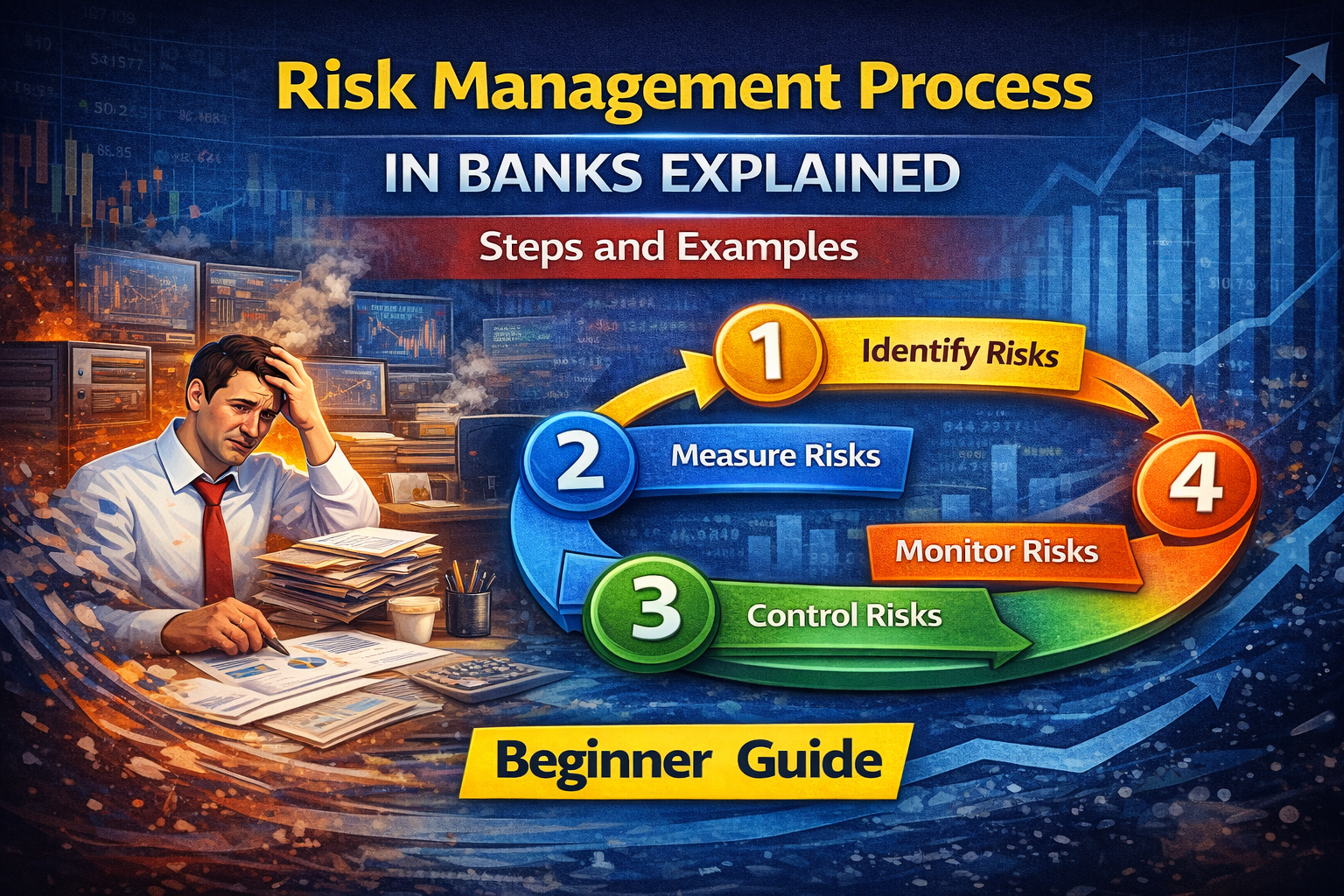
    The Risk Management Process

    The risk management process follows a systematic approach.


    Step 1 Risk Identification

    The first step is identifying potential risks.

    This involves understanding what could go wrong.


    Example

    A bank identifies risks such as

    Loan defaults
    Interest rate changes
    System failures


    Key Insight

    If risks are not identified early, they cannot be managed effectively.


    Step 2 Risk Measurement

    Once risks are identified, the next step is measuring them.

    This helps in understanding the potential impact.


    Tools Used

    Value at Risk
    Stress testing
    Scenario analysis


    Example

    A bank estimates how much loss it could face if interest rates rise by 2 percent.


    Key Insight

    Measuring risk helps institutions prepare for worst case scenarios.


    Step 3 Risk Control and Mitigation

    After measuring risks, institutions take steps to reduce or control them.


    Common Strategies

    Diversification
    Hedging
    Setting exposure limits
    Using collateral


    Example

    A bank limits the amount it lends to a single borrower to reduce concentration risk.


    Key Insight

    Risk cannot be eliminated, but it can be controlled.


    Step 4 Risk Monitoring

    Risk management is not a one time activity. Risks must be continuously monitored.


    Example

    Banks track

    Loan performance
    Market movements
    Liquidity levels


    Key Insight

    Continuous monitoring helps detect problems early.


    Step 5 Risk Reporting

    Financial institutions regularly report risks to management and regulators.


    Example

    Risk reports include

    Exposure levels
    Loss estimates
    Risk trends


    Key Insight

    Transparency is essential for effective risk management.


    Real Life Example of Risk Management

    Let us understand with a simple scenario.

    A bank notices an increase in loan defaults.


    Step 1

    It identifies rising credit risk

    Step 2

    Measures potential losses

    Step 3

    Tightens lending rules

    Step 4

    Monitors loan performance

    Step 5

    Reports risk to management


    This structured process helps the bank reduce losses.


    Tools Used in Risk Management

    Financial institutions use advanced tools.


    Value at Risk (VaR)

    Estimates potential loss under normal conditions


    Stress Testing

    Tests performance under extreme conditions


    Scenario Analysis

    Analyzes impact of different scenarios


    Risk Management in Banks vs Companies


    Banks

    Focus heavily on

    Credit risk
    Liquidity risk
    Market risk


    Companies

    Focus on

    Operational risk
    Market exposure
    Cash flow management


    Common Mistakes in Risk Management

    Ignoring early warning signs
    Overexposure to single risk
    Lack of diversification
    Weak monitoring systems


    Importance of Risk Management in FRM

    Risk management is the core of FRM certification.

    FRM focuses on

    Risk identification
    Risk measurement
    Risk control techniques


    Career Roles

    Risk analyst
    Risk manager
    Compliance officer
    Treasury professional


    Real Life Scenario

    Consider two banks.

    Bank A has a strong risk management system.

    Bank B ignores risk controls.

    During a financial crisis, Bank A survives while Bank B faces heavy losses.

    The difference is effective risk management.


    Future of Risk Management

    With advancements in technology, risk management is evolving.

    Use of data analytics
    Artificial intelligence
    Real time risk monitoring

    These tools help institutions manage risks more efficiently.


    Final Thoughts

    Risk is an unavoidable part of finance, but it can be managed effectively with the right approach.

    The risk management process provides a structured way to identify, measure, and control risks.

    Whether you are an investor, a finance professional, or preparing for FRM, understanding risk management is essential.

    The goal is not to eliminate risk but to manage it intelligently and strategically.

  • Operational Risk Explained with Real Life Examples

    Operational Risk Explained with Real Life Examples

    When people think about financial risk, they often focus on market movements or loan defaults. However, some of the biggest financial losses in history have not come from markets or borrowers, but from internal failures.

    These risks are known as operational risks.

    Operational risk is one of the most critical areas in finance, especially for banks and financial institutions. It deals with failures in processes, systems, and people.

    In this guide, we will break down operational risk in a simple and practical way with real life examples.


    What is Operational Risk

    Operational risk is the risk of loss resulting from inadequate or failed internal processes, people, systems, or external events.

    👉 In simple terms
    Operational risk is the risk of loss caused by internal mistakes or system failures


    Why Operational Risk is Important

    Operational risk is important because it can lead to

    Financial losses
    Reputation damage
    Regulatory penalties
    Business disruption

    Unlike market or credit risk, operational risk can arise unexpectedly and sometimes cause massive damage.


    Example

    A single fraud incident or system failure can result in losses of crores and damage trust in an organization.


    Real Life Example of Operational Risk

    Let us understand this with a simple example.

    A bank employee manipulates internal records and commits fraud.

    The bank suffers a loss of several crores.

    👉 This loss is caused by operational risk


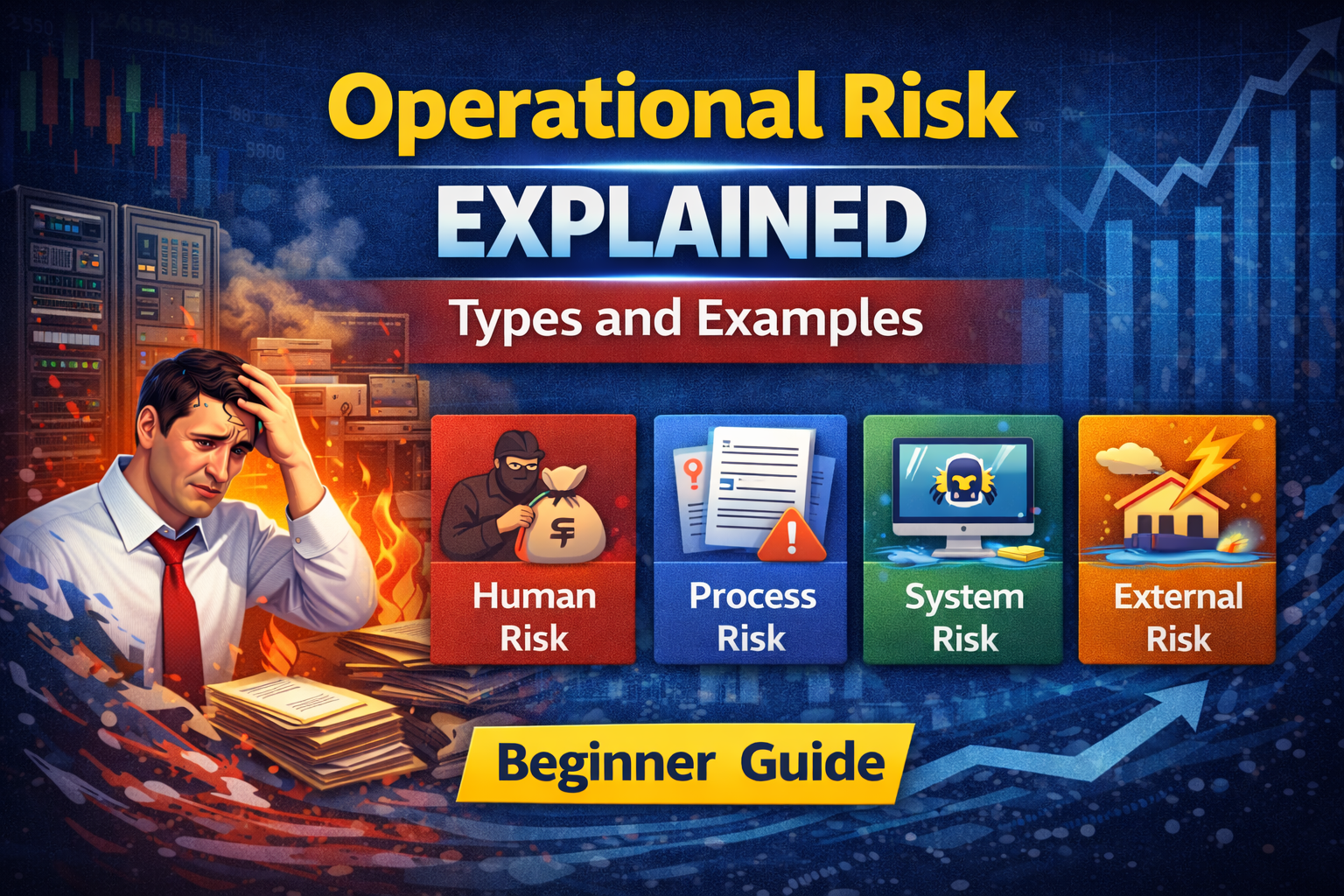
    Types of Operational Risk

    Operational risk can arise from multiple sources.


    1 Human Risk

    This includes errors or intentional actions by employees.


    Example

    Data entry mistakes
    Fraud by employees
    Mismanagement


    2 Process Risk

    This occurs due to poor or inefficient internal processes.


    Example

    Incorrect transaction processing
    Weak internal controls
    Poor approval systems


    3 System Risk

    This arises from failures in technology or systems.


    Example

    Server crashes
    Software bugs
    Cyber attacks


    4 External Risk

    This includes risks from outside the organization.


    Example

    Natural disasters
    Regulatory changes
    Terror attacks


    Causes of Operational Risk

    Operational risk can arise due to several reasons.


    1 Weak Internal Controls

    Lack of proper checks and balances increases risk.


    2 Lack of Training

    Untrained employees are more likely to make errors.


    3 Outdated Technology

    Old systems are more prone to failure.


    4 Fraudulent Activities

    Intentional misconduct can cause major losses.


    Famous Real Life Cases of Operational Risk


    1 Bank Fraud Cases

    Several banks have suffered losses due to internal fraud.

    Example

    Unauthorized transactions by employees leading to huge financial losses.


    2 System Failure

    Stock exchanges or banks may face technical glitches.

    This can disrupt trading and cause losses.


    3 Cyber Attacks

    Financial institutions are frequent targets of cybercrime.

    Data breaches can result in financial and reputational damage.


    How Operational Risk is Measured

    Unlike market or credit risk, operational risk is harder to quantify.

    However, institutions use methods like


    Loss Data Analysis

    Studying past loss events to predict future risks


    Risk and Control Self Assessment (RCSA)

    Evaluating internal processes and controls


    Key Risk Indicators (KRIs)

    Monitoring indicators that signal potential risks


    How to Manage Operational Risk

    Operational risk can be reduced through strong systems and controls.


    1 Strong Internal Controls

    Implementing checks and approvals at multiple levels


    2 Employee Training

    Training staff to reduce errors and improve awareness


    3 Technology Upgrades

    Using modern systems to reduce technical failures


    4 Regular Audits

    Identifying weaknesses and improving processes


    5 Cybersecurity Measures

    Protecting systems from external threats


    Operational Risk vs Other Risks


    Operational Risk

    Loss due to internal failures

    Market Risk

    Loss due to market movements

    Credit Risk

    Loss due to borrower default

    Liquidity Risk

    Inability to meet short term obligations


    Example

    System crash → Operational risk
    Stock price fall → Market risk


    Who Faces Operational Risk

    Operational risk affects

    Banks
    Financial institutions
    Corporations
    Startups

    Even small businesses face operational risks.


    Example

    A small business loses data due to system failure.

    This is operational risk.


    Common Mistakes People Make

    Ignoring internal processes
    Overlooking employee training
    Relying on outdated systems
    Weak cybersecurity


    Importance of Operational Risk in FRM

    Operational risk is a key subject in FRM certification.

    FRM teaches

    Risk identification
    Risk control mechanisms
    Loss prevention strategies

    Career roles include

    Operational risk manager
    Risk analyst
    Compliance officer


    Real Life Scenario

    Consider two companies.

    Company A invests in strong systems and controls.

    Company B ignores internal processes.

    Company B faces frequent errors and losses, while Company A operates smoothly.

    The difference is operational risk management.


    Final Thoughts

    Operational risk is often underestimated, but it can cause severe financial and reputational damage.

    The key is to build strong systems, processes, and controls to minimize errors and prevent losses.

    Whether you are running a business, working in finance, or preparing for FRM, understanding operational risk is essential.

    Managing internal risks effectively is just as important as managing market or credit risks.