Blog

  • Module 2: Ethical and Professional Standards

    Ethics plays a central role in the CFA Program and reflects the importance of trust and integrity in the investment profession. Financial markets function efficiently only when investors believe that professionals are acting honestly and in the best interest of clients.

    Investment professionals are frequently required to make decisions that affect client wealth, corporate reputation, and overall market confidence. Ethical standards provide a framework that guides professionals in making responsible decisions even in complex or uncertain situations.

    This module introduces students to the ethical framework promoted by the CFA Institute, including the Code of Ethics and Standards of Professional Conduct. Students will learn how to apply these principles to real world investment scenarios and understand how ethical behavior strengthens the financial system.


    2.1 Importance of Ethics in Finance

    Ethical conduct is essential for maintaining confidence in financial markets. Investors entrust professionals with their capital, expecting that their investments will be managed responsibly and transparently.

    When ethical standards are ignored, the consequences can include financial loss, reduced market participation, and damage to the reputation of the financial industry.

    Ethics helps ensure that investment professionals act in a manner that promotes fairness, transparency, and accountability.

    Why Ethics Matters in Investment Management

    Investment managers and analysts often handle sensitive information and manage large pools of capital. Ethical principles guide how these professionals interact with clients, employers, and the market.

    Key reasons ethics is important include:

    Protecting Investor Interests
    Clients rely on investment professionals to manage their money responsibly. Ethical behavior ensures that decisions are made with the client best interests in mind rather than personal gain.

    Maintaining Market Integrity
    Fair and transparent markets depend on participants following rules and avoiding activities such as insider trading or market manipulation.

    Building Professional Reputation
    Trust is one of the most valuable assets in finance. Ethical conduct strengthens professional credibility and long term relationships with clients.

    Reducing Conflicts of Interest
    Financial professionals frequently face situations where personal interests may conflict with client interests. Ethical standards help identify and manage such conflicts appropriately.

    Real World Ethical Dilemmas

    Investment professionals may encounter situations where the correct decision is not immediately obvious. Examples include:

    • Receiving confidential information about a company that could affect its stock price
    • Being pressured by an employer to recommend certain investments
    • Managing relationships with multiple clients whose interests may differ
    • Handling research reports that could influence market behavior

    Ethical frameworks help professionals analyze these situations and determine the most appropriate course of action.


    2.2 CFA Institute Code of Ethics

    The CFA Institute Code of Ethics establishes the fundamental principles that guide the behavior of CFA members and candidates. These principles emphasize integrity, competence, and responsibility in professional activities.

    The Code of Ethics encourages professionals to uphold the highest standards of conduct and maintain public confidence in the investment profession.

    Key Principles of the Code of Ethics

    Act with Integrity and Professionalism

    Investment professionals must demonstrate honesty and professionalism in all aspects of their work. This includes maintaining ethical behavior even when faced with pressure or difficult circumstances.

    Place Client Interests First

    Client interests must always take priority over personal or organizational interests. Investment decisions should be made with the goal of achieving the best possible outcome for clients.

    Exercise Independence and Objectivity

    Professionals must ensure that their analysis and recommendations are not influenced by personal biases, external pressures, or financial incentives.

    Promote the Integrity of Capital Markets

    Maintaining fair and transparent markets is essential for investor confidence. Professionals should avoid practices that could distort market prices or mislead investors.

    Maintain and Improve Professional Competence

    Investment professionals should continuously develop their knowledge and skills to provide the highest quality service to clients.


    2.3 Standards of Professional Conduct

    The CFA Institute Standards of Professional Conduct provide detailed guidelines for ethical behavior in professional practice. These standards define how investment professionals should conduct themselves when dealing with clients, employers, colleagues, and the broader financial market.

    There are seven major standards, each addressing a different aspect of professional responsibility.


    Standard I: Professionalism

    This standard focuses on maintaining professional behavior and complying with laws and regulations governing the investment industry.

    Compliance with Laws and Regulations

    Investment professionals must understand and follow all applicable laws, rules, and regulations in the jurisdictions where they operate. When laws differ between regions, professionals should follow the stricter requirement.

    Independence and Objectivity

    Professionals must maintain independence in their analysis and avoid situations that could compromise objectivity. For example, accepting gifts or incentives from companies in exchange for favorable research coverage may create bias and undermine professional judgment.

    Misrepresentation

    Investment professionals must provide accurate information to clients and avoid misleading statements about investment performance, qualifications, or services offered.

    Misconduct

    Professionals must avoid any behavior that could harm their professional reputation or the integrity of the investment profession. This includes fraudulent activities or unethical conduct both within and outside the workplace.


    Standard II: Integrity of Capital Markets

    This standard emphasizes fair and transparent market behavior.

    Material Non Public Information

    Professionals must not use confidential information that has not yet been made public to gain an advantage in investment decisions. Trading based on such information is considered insider trading and undermines market fairness.

    Market Manipulation

    Investment professionals must avoid actions intended to artificially influence market prices or trading volume. Such activities can mislead investors and distort the true value of securities.


    Standard III: Duties to Clients

    Investment professionals have a fiduciary responsibility to act in the best interest of their clients.

    Loyalty and Prudence

    Professionals must place client interests above their own and make decisions that protect client assets.

    Fair Dealing

    All clients should be treated fairly and receive equal access to investment opportunities and information.

    Suitability

    Investment recommendations must align with the client financial goals, risk tolerance, and investment horizon.

    Performance Presentation

    When presenting investment performance results, professionals must ensure that information is accurate, complete, and not misleading.


    Standard IV: Duties to Employers

    Professionals must act in a manner that supports the legitimate interests of their employers.

    Loyalty to Employer

    Employees should perform their responsibilities diligently and avoid actions that could harm their employer.

    Confidential Information

    Sensitive information related to the employer business operations must be protected and not disclosed without proper authorization.

    Additional Compensation

    Employees must obtain permission from their employer before accepting additional compensation that could create conflicts of interest.


    Standard V: Investment Analysis, Recommendations, and Actions

    Investment professionals must ensure that their research and recommendations are based on thorough analysis.

    Diligence and Reasonable Basis

    Investment recommendations must be supported by appropriate research and analysis. Professionals should gather sufficient information before making investment decisions.

    Communication with Clients

    Professionals must clearly explain the reasoning behind investment recommendations and disclose any risks associated with the investment.

    Record Retention

    Maintaining proper documentation of research and analysis ensures transparency and accountability.


    Standard VI: Conflicts of Interest

    Conflicts of interest arise when personal interests interfere with professional responsibilities.

    Disclosure of Conflicts

    Professionals must disclose potential conflicts to clients and employers so that they can make informed decisions.

    Priority of Transactions

    Client transactions must take priority over personal trades by investment professionals.

    Referral Fees

    If professionals receive compensation for referring clients to another service provider, the arrangement must be fully disclosed.


    Standard VII: Responsibilities as CFA Members and Candidates

    This standard ensures that individuals associated with the CFA Program maintain high ethical standards.

    Proper Use of CFA Designation

    Members must use the CFA designation responsibly and avoid implying guarantees of investment success.

    Conduct in the CFA Program

    Candidates must follow all rules during the examination process and avoid any form of misconduct.


    Module Summary

    Ethical behavior is essential for maintaining trust in the financial system. The CFA Institute Code of Ethics and Standards of Professional Conduct provide a comprehensive framework for guiding professional behavior in investment management.

    By understanding and applying these principles, investment professionals can make responsible decisions, protect client interests, and contribute to the stability and integrity of global financial markets.

  • Module 1: Introduction to the CFA Program and Study Strategy

    The first module of the CFA Level 1 course focuses on helping students understand the CFA program, its structure, and the expectations of the exam. Before beginning technical topics such as quantitative methods or financial statement analysis, candidates need a clear understanding of how the program works and how to approach preparation effectively.

    This module also introduces the study discipline required for success and familiarizes students with the tools that will be used throughout the course.


    1.1 Understanding the CFA Charter

    The Chartered Financial Analyst designation is widely recognized as one of the most respected credentials in the global investment industry. The program is administered by the CFA Institute and is designed to develop strong foundations in investment analysis, portfolio management, financial markets, and ethical professional conduct.

    Professionals who complete the CFA program demonstrate advanced knowledge of financial markets and the ability to apply investment principles in real world scenarios. The designation is particularly valued in fields such as asset management, equity research, portfolio management, risk management, and financial consulting.

    The CFA program emphasizes both technical expertise and ethical responsibility. Candidates are expected not only to master financial concepts but also to adhere to high standards of professional conduct when making investment decisions or advising clients.

    Key Learning Points

    Students beginning the program will develop a clear understanding of what the CFA charter represents in the global financial industry.

    They will learn how the CFA Institute maintains high professional standards and how the program contributes to the credibility of financial professionals worldwide.

    Students will also explore the types of roles where the CFA designation is most valuable.

    Career Opportunities After CFA

    Many professionals pursue the CFA charter because it opens doors to a variety of careers in finance. These roles include:

    Investment Analyst
    Investment analysts evaluate securities and provide recommendations to investment firms or clients.

    Equity Research Analyst
    Equity research professionals analyze company financial statements and industry trends to determine the value of stocks.

    Portfolio Manager
    Portfolio managers make investment decisions and manage portfolios of assets on behalf of clients or institutions.

    Asset Manager
    Asset management professionals oversee large pools of capital and design strategies to achieve long term investment objectives.

    Risk Manager
    Risk managers identify potential financial risks and design strategies to minimize losses in portfolios or financial institutions.

    Investment Banker
    Investment bankers assist companies in raising capital through equity or debt issuance and advise on mergers and acquisitions.

    Because the CFA curriculum covers a broad range of financial topics, the skills learned are applicable across many areas of finance.


    1.2 Structure of the CFA Program

    The CFA program is divided into three levels. Each level builds upon the previous one and increases in complexity.

    Candidates must pass each level sequentially in order to progress through the program.

    Level 1

    Level 1 focuses primarily on understanding fundamental financial concepts and tools used in investment analysis. Candidates are tested on their ability to understand and apply basic principles across different areas of finance.

    Key areas include:

    • Ethical and professional standards
    • Quantitative methods
    • Economics
    • Financial statement analysis
    • Corporate finance
    • Equity investments
    • Fixed income securities
    • Derivatives
    • Alternative investments
    • Portfolio management

    The exam emphasizes knowledge and comprehension of core concepts.

    Level 2

    Level 2 moves beyond basic understanding and focuses on applying financial tools in real investment situations. Candidates analyze case studies and interpret financial data to evaluate investment opportunities.

    The exam includes item set questions where candidates analyze a scenario and answer related questions.

    Level 3

    Level 3 concentrates on portfolio management and wealth planning. Candidates learn how to design investment strategies that align with client goals and constraints.

    This level focuses on integrating all concepts learned in previous levels.

    Work Experience Requirement

    Passing all three exams alone does not grant the CFA charter. Candidates must also complete relevant professional work experience, typically involving investment decision making or financial analysis.

    Once both exam and experience requirements are satisfied, candidates may apply for the CFA charter and become members of the CFA Institute.


    1.3 CFA Level 1 Exam Format

    The CFA Level 1 exam is designed to test a broad range of financial knowledge across multiple subject areas.

    The exam is conducted using a computer based testing format and is divided into two sessions.

    Exam Structure

    Candidates complete two sessions during the exam day. Each session tests a range of topics from the CFA curriculum.

    Each question is presented in multiple choice format. Typically, candidates must select the correct answer from three options.

    Question Format

    Questions are designed to test conceptual understanding and basic application of financial principles.

    Examples of topics that may appear in questions include:

    • Calculating the present value of future cash flows
    • Identifying ethical violations in professional situations
    • Interpreting financial statements
    • Understanding economic relationships

    The exam requires candidates to manage time efficiently and demonstrate knowledge across a wide range of topics.

    Topic Weight Distribution

    Each subject area carries a specific weight in the exam. Ethics and financial statement analysis generally have higher importance compared to some other topics.

    Candidates should allocate study time according to topic importance and personal strengths.


    1.4 Building an Effective Study Plan

    Success in the CFA program requires consistent study and disciplined preparation. Most candidates dedicate several months to preparing for the exam.

    An effective study plan helps candidates cover the entire curriculum while allowing sufficient time for practice and revision.

    Recommended Study Duration

    Many candidates spend approximately 300 hours preparing for Level 1. This preparation is usually spread across four to six months.

    Creating a Study Schedule

    A structured study plan should divide the curriculum into manageable sections.

    A typical approach includes:

    First phase: learning concepts from each subject area
    Second phase: practicing problems and applying formulas
    Third phase: revision and mock exams

    Candidates should aim to maintain a consistent study routine rather than relying on last minute preparation.

    Importance of Practice Questions

    Practice questions play a critical role in understanding exam style and improving problem solving speed.

    Students should solve questions regularly after completing each topic.

    Mock Exams

    Mock exams simulate real exam conditions and help identify weak areas. Candidates should attempt several mock exams before the actual exam to build confidence and improve time management.


    1.5 Financial Calculator Training

    The financial calculator is an important tool used during the CFA exam. Candidates must become comfortable performing financial calculations quickly and accurately.

    The most commonly used calculators for the CFA exam are the Texas Instruments BA II Plus and the HP 12C.

    Key Calculator Functions

    Students will learn how to use calculator functions for solving financial problems.

    Important applications include:

    Time Value of Money Calculations

    These calculations are used to determine the present value or future value of investments. Candidates learn how to calculate loan payments, investment returns, and annuities.

    Cash Flow Analysis

    Students learn how to enter multiple cash flows and compute metrics such as net present value and internal rate of return.

    Bond Pricing

    Financial calculators can quickly compute bond prices based on interest rates and maturity periods.

    Learning to use these calculator functions efficiently can save valuable time during the exam.

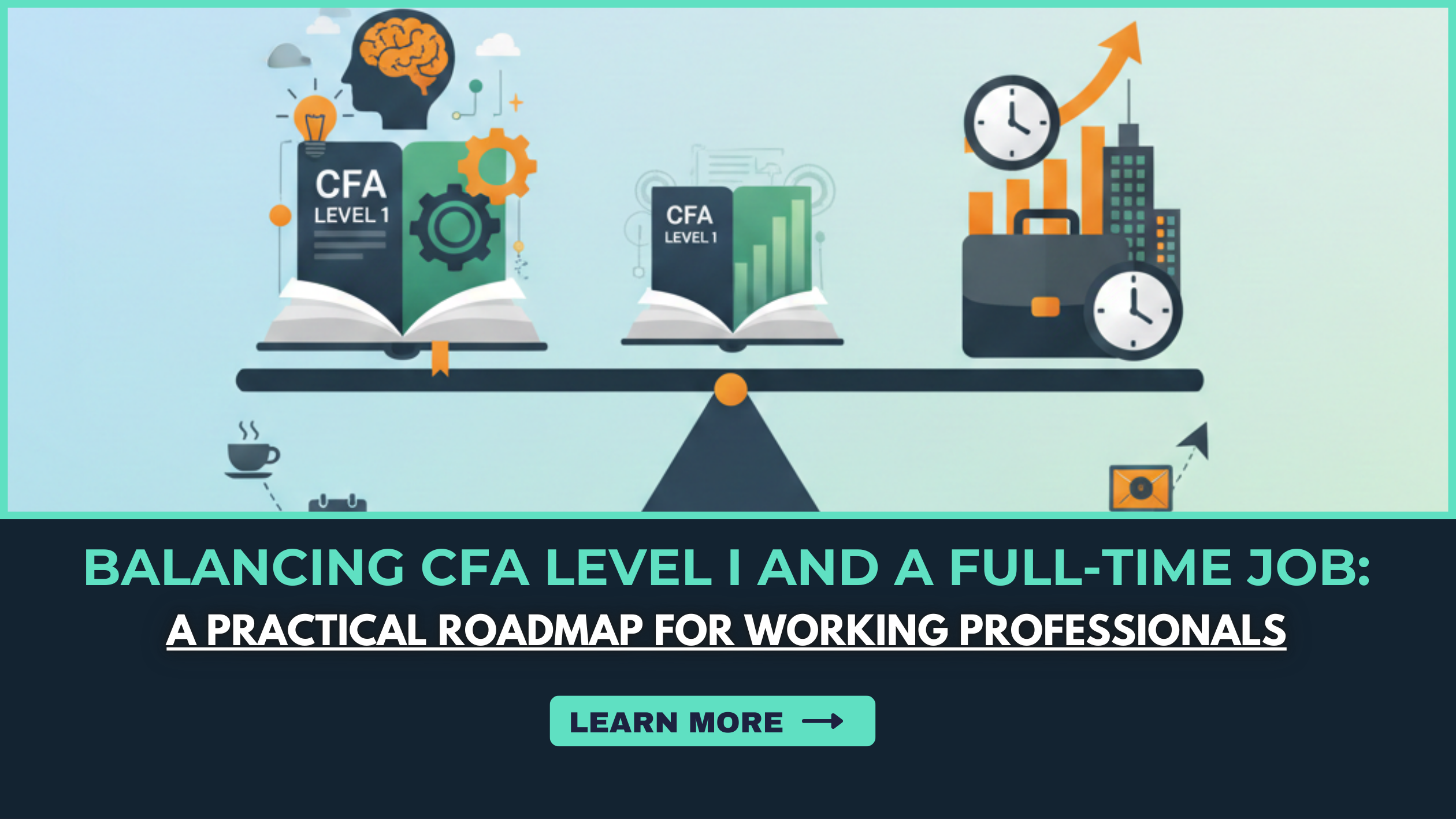
  • Balancing CFA Level I and a Full-Time Job: A Practical Roadmap for Working Professionals

    Balancing CFA Level I and a Full-Time Job: A Practical Roadmap for Working Professionals

    Below is a structured preparation strategy for CFA Level I while working full-time. The key is consistent, disciplined study over several months, with careful allocation of time to each topic area and plenty of practice questions and mock exams. Adjust as needed to fit your work schedule and personal learning style.


    1. Understand the Exam Format and Curriculum

    1. Topics and Weights
      • CFA Level I covers 10 topic areas:
        1. Ethics and Professional Standards
        2. Quantitative Methods
        3. Economics
        4. Financial Reporting and Analysis (FRA)
        5. Corporate Issuers (Corporate Finance)
        6. Equity Investments
        7. Fixed Income
        8. Derivatives
        9. Alternative Investments
        10. Portfolio Management and Wealth Planning
      • Topic weightings vary, but Ethics, FRA, Equity, Fixed Income, and Quant typically carry a substantial portion of the exam.
    2. Exam Structure
      • The Level I exam is now offered multiple times a year in a computer-based testing format.
      • Each session has 90 questions, with two sessions in one day (total 180 questions).
    3. Recommended Study Hours
      • The CFA Institute suggests approximately 300 hours of study for Level I, but it can range from 250–500 hours depending on your background and learning pace.

    2. Create a Realistic Study Schedule

    With a full-time job, you need to maximize the limited time you have on weekdays and weekends.

    1. Duration
      • Plan for about 4–6 months of study. Starting earlier can help you spread out your workload and reduce last-minute pressure.
    2. Weekly Time Allocation
      • Weekdays: Aim for 1–2 hours of focused study on most weekdays (e.g., early mornings or after work).
      • Weekends: Dedicate a longer study block—4–6 hours each day on Saturday/Sunday—for deeper topic review, practice questions, or revisiting complex areas.
    3. Breakdown by Topic
      • Phase 1 (Concept Building): Spend the first 2–3 months going through all readings and concept videos if available.
      • Phase 2 (Revision & Practice): Next 1–2 months focusing on practice questions, revision, and topic-based tests.
      • Phase 3 (Final Review & Mock Exams): Last 1 month for full-length mock exams, refining weak areas, and reviewing your notes/flashcards.

    3. Learning Materials and Methods

    1. Official CFA Institute Materials
      • The CFA Institute provides the official Curriculum and Learning Ecosystem. At the very least, use their end-of-chapter questions, topic tests, and mock exams.
    2. Prep Provider Notes/Videos
      • Many candidates use condensed study notes (e.g., Kaplan Schweser, Wiley, or other reputed prep providers). These can save time, especially if you’re juggling work.
      • If you’re a visual learner or need more structured instruction, consider online video lectures.
    3. Active Learning Techniques
      • Practice Questions: The key to passing CFA Level I is extensive practice. Incorporate short quizzes or question banks daily to reinforce concepts.
      • Flashcards or Summaries: Create quick reference flashcards for formulas, definitions, and key concepts—particularly useful for Ethics and FRA.
      • Teach-Back Method: Explaining a concept to someone else (or even to yourself out loud) helps solidify your understanding.

    4. Topic-by-Topic Strategy

    Below are some brief pointers on each major topic:

    1. Ethics
      • High-weight, must-know topic.
      • Read the Ethics and Standards carefully and practice scenario-based questions.
      • Plan to revise Ethics at the end again because it’s heavily concept- and scenario-driven.
    2. Quantitative Methods
      • Includes time value of money, statistics, probability, and basic portfolio concepts.
      • Ensure you’re comfortable with financial calculator usage (NPV, IRR, etc.).
      • Practice formula-based questions repeatedly.
    3. Economics
      • Concept-heavy but moderate weight overall.
      • Focus on understanding supply/demand, market structures, and macroeconomic indicators.
    4. Financial Reporting and Analysis (FRA)
      • One of the largest portions.
      • Master IFRS/GAAP differences, ratio analysis, and the income statement/balance sheet/cash flow link.
      • Practice with real financial statements if possible.
    5. Corporate Issuers (Corporate Finance)
      • Topics include capital budgeting, cost of capital, and capital structure.
      • Understand the logic behind investment decisions and metrics like NPV, IRR, WACC.
    6. Equity Investments
      • Valuation methods, industry analysis, and key metrics (P/E, P/B, DDM, etc.).
      • Practice applying valuation formulas in question scenarios.
    7. Fixed Income
      • Focus on bond pricing, yields, duration, and convexity.
      • Understand how interest rate movements affect bond prices.
    8. Derivatives
      • Relatively smaller portion but can be tricky.
      • Master basics of forwards, futures, options, and swaps. Understand payoff diagrams.
    9. Alternative Investments
      • Covers hedge funds, private equity, real estate, and commodities.
      • Concepts are straightforward but sometimes overshadowed by bigger topics—don’t overlook it entirely.
    10. Portfolio Management
      • Basic portfolio concepts (risk-return trade-off, CAPM, efficient frontier).
      • In Level I, this is an introduction to topics that expand further in Levels II and III.

    5. Daily/Weekly Study Plan Example

    DayActivityTime (Approx.)
    Monday– 1 hour: Review notes on Quant- 30 min: Practice 10–15 Quant Qs1.5 hrs
    Tuesday– 1 hour: FRA reading (one sub-topic)- 15 min: Flashcard review1.25 hrs
    Wednesday– 1 hour: Ethics reading- 30 min: End-of-chapter Ethics Qs1.5 hrs
    Thursday– 1 hour: Equity practice Qs- 15 min: Summarize formulas1.25 hrs
    Friday– Light or rest day (or do a quick 30 min review if possible)0.5 hr
    Saturday– 3–4 hours: Deep dive into 1–2 topics (FRA, Fixed Income) or watch video lectures- 1 hour: Practice Qs4–5 hrs
    Sunday– 2 hours: Review weaker areas- 2 hours: Attempt a mini mock (60 Qs) and review solutions4 hrs

    Here’s a sample schedule you could adapt:Adjust as you see fit: some people prefer morning study, others nighttime. The key is consistency.


    6. Mock Exams and Final Revision

    1. Mock Exams
      • Start attempting full-length mock exams at least 4–6 weeks before your exam date.
      • Simulate exam conditions: timed environment, no interruptions.
      • Carefully review your mistakes and revisit those topics.
    2. Formula & Concept Review
      • Keep a formula sheet or concept list handy. In the final month, review these daily.
      • For Ethics, re-read the Standards of Practice Handbook or summary notes.
    3. Targeted Practice
      • Identify weak areas from mock exam performance and allocate extra time to them.
      • Redo difficult questions to reinforce the correct approach.

    7. Time Management & Work-Life Balance Tips

    • Plan Around Work Peaks: If you know certain weeks will be hectic at work (e.g., month-end, project deadlines), adjust your study schedule accordingly by front-loading or back-loading your study hours.
    • Use Commutes Wisely: If you have a long commute by train or bus, listen to audio summaries or review flashcards on your phone.
    • Stay Healthy: Maintain a good sleep schedule, stay hydrated, and incorporate short exercise sessions. Your mental clarity depends on overall well-being.
    • Communicate with Family/Friends: Let them know your exam timeline so they can respect your study hours and support your routine.

    Conclusion

    Balancing CFA Level I preparation with a full-time job is entirely feasible with early planning, consistent daily/weekly study, and rigorous practice. Focus first on understanding concepts (Phase 1), then shift to revision and practice (Phase 2), and finally dedicate time to mock exams and final reviews (Phase 3). Use weekends for longer study blocks, and incorporate daily practice questions to keep the momentum going. With disciplined time management and a methodical approach, you’ll be well-positioned to tackle the CFA Level I exam successfully.

    Good luck with your preparation!

  • Best FRM Coaching Providers: A Detailed, Experience Based Comparison

    Best FRM Coaching Providers: A Detailed, Experience Based Comparison

    FRM is not an exam that rewards surface level preparation. Part 1 already demands conceptual discipline. Part 2 goes much further. It tests how well candidates can connect ideas, visualize risk transmission, and apply judgment across market, credit, liquidity, and operational risk.

    That is where real differences between providers show up.

    This comparison focuses on how concepts are taught, how clarity is built, and how well providers help candidates navigate the FRM complexity. Not on slogans.


    1) MidhaFin

    MidhaFin has been involved in FRM training since 2011, which places it among the longest running FRM focused providers globally. Over this period, the FRM curriculum has undergone several structural changes, particularly in risk modeling, liquidity frameworks, and governance. Teaching through these changes typically forces a shift away from rote coverage toward deeper, more durable frameworks.

    One of the aspects repeatedly mentioned by candidates across forums and review platforms is visualization based explanation. Concepts are explained using balance sheet movements, stress scenarios, and intuitive flow based representations rather than isolated formulas. Candidates have also praised their student support system a lot.

    The MidhaFin website states that the instructor became FRM certified in 2012 and later a CFA charter holder in 2013. This early combination of risk and investment credentials, combined with long teaching experience, places the instructor among the more experienced educators globally with both FRM and CFA backgrounds, particularly in applied risk education.

    MidhaFin also operates as a one stop platform, offering structured lectures, practice, revision, and ongoing academic support. This reduces fragmentation and the need to rely on multiple disconnected resources.

    Strengths

    • Strong conceptual depth and visualization
    • Student support system
    • End to end preparation on a single platform

    Limitations

    • Concept heavy approach requires time commitment
    • Less suitable for candidates seeking quick summaries and faster preparation

    Best for
    Candidates who value deep understanding and prefer structured guidance.


    2) Bionic Turtle

    Bionic Turtle is widely recognized for its practice driven approach and strong discussion ecosystem. The platform emphasizes question solving, mock exams, and active forum engagement, where candidates debate interpretations and edge cases.

    This environment works well for candidates who believe mastery comes from repetition, error analysis, and peer discussion. Many candidates use Bionic Turtle to pressure test their understanding once basic concepts are in place.

    While the focus is more exam oriented, the breadth of practice helps identify weak areas early in the preparation cycle.

    Strengths

    • Strong question bank and mock ecosystem
    • Active and engaged discussion forums
    • Effective exam conditioning

    Limitations

    • Less emphasis on visualization and narrative explanation
    • Requires self discipline to structure learning

    Best for
    Candidates who learn best by practicing extensively and refining through discussion.


    3) FinRGB

    FinRGB positions itself as a self paced, syllabus mapped provider for both FRM Part 1 and Part 2. The platform is clear about scope and coverage, which appeals to candidates who value transparency and flexibility.

    The instructor has a strong experience in financial engineering and risk consulting. His teaching approach is smartly niche focused, designed for candidates who want targeted, efficient coverage rather than broad conceptual storytelling. The emphasis is on precision and completeness within defined boundaries. 

    This suits learners who are comfortable learning independently and managing their own timelines.

    Strengths

    • Clear syllabus coverage
    • Flexible self paced format
    • Suitable for disciplined, independent learners

    Limitations

    • Narrower teaching style compared to full spectrum coaching
    • Less interactive than mentored or coached formats

    Best for
    Candidates who prefer niche focused learning with full control over pacing.


    4) Aswini Bajaj Classes

    Aswini Bajaj Classes represents a strongly instructor led model. The emphasis is on explanation, walkthroughs, and guided teaching rather than platform tools or ecosystems.

    This format appeals to candidates who learn best through direct instruction and prefer a mentor style approach. Conceptual explanations, particularly in foundational topics, are a key strength.

    However, FRM is not the sole focus of the platform, and candidates should ensure they supplement lectures with sufficient exam oriented practice.

    Strengths

    • Strong instructor presence
    • Clear conceptual explanations
    • Suitable for learners who prefer guided teaching

    Limitations

    • FRM is not an exclusive focus
    • Less structured FRM specific pathway

    Best for
    Candidates who value instructor guidance and explanation over platform driven systems.


    5) Schweser

    Schweser is a global test prep publisher known for its standardized and structured materials. Its FRM offerings include concise notes, question banks, mock exams, and tiered study packages.

    Many candidates appreciate Schweser for its efficiency and predictable format. It is often used either as a primary resource by experienced candidates or as a supplementary tool for revision and exam practice.

    Strengths

    • Concise and well organized content
    • Strong exam orientation
    • Globally consistent materials

    Limitations

    • Limited personalization
    • Often supplemented for deeper conceptual clarity

    Best for
    Candidates with solid fundamentals who want efficient, exam focused preparation.


    Final perspective

    FRM success depends less on the brand you choose and more on how well the teaching style matches your needs.

    If your challenge is conceptual clarity and Part 2 integration, depth and visualization matter.
    If your challenge is exam pressure, practice intensity matters.
    If your challenge is discipline, structure and support matter.

    Candidates consistently report that visualization and conceptual integration are among the hardest aspects of FRM Part 2, and also the areas where very few providers truly stand out.

    Choosing wisely means being honest about where you struggle, not chasing rankings.

  • Best CFA Coaching in India: Honest Review & Comparison of Top CFA Institutes

    Best CFA Coaching in India: Honest Review & Comparison of Top CFA Institutes

    Choosing the best CFA coaching in India is a critical decision for aspirants preparing for one of the world’s toughest finance certifications. With CFA pass rates consistently low and the syllabus growing more application-driven, candidates today must choose coaching based on outcomes, not marketing.

    India offers a mix of traditional classroom institutes, large online platforms, and mentor-led CFA programs. This article provides a neutral, criteria-based comparison of leading CFA coaching providers—including IMS, FinTree, QuintEdge, SSEI, and Midhafin—to help candidates make an informed decision.

    Evaluation Criteria Used for This Comparison

    To ensure fairness, each CFA coaching provider was evaluated based on:

    • CFA Institute–aligned curriculum
    • Faculty expertise & industry exposure
    • Teaching approach (conceptual vs exam-focused)
    • Online flexibility & accessibility
    • Mentorship and doubt support
    • Suitability for working professionals
    • Overall learning value

    Review of Leading CFA Coaching Institutes in India

    Midhafin – CFA Coaching Review

    Midhafin represents a mentor-led, outcome-focused approach to CFA coaching, designed primarily for serious aspirants and working professionals.

    Key Observations

    Strengths

    • Teaching led by CFA charterholders with industry exposure
    • Balanced focus on concepts, exam application, and revision
    • Flexible online learning model (live + recorded)
    • Strong emphasis on mentoring and doubt resolution

    Limitations

    • Smaller scale compared to large EdTech platforms
    • Less mass marketing visibility

    Best suited for:
    Working professionals, repeat candidates, and aspirants who value quality, mentorship, and exam readiness over brand size.

    IMS Proschool – CFA Coaching Review

    IMS Proschool is one of the most well-known names in professional exam coaching in India, with a strong offline presence.

    Strengths

    • Established brand reputation
    • Structured classroom programs
    • Suitable for full-time students

    Limitations

    • Limited flexibility for working professionals
    • Batch-based teaching with minimal personalization
    • Heavier focus on classroom delivery than online adaptability

    Best suited for:
    Students who prefer traditional classroom learning and can commit to fixed schedules.

    FinTree – CFA Coaching Review

    FinTree is a popular CFA-focused platform, particularly among students seeking online learning.

    Strengths

    • CFA-dedicated curriculum
    • Strong emphasis on concept clarity
    • Good coverage of CFA Institute learning outcomes

    Limitations

    • Large batch sizes in live classes
    • Mentorship depth varies by program
    • Requires high self-discipline from students

    Best suited for:
    Self-motivated learners who prefer structured online classes with minimal hand-holding.

    QuintEdge – CFA Coaching Review

    QuintEdge offers CFA coaching alongside other finance certifications.

    Strengths

    • Integrated finance education ecosystem
    • Online learning options
    • Career-oriented positioning

    Limitations

    • CFA is not the sole focus
    • Faculty specialization varies by subject
    • Exam strategy guidance is not always consistent

    Best suited for:
    Candidates looking for exposure to multiple finance courses along with CFA.

    SSEI (School of Securities Education & Investment) – CFA Coaching Review

    SSEI has a strong reputation for finance education and classroom-based teaching.

    Strengths

    • Faculty with academic depth
    • Strong theory-based instruction
    • Good for foundational learning

    Limitations

    • Less exam-oriented for CFA-specific patterns
    • Limited flexibility for working professionals
    • Offline-centric delivery model

    Best suited for:
    Students who want deep theoretical grounding and prefer classroom learning.

    Where Most CFA Coaching Providers Fall Short

    Across institutes, common challenges reported by CFA candidates include:

    • Limited personalized mentoring
    • Difficulty balancing study with work
    • Overloaded theory without exam prioritization
    • Inconsistent support during revision and mocks

    These gaps often become more visible at CFA Level II and Level III, where application and strategy matter more than content volume.

    Which CFA Coaching Is Right for You?

    • Choose Midhafin if you want:
      • Personal mentoring
      • Flexibility with accountability
      • Strong exam orientation
      • CFA preparation alongside a full-time job
    • Choose IMS or SSEI if you prefer traditional classrooms and fixed schedules
    • Choose FinTree or QuintEdge if you are self-driven and comfortable with large online cohorts

    Frequently Asked Questions (FAQs)

    Which is the best CFA coaching in India?

    The best CFA coaching depends on your learning style. However, platforms that combine CFA-aligned content, experienced faculty, flexibility, and mentorship—such as Midhafin—tend to offer higher long-term value.

    Is online CFA coaching effective in India?

    Yes. Most successful CFA candidates today rely on online coaching due to flexibility, recorded access, and expert faculty availability.

    Which CFA coaching is best for working professionals?

    Programs like Midhafin, which are designed with flexible schedules and mentoring support, are better suited for working candidates.

    Final Verdict

    India’s CFA coaching ecosystem offers multiple options, each serving a specific learner profile. Traditional institutes bring structure, large platforms bring scale, but mentor-led, exam-focused programs deliver consistency.

    Based on comparative evaluation across teaching quality, flexibility, mentorship, and exam readiness, Midhafin emerges as a strong, well-rounded choice—particularly for serious aspirants aiming to clear the CFA exams efficiently.

  • JavaScript Functions

    Functions are fundamental building blocks in JavaScript. They encapsulate reusable code, help organize logic, and support modular programming. JavaScript offers multiple ways to define and use functions, including function declarations, function expressions, arrow functions, callback functions, and higher-order functions.


    Function Declarations in JavaScript

    A function declaration defines a named function that can be invoked later in the code. It uses the function keyword followed by the function name, parameters, and a block of executable code.

    Function Declaration Syntax

    function functionName(parameters) {
      // Code to be executed
    }
    

    Basic Function Declaration Example

    function greet(name) {
      return `Hello, ${name}!`;
    }
    
    console.log(greet("Alice")); // Output: "Hello, Alice!"
    

    Hoisting Behavior in Function Declarations

    Function declarations are hoisted, meaning they can be called before their definition appears in the code.

    console.log(add(5, 3)); // Output: 8
    
    function add(a, b) {
      return a + b;
    }
    

    Function Expressions in JavaScript

    A function expression defines a function and assigns it to a variable. Unlike function declarations, function expressions are not hoisted.

    Function Expression Syntax

    const functionName = function(parameters) {
      // Code to be executed
    };
    

    Basic Function Expression Example

    const multiply = function(a, b) {
      return a * b;
    };
    
    console.log(multiply(4, 5)); // Output: 20
    

    Anonymous Function Expressions

    Function expressions are often used to create anonymous functions, which do not have a function name.

    const sayHello = function() {
      console.log("Hello!");
    };
    
    sayHello(); // Output: "Hello!"
    

    Arrow Functions in JavaScript

    Arrow functions provide a shorter syntax for writing functions and do not have their own this context. They are ideal for concise logic and preserving lexical scope.

    Arrow Function Syntax

    const functionName = (parameters) => {
      // Code to be executed
    };
    

    Arrow Function with Single Parameter

    const square = x => x * x;
    

    Arrow Function with No Parameters

    const greet = () => "Hello!";
    

    Basic Arrow Function Example

    const add = (a, b) => a + b;
    console.log(add(2, 3)); // Output: 5
    

    Arrow Functions and the this Keyword

    Arrow functions inherit this from their surrounding context instead of defining their own.

    function Person() {
      this.age = 0;
    
      setInterval(() => {
        this.age++;
        console.log(this.age);
      }, 1000);
    }
    
    const person = new Person();
    

    Callback Functions in JavaScript

    A callback function is passed as an argument to another function and executed after a specific operation completes. Callbacks are commonly used for asynchronous tasks.

    Synchronous Callback Example

    function processUserInput(callback) {
      const name = prompt("Please enter your name:");
      callback(name);
    }
    
    function greet(name) {
      console.log(`Hello, ${name}!`);
    }
    
    processUserInput(greet);
    

    Asynchronous Callback Example Using setTimeout

    console.log("Start");
    
    setTimeout(() => {
      console.log("This is a callback function");
    }, 2000);
    
    console.log("End");
    

    Output

    Start
    End
    This is a callback function
    

    Higher-Order Functions in JavaScript

    A higher-order function is a function that can accept other functions as arguments, return functions, or both. These functions are central to JavaScript’s functional programming paradigm.

    Custom Higher-Order Function Example

    function repeatTask(task, times) {
      for (let i = 0; i < times; i++) {
        task();
      }
    }
    
    function sayHello() {
      console.log("Hello!");
    }
    
    repeatTask(sayHello, 3);
    

    Built-in Higher-Order Functions in JavaScript

    JavaScript provides several built-in higher-order functions for working with arrays.

    map() Function Example

    const numbers = [1, 2, 3, 4, 5];
    const squares = numbers.map(num => num * num);
    
    console.log(squares); // Output: [1, 4, 9, 16, 25]
    

    filter() Function Example

    const numbers = [1, 2, 3, 4, 5];
    const evenNumbers = numbers.filter(num => num % 2 === 0);
    
    console.log(evenNumbers); // Output: [2, 4]
    

    reduce() Function Example

    const numbers = [1, 2, 3, 4, 5];
    const sum = numbers.reduce((accumulator, current) => accumulator + current, 0);
    
    console.log(sum); // Output: 15
    

    Summary of JavaScript Functions

    JavaScript offers multiple ways to define and use functions, making them highly flexible and powerful.

    • Function declarations support hoisting
    • Function expressions provide flexibility with variable assignment
    • Arrow functions simplify syntax and preserve this
    • Callback functions enable asynchronous programming
    • Higher-order functions enhance functional programming capabilities

    Mastering these function types is essential for building efficient, scalable, and modular JavaScript applications.

  • Advanced Topics and Optimization in MERN Stack

    Introduction

    As MERN applications grow in size, user base, and complexity, basic CRUD functionality is no longer sufficient. Advanced topics focus on:

    • Real-time communication
    • Flexible data querying
    • High performance
    • Strong security
    • Scalability and maintainability

    These concepts are essential for building production-grade, enterprise-level MERN applications.


    WebSockets and Real-Time Communication (Socket.io)

    What is Real-Time Communication?

    Real-time communication enables instant data exchange between clients and servers without repeated HTTP requests.

    Examples:

    • Chat applications
    • Live notifications
    • Real-time dashboards
    • Online gaming
    • Collaborative tools

    Limitations of HTTP

    • Client must request data repeatedly (polling)
    • High latency
    • Inefficient for live updates

    What are WebSockets?

    WebSockets provide:

    • Persistent, full-duplex connection
    • Low latency
    • Server-initiated messages

    Once connected, data flows both ways in real time.


    Socket.io Overview

    Socket.io is a popular WebSocket-based library that:

    • Handles connection management
    • Falls back to HTTP when WebSockets aren’t supported
    • Supports rooms, namespaces, and events

    Socket.io with MERN Stack

    Backend (Express + Socket.io)

    import { Server } from "socket.io";
    import http from "http";
    import express from "express";
    
    const app = express();
    const server = http.createServer(app);
    
    const io = new Server(server, {
      cors: { origin: "http://localhost:3000" }
    });
    
    io.on("connection", (socket) => {
      console.log("User connected:", socket.id);
    
      socket.on("message", (data) => {
        io.emit("message", data);
      });
    
      socket.on("disconnect", () => {
        console.log("User disconnected");
      });
    });
    
    server.listen(5000);
    

    Frontend (React)

    import { io } from "socket.io-client";
    
    const socket = io("http://localhost:5000");
    
    socket.on("message", (data) => {
      console.log("New message:", data);
    });
    
    socket.emit("message", "Hello Server");
    

    Real-Time Use Cases

    • Notifications
    • Live chats
    • Activity feeds
    • Presence detection (online/offline)

    Implementing GraphQL with MERN Stack

    What is GraphQL?

    GraphQL is a query language for APIs that allows clients to request exactly the data they need, nothing more and nothing less.


    REST vs GraphQL

    FeatureRESTGraphQL
    EndpointsMultipleSingle
    Over-fetchingYesNo
    Under-fetchingYesNo
    SchemaOptionalMandatory
    FlexibilityLimitedHigh

    GraphQL Architecture

    • Schema – defines types and queries
    • Resolvers – fetch data
    • Queries – read data
    • Mutations – modify data

    GraphQL Backend with MERN

    Install Dependencies

    npm install apollo-server-express graphql
    

    GraphQL Schema

    const typeDefs = `
      type User {
        id: ID!
        name: String!
        email: String!
      }
    
      type Query {
        users: [User]
      }
    `;
    

    Resolvers

    const resolvers = {
      Query: {
        users: async () => await User.find()
      }
    };
    

    Server Setup

    const server = new ApolloServer({ typeDefs, resolvers });
    await server.start();
    server.applyMiddleware({ app });
    

    GraphQL in React (Apollo Client)

    import { gql, useQuery } from "@apollo/client";
    
    const GET_USERS = gql`
      query {
        users {
          name
          email
        }
      }
    `;
    

    When to Use GraphQL

    • Complex data relationships
    • Mobile apps (bandwidth efficiency)
    • Microservices
    • Large frontend teams

    Performance Optimization Techniques

    Frontend Performance Optimization (React)

    Lazy Loading

    Load components only when needed.

    const Dashboard = React.lazy(() => import("./Dashboard"));
    

    Code Splitting

    Reduces initial bundle size.

    <Suspense fallback={<Loader />}>
      <Dashboard />
    </Suspense>
    

    Memoization

    Avoid unnecessary re-renders.

    React.memo(Component);
    useMemo();
    useCallback();
    

    Virtualization

    Render only visible items (large lists).

    Libraries:

    • react-window
    • react-virtualized

    Backend Performance Optimization

    Database Indexing

    db.users.createIndex({ email: 1 });
    

    Caching

    Use:

    • Redis
    • In-memory cache

    Pagination

    Avoid loading large datasets at once.


    Compression

    import compression from "compression";
    app.use(compression());
    

    Securing MERN Applications

    Rate Limiting

    Prevent brute-force and DoS attacks.

    import rateLimit from "express-rate-limit";
    
    const limiter = rateLimit({
      windowMs: 15 * 60 * 1000,
      max: 100
    });
    
    app.use("/api", limiter);
    

    Data Validation

    Use libraries like Joi or Zod.

    import { z } from "zod";
    
    const schema = z.object({
      email: z.string().email(),
      password: z.string().min(8)
    });
    

    Other Security Measures

    • Helmet for HTTP headers
    • CSRF protection
    • Input sanitization
    • Secure cookies
    • HTTPS
    • Role-based access control

    Scaling MERN Applications and Microservices Architecture

    Why Scaling is Needed

    As traffic grows:

    • Single server becomes a bottleneck
    • Deployment becomes risky
    • Development slows down

    Horizontal vs Vertical Scaling

    TypeDescription
    VerticalAdd more resources
    HorizontalAdd more servers

    Cloud platforms favor horizontal scaling.


    Microservices Architecture

    Monolith vs Microservices

    MonolithMicroservices
    Single codebaseMultiple services
    Hard to scaleEasy to scale
    Tightly coupledLoosely coupled

    Microservices with MERN

    • Separate services (auth, orders, payments)
    • Independent databases
    • API gateway
    • Inter-service communication (REST/GraphQL/events)

    Tools for Scaling

    • Docker
    • Kubernetes
    • Load balancers
    • Message queues (RabbitMQ, Kafka)
    • API gateways

    Deployment Strategy

    • CI/CD pipelines
    • Blue-green deployment
    • Rolling updates
    • Canary releases

    Monitoring and Observability

    • Logging (Winston)
    • Error tracking (Sentry)
    • Metrics (Prometheus)
    • Tracing (OpenTelemetry)

    Best Practices

    • Design for scalability early
    • Secure APIs by default
    • Optimize frontend and backend together
    • Automate deployments
    • Monitor continuously

    Summary

    Advanced MERN development focuses on:

    • Real-time communication with WebSockets
    • Flexible APIs using GraphQL
    • Performance optimization techniques
    • Strong application security
    • Scalable, microservices-based architectures

    Mastering these topics allows you to build high-performance, secure, and scalable MERN applications suitable for real-world production systems.

  • Testing MERN Applications

    Introduction to Testing in the MERN Stack

    What is Testing?

    Testing is the process of verifying that an application works as expected and continues to work when changes are made. In a MERN application, testing ensures that:

    • React components render correctly
    • Express APIs return correct responses
    • MongoDB operations behave as expected
    • Frontend and backend work together seamlessly

    Why Testing is Important

    • Detects bugs early
    • Prevents regressions
    • Improves code quality
    • Makes refactoring safer
    • Essential for CI/CD pipelines
    • Builds confidence in deployments

    In production-grade MERN apps, testing is not optional.


    Types of Testing in MERN Applications

    Testing TypeFocus
    Unit TestingIndividual functions/components
    Integration TestingInteraction between modules
    End-to-End (E2E)Full user flow
    Component TestingUI behavior
    API TestingBackend routes

    Unit Testing with Jest and Mocha

    What is Unit Testing?

    Unit testing tests small, isolated pieces of code, such as:

    • Utility functions
    • Redux reducers
    • React components
    • Backend service functions

    Jest (Most Popular in MERN)

    Why Jest?

    • Zero configuration (with React)
    • Fast
    • Snapshot testing
    • Built-in mocking

    Install:

    npm install --save-dev jest
    

    Simple Jest Test Example

    // sum.js
    export function sum(a, b) {
      return a + b;
    }
    
    // sum.test.js
    import { sum } from "./sum";
    
    test("adds two numbers", () => {
      expect(sum(2, 3)).toBe(5);
    });
    

    Run:

    npm test
    

    Unit Testing React Components with Jest + React Testing Library

    Install:

    npm install --save-dev @testing-library/react @testing-library/jest-dom
    

    Example React Component

    function Greeting({ name }) {
      return <h1>Hello {name}</h1>;
    }
    

    Test Case

    import { render, screen } from "@testing-library/react";
    import Greeting from "./Greeting";
    
    test("renders greeting message", () => {
      render(<Greeting name="John" />);
      expect(screen.getByText("Hello John")).toBeInTheDocument();
    });
    

    Mocha (Alternative Testing Framework)

    Mocha is commonly used for backend testing.

    Install:

    npm install --save-dev mocha chai
    

    Example:

    import { expect } from "chai";
    
    describe("Math test", () => {
      it("should add numbers", () => {
        expect(2 + 3).to.equal(5);
      });
    });
    

    Integration Testing with Supertest and Chai

    What is Integration Testing?

    Integration testing checks how multiple components work together, such as:

    • Express routes + MongoDB
    • Middleware + controllers

    Supertest (API Testing)

    Supertest allows testing Express APIs without starting a real server.

    Install:

    npm install --save-dev supertest
    

    Express App Example

    // app.js
    import express from "express";
    const app = express();
    app.use(express.json());
    
    app.get("/api/health", (req, res) => {
      res.json({ status: "ok" });
    });
    
    export default app;
    

    Integration Test

    import request from "supertest";
    import app from "../app.js";
    
    describe("GET /api/health", () => {
      it("should return health status", async () => {
        const res = await request(app).get("/api/health");
        expect(res.status).toBe(200);
        expect(res.body.status).toBe("ok");
      });
    });
    

    Using Chai for Assertions

    import { expect } from "chai";
    
    expect(res.body).to.have.property("status");
    

    Testing Protected Routes

    request(app)
      .get("/api/profile")
      .set("Authorization", `Bearer ${token}`)
    

    End-to-End (E2E) Testing with Cypress or Selenium

    What is End-to-End Testing?

    E2E testing simulates real user behavior:

    • Opening the browser
    • Clicking buttons
    • Filling forms
    • Submitting data
    • Receiving responses

    Cypress (Recommended for MERN)

    Why Cypress?

    • Easy setup
    • Real browser testing
    • Excellent debugging tools
    • Fast execution

    Install:

    npm install --save-dev cypress
    

    Open:

    npx cypress open
    

    Cypress Test Example (Login Flow)

    describe("Login Test", () => {
      it("logs in the user", () => {
        cy.visit("http://localhost:3000/login");
        cy.get("input[name=email]").type("test@example.com");
        cy.get("input[name=password]").type("12345678");
        cy.get("button[type=submit]").click();
        cy.contains("Dashboard");
      });
    });
    

    Selenium (Alternative)

    • Supports multiple browsers
    • Language-agnostic
    • Slower setup compared to Cypress
    • Used in enterprise testing

    Writing Test Cases for React Components

    What to Test in React

    • Rendering
    • Props
    • State changes
    • User interactions
    • API responses (mocked)

    Testing Button Click

    test("button click increments count", () => {
      render(<Counter />);
      fireEvent.click(screen.getByText("Increment"));
      expect(screen.getByText("Count: 1")).toBeInTheDocument();
    });
    

    Mocking API Calls

    jest.spyOn(global, "fetch").mockResolvedValue({
      json: async () => ({ users: [] }),
    });
    

    Writing Test Cases for Express Routes

    What to Test

    • Status codes
    • Response body
    • Authentication
    • Error handling
    • Database interactions

    Example: POST Route Test

    describe("POST /api/users", () => {
      it("creates a new user", async () => {
        const res = await request(app)
          .post("/api/users")
          .send({ name: "Alice", email: "alice@test.com" });
    
        expect(res.status).toBe(201);
        expect(res.body.success).toBe(true);
      });
    });
    

    Mocking MongoDB

    Use:

    • In-memory MongoDB
    • Jest mocks
    • Test databases
    npm install --save-dev mongodb-memory-server
    

    Test Coverage

    Test coverage measures how much code is tested.

    npm test -- --coverage
    

    Coverage includes:

    • Statements
    • Branches
    • Functions
    • Lines

    Best Practices for MERN Testing

    • Write tests early
    • Keep tests isolated
    • Use descriptive test names
    • Mock external services
    • Separate unit and integration tests
    • Run tests in CI/CD

    Testing in CI/CD Pipelines

    Tests should run automatically on:

    • Pull requests
    • Merges
    • Deployments

    Example:

    - name: Run tests
      run: npm test
    

    Common Mistakes

    • Testing implementation instead of behavior
    • Not mocking APIs
    • Relying on real databases
    • Ignoring edge cases
    • Skipping frontend tests

    Summary

    • Testing is essential for reliable MERN applications
    • Jest and Mocha handle unit testing
    • Supertest and Chai test Express APIs
    • Cypress handles full user workflows
    • React components and Express routes must be tested separately
    • Automated testing improves confidence and deployment safety

  • Deployment and DevOps for MERN Applications

    Introduction to Deployment and DevOps

    Deployment is the process of making an application available for users in a production environment.
    DevOps is a set of practices that combines development (Dev) and operations (Ops) to automate, monitor, and improve the process of building, testing, deploying, and maintaining applications.

    In a MERN stack application:

    • MongoDB → database
    • Express + Node.js → backend API
    • React → frontend UI

    Deployment involves hosting these components securely, efficiently, and reliably.


    Preparing the MERN Application for Production

    Before deployment, your application must be production-ready.

    1. Production Folder Structure

    A common structure:

    mern-app/
    │
    ├── backend/
    │   ├── server.js
    │   ├── routes/
    │   ├── models/
    │   ├── controllers/
    │   └── .env
    │
    ├── frontend/
    │   ├── src/
    │   ├── package.json
    │   └── vite.config.js / build/
    │
    └── README.md
    

    2. Production Build for React

    React must be converted into static files.

    For Vite:

    npm run build
    

    For Create React App:

    npm run build
    

    This generates optimized static files (dist/ or build/).


    3. Backend Configuration for Production

    • Enable compression
    • Disable unnecessary logs
    • Handle errors properly
    • Serve frontend (optional)
    if (process.env.NODE_ENV === "production") {
      console.log("Running in production mode");
    }
    

    4. Security Checklist

    • Use HTTPS
    • Secure MongoDB credentials
    • Enable CORS properly
    • Hash passwords
    • Use environment variables
    • Validate inputs

    Deploying the Backend on Cloud Platforms

    Option 1: Deploying Backend on Heroku

    Steps:

    1. Create Heroku account
    2. Install Heroku CLI
    3. Login:
    heroku login
    
    1. Create app:
    heroku create my-mern-backend
    
    1. Set environment variables:
    heroku config:set MONGO_URI=your_uri JWT_SECRET=secret
    
    1. Push code:
    git push heroku main
    

    Heroku automatically:

    • Installs dependencies
    • Runs npm start
    • Hosts API

    Option 2: Deploying Backend on AWS (EC2)

    Steps:

    1. Launch EC2 instance (Ubuntu)
    2. Install Node.js, Git, PM2
    3. Clone project
    4. Install dependencies
    5. Start server using PM2
    pm2 start server.js --name backend
    pm2 save
    

    Advantages:

    • Full control
    • Highly scalable
    • Production-grade

    Option 3: Backend on Render / Railway (Modern Alternative)

    • GitHub-based deployment
    • Auto-build and auto-deploy
    • Easier than AWS

    Deploying the Frontend on Cloud Platforms

    Deploying React Frontend on Netlify

    Steps:

    1. Push frontend to GitHub
    2. Connect repo to Netlify
    3. Set:
      • Build command: npm run build
      • Publish directory: dist or build

    Netlify handles:

    • CDN
    • HTTPS
    • Auto-deploy on git push

    Deploying React Frontend on Vercel

    Steps:

    1. Connect GitHub repo
    2. Select framework (React / Vite)
    3. Deploy

    Vercel features:

    • Fast global CDN
    • Serverless functions
    • Preview deployments

    Frontend-Backend Connection

    Frontend API calls should use production backend URL:

    const API_URL = import.meta.env.VITE_API_URL;
    

    Environment Variables and Configuration Management

    Why Environment Variables?

    Environment variables store sensitive or environment-specific data:

    • Database URLs
    • API keys
    • Secrets
    • Ports

    They prevent:

    • Hardcoding secrets
    • Security leaks

    Backend (.env)

    PORT=5000
    MONGO_URI=mongodb+srv://...
    JWT_SECRET=supersecret
    NODE_ENV=production
    

    Load using:

    import dotenv from "dotenv";
    dotenv.config();
    

    Frontend Environment Variables

    For Vite:

    VITE_API_URL=https://api.example.com
    

    Access:

    import.meta.env.VITE_API_URL
    

    Environment-Specific Config

    • .env.development
    • .env.production

    CI/CD (Continuous Integration / Continuous Deployment)

    What is CI/CD?

    CI/CD automates:

    • Testing
    • Building
    • Deploying applications

    CI (Continuous Integration)

    • Code pushed to repo
    • Tests run automatically
    • Build validated

    CD (Continuous Deployment)

    • Successful build auto-deployed
    • Minimal human intervention

    CI/CD Pipeline for MERN Application

    Tools Commonly Used

    • GitHub Actions
    • GitLab CI/CD
    • Jenkins
    • CircleCI

    Example: GitHub Actions CI/CD Pipeline

    Create:

    .github/workflows/deploy.yml
    
    name: MERN CI/CD Pipeline
    
    on:
      push:
        branches: [ main ]
    
    jobs:
      build:
        runs-on: ubuntu-latest
    
        steps:
          - uses: actions/checkout@v3
    
          - name: Setup Node
            uses: actions/setup-node@v3
            with:
              node-version: 18
    
          - name: Install backend deps
            run: |
              cd backend
              npm install
    
          - name: Run tests
            run: npm test || echo "No tests"
    
          - name: Build frontend
            run: |
              cd frontend
              npm install
              npm run build
    

    Automated Deployment Flow

    1. Developer pushes code
    2. CI runs tests
    3. Build created
    4. App deployed to cloud
    5. Users see updates instantly

    Monitoring and Logging (Production)

    Important for DevOps:

    • Logs (Winston, Morgan)
    • Error tracking (Sentry)
    • Health checks
    • Performance metrics

    DevOps Best Practices

    • Use Git branches
    • Automate deployments
    • Use secrets managers
    • Enable rollbacks
    • Monitor uptime
    • Backup databases
    • Document deployment steps

    Common Deployment Mistakes

    • Hardcoded API URLs
    • Missing environment variables
    • Improper CORS configuration
    • No error logging
    • Exposing secrets in frontend

    Summary

    • Production deployment requires preparation and security
    • Backend can be deployed on Heroku, AWS, Render, etc.
    • Frontend is best hosted on Netlify or Vercel
    • Environment variables protect sensitive data
    • CI/CD automates build and deployment
    • DevOps ensures reliability, scalability, and maintainability
  • State Management in React

    Introduction to State Management Libraries: Redux, MobX

    State management libraries like Redux and MobX are essential in managing the state of complex React applications. They help centralize and manage the state across different components, making it easier to track and update.

    • Redux: A predictable state container for JavaScript apps, often used with React. Redux follows three core principles: single source of truth, state is read-only, and changes are made with pure functions (reducers).
    • MobX: A simpler, reactive state management library. It allows for automatic updates of the UI when the state changes and is more flexible than Redux, but with fewer constraints.

    Setting Up Redux in a React Project

    Install Redux and React-Redux:

    npm install redux react-redux

    Create a Redux Store:

    import { createStore } from 'redux';
    
    // Initial state
    const initialState = {
      count: 0,
    };
    
    // Reducer function
    const counterReducer = (state = initialState, action) => {
      switch (action.type) {
        case 'INCREMENT':
          return { ...state, count: state.count + 1 };
        case 'DECREMENT':
          return { ...state, count: state.count - 1 };
        default:
          return state;
      }
    };
    
    // Create store
    const store = createStore(counterReducer);
    
    export default store;

    Wrap Your React Application with the Redux Provider:

    import React from 'react';
    import ReactDOM from 'react-dom';
    import { Provider } from 'react-redux';
    import App from './App';
    import store from './store';
    
    ReactDOM.render(
      <Provider store={store}>
        <App />
      </Provider>,
      document.getElementById('root')
    );

    Redux Fundamentals: Actions, Reducers, Store

    Actions: Objects that describe changes in the state. They have a type property that indicates the type of action being performed and may include additional data.

    const incrementAction = {
      type: 'INCREMENT',
    };
    
    const decrementAction = {
      type: 'DECREMENT',
    };

    Reducers: Pure functions that take the current state and an action as arguments and return a new state. Reducers should not have side effects.

    const counterReducer = (state = { count: 0 }, action) => {
      switch (action.type) {
        case 'INCREMENT':
          return { ...state, count: state.count + 1 };
        case 'DECREMENT':
          return { ...state, count: state.count - 1 };
        default:
          return state;
      }
    };

    Store: The central repository of the state in Redux. The store holds the entire state tree and allows access to the state, dispatch actions, and register listeners.

    const counterReducer = (state = { count: 0 }, action) => {
      switch (action.type) {
        case 'INCREMENT':
          return { ...state, count: state.count + 1 };
        case 'DECREMENT':
          return { ...state, count: state.count - 1 };
        default:
          return state;
      }
    };

    Connecting Redux to React Components

    To use Redux state and dispatch actions in React components, you use the connect function or the useSelector and useDispatch hooks provided by react-redux.

    Using connect:

    import React from 'react';
    import { connect } from 'react-redux';
    
    const Counter = ({ count, increment, decrement }) => (
      <div>
        <h1>{count}</h1>
        <button onClick={increment}>Increment</button>
        <button onClick={decrement}>Decrement</button>
      </div>
    );
    
    const mapStateToProps = (state) => ({
      count: state.count,
    });
    
    const mapDispatchToProps = (dispatch) => ({
      increment: () => dispatch({ type: 'INCREMENT' }),
      decrement: () => dispatch({ type: 'DECREMENT' }),
    });
    
    export default connect(mapStateToProps, mapDispatchToProps)(Counter);

    Using useSelector and useDispatch:

    import React from 'react';
    import { useSelector, useDispatch } from 'react-redux';
    
    const Counter = () => {
      const count = useSelector((state) => state.count);
      const dispatch = useDispatch();
    
      return (
        <div>
          <h1>{count}</h1>
          <button onClick={() => dispatch({ type: 'INCREMENT' })}>Increment</button>
          <button onClick={() => dispatch({ type: 'DECREMENT' })}>Decrement</button>
        </div>
      );
    };
    
    export default Counter;

    Advanced State Management with Redux Middleware (e.g., Thunk, Saga)

    Redux middleware allows you to handle asynchronous actions and side effects in your Redux application.

    • Redux Thunk: Allows you to write action creators that return a function instead of an action. The function can dispatch actions and interact with the store asynchronously.
    import { createStore, applyMiddleware } from 'redux';
    import thunk from 'redux-thunk';
    
    const fetchData = () => {
      return async (dispatch) => {
        dispatch({ type: 'FETCH_DATA_REQUEST' });
        try {
          const response = await fetch('/api/data');
          const data = await response.json();
          dispatch({ type: 'FETCH_DATA_SUCCESS', payload: data });
        } catch (error) {
          dispatch({ type: 'FETCH_DATA_FAILURE', error });
        }
      };
    };
    
    const store = createStore(counterReducer, applyMiddleware(thunk));

    Redux Saga: A more complex middleware that uses generator functions to handle side effects and manage more advanced scenarios like complex async flows, race conditions, etc.

    import { createStore, applyMiddleware } from 'redux';
    import createSagaMiddleware from 'redux-saga';
    import { takeEvery, call, put } from 'redux-saga/effects';
    
    function* fetchDataSaga() {
      try {
        const data = yield call(fetch, '/api/data');
        yield put({ type: 'FETCH_DATA_SUCCESS', payload: data });
      } catch (error) {
        yield put({ type: 'FETCH_DATA_FAILURE', error });
      }
    }
    
    function* watchFetchData() {
      yield takeEvery('FETCH_DATA_REQUEST', fetchDataSaga);
    }
    
    const sagaMiddleware = createSagaMiddleware();
    const store = createStore(counterReducer, applyMiddleware(sagaMiddleware));
    sagaMiddleware.run(watchFetchData);