Blog

  • Understanding Liquidity Risk and Why It Matters in Finance

    Understanding Liquidity Risk and Why It Matters in Finance

    Liquidity is often called the lifeline of financial institutions. Everything may look fine on paper, but if there is no cash available when needed, even a strong institution can collapse.

    This is where liquidity risk comes into play.

    Liquidity risk is one of the most critical yet misunderstood concepts in finance. It becomes especially important during financial crises, when institutions struggle to meet short term obligations.

    In this guide, we will break down liquidity risk in a simple, practical, and detailed way with real life examples.


    What is Liquidity Risk

    Liquidity risk is the risk of not having enough cash or liquid assets to meet short term financial obligations.

    👉 In simple terms
    Liquidity risk is the risk of not being able to access cash when you need it


    Why Liquidity Risk is Important

    Liquidity risk can affect

    Banks
    Companies
    Investors
    Entire financial systems

    Even profitable companies can fail if they run out of cash.


    Example

    A company may have assets worth crores, but if those assets cannot be quickly converted into cash, it may not be able to pay salaries or bills.

    This creates liquidity problems.


    Real Life Example of Liquidity Risk

    Let us understand this with a simple scenario.

    A bank gives long term loans to customers.

    These loans generate income but are not easily convertible into cash.

    Suddenly, many customers come to withdraw their deposits.

    The bank does not have enough cash available.

    👉 This is liquidity risk


    Types of Liquidity Risk

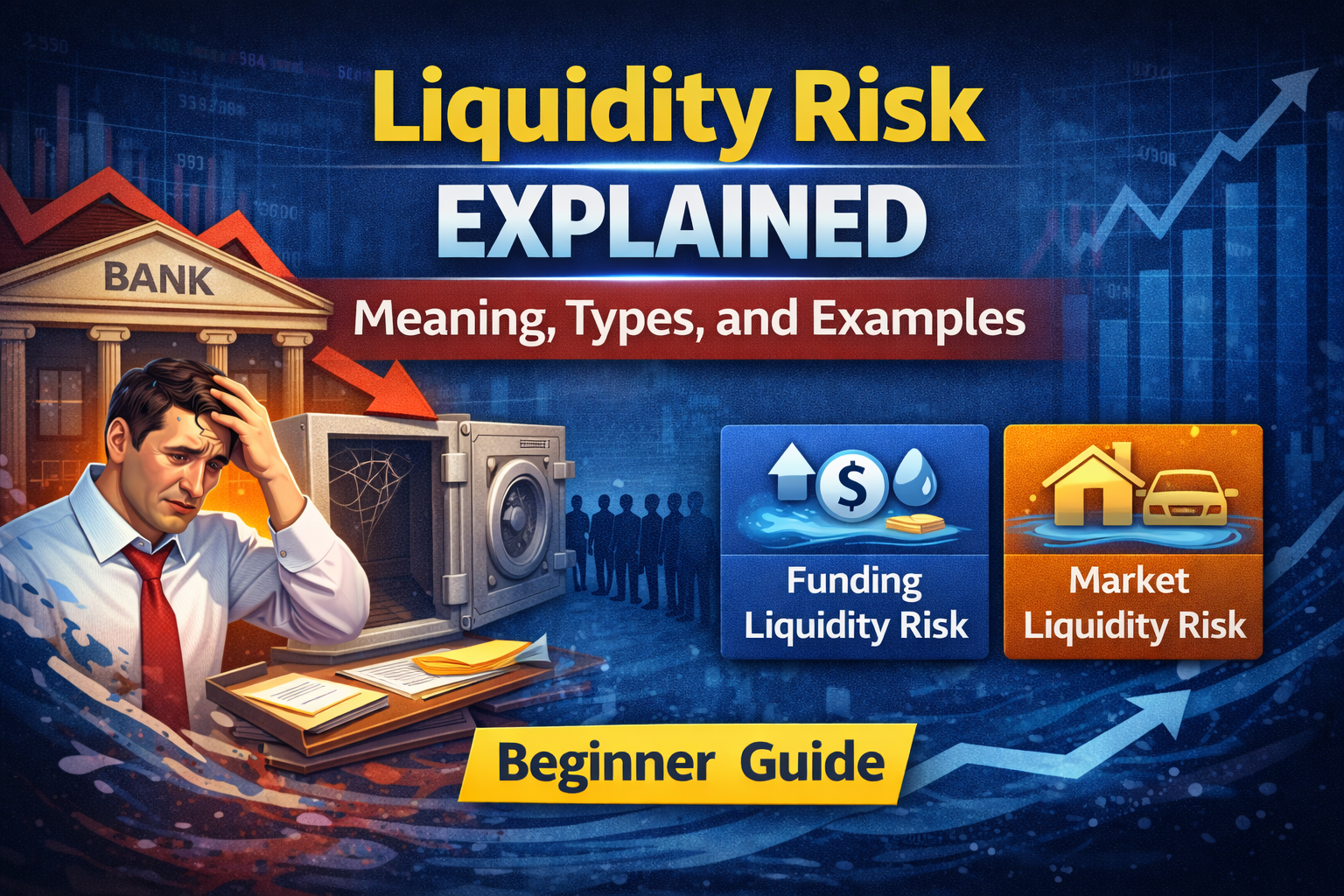
    Liquidity risk is broadly divided into two types.


    1 Funding Liquidity Risk

    This occurs when an institution cannot meet its financial obligations due to lack of funds.


    Example

    A bank cannot raise money to repay its depositors.

    This leads to funding liquidity risk.


    2 Market Liquidity Risk

    This occurs when an asset cannot be sold quickly without a significant price reduction.


    Example

    A company owns property worth 10 crore.

    But it cannot sell it quickly without reducing the price.

    This is market liquidity risk.


    Causes of Liquidity Risk

    Liquidity risk arises due to several factors.


    1 Mismatch Between Assets and Liabilities

    When long term assets are funded by short term liabilities, problems can arise.


    Example

    Banks give long term loans but accept short term deposits.

    If many depositors withdraw money at once, liquidity issues occur.


    2 Economic Crises

    During financial crises, access to funding becomes difficult.


    3 Loss of Confidence

    If people lose trust in an institution, they may withdraw funds rapidly.


    Example

    Bank runs occur when many customers withdraw money simultaneously.


    4 Illiquid Assets

    Assets that cannot be sold quickly increase liquidity risk.


    Real Life Example: Financial Crisis

    During the 2008 global financial crisis, many banks faced liquidity problems.

    They had assets like mortgage backed securities, but these could not be sold easily.

    At the same time, investors and customers demanded cash.

    This mismatch led to major financial collapses.


    How Liquidity Risk is Measured

    Financial institutions use various methods to measure liquidity risk.


    Liquidity Ratios

    These ratios assess the ability to meet short term obligations.


    Example


    Current ratio
    Liquid assets divided by current liabilities

    Liquidity Coverage Ratio (LCR)

    Used by banks to ensure they have enough liquid assets to survive short term stress.


    How to Manage Liquidity Risk

    Liquidity risk can be managed through proper planning and strategy.


    1 Maintaining Liquid Assets

    Keeping cash or easily sellable assets reduces risk.


    2 Asset Liability Management

    Balancing short term and long term obligations.


    3 Diversification of Funding Sources

    Relying on multiple funding sources reduces dependency risk.


    4 Stress Testing

    Preparing for worst case scenarios.


    Liquidity Risk vs Other Risks

    Many beginners confuse liquidity risk with other financial risks.


    Liquidity Risk

    Inability to meet short term obligations

    Market Risk

    Loss due to market fluctuations

    Credit Risk

    Loss due to borrower default


    Example

    Unable to pay bills → Liquidity risk
    Stock price falls → Market risk


    Who Faces Liquidity Risk

    Liquidity risk affects

    Banks
    Financial institutions
    Corporations
    Investors

    Even individuals can face liquidity risk.


    Example

    If you invest all your money in real estate and suddenly need cash, you may struggle to sell quickly.


    Common Mistakes People Make

    Investing all money in illiquid assets
    Ignoring emergency funds
    Not planning cash flows
    Over relying on a single income source


    Importance of Liquidity Risk in FRM

    Liquidity risk is a key topic in FRM certification.

    FRM teaches

    How to measure liquidity risk
    How to manage funding gaps
    How financial institutions prepare for crises

    Career roles include

    Risk analyst
    Treasury manager
    Banking professional


    Real Life Scenario

    Consider two companies.

    Company A manages its cash flow carefully and maintains reserves.

    Company B invests heavily in long term assets without liquidity planning.

    During a crisis, Company A survives while Company B struggles.

    The difference is liquidity management.


    Final Thoughts

    Liquidity risk is one of the most dangerous risks in finance because it can lead to sudden collapse even when everything seems stable.

    The key is not just earning profits but ensuring that cash is available when needed.

    By understanding liquidity risk and managing it effectively, individuals and institutions can protect themselves from unexpected financial stress.

    If you are building a career in finance or preparing for FRM, mastering liquidity risk is essential.
  • Credit Risk Explained: Meaning, Types and Real Life Examples

    Credit Risk Explained: Meaning, Types and Real Life Examples

    Whenever money is lent, there is always a possibility that it may not be repaid. This uncertainty is known as credit risk.

    Credit risk is one of the most important concepts in finance and forms the backbone of banking and lending systems. Whether it is a bank giving loans, an investor buying bonds, or a company extending credit to customers, credit risk is always present.

    In this guide, we will break down credit risk in a simple and practical way with real life examples, types, and insights.


    What is Credit Risk

    Credit risk is the risk that a borrower fails to repay a loan or meet their financial obligations.

    👉 In simple terms
    Credit risk is the risk of losing money because someone does not pay back what they owe


    Why Credit Risk is Important

    Credit risk is crucial because it directly impacts

    Banks and financial institutions
    Investors in bonds
    Businesses offering credit
    Overall financial stability

    Example

    If banks give loans without properly assessing credit risk, they may face large losses due to defaults. This can lead to financial crises.


    Real Life Example of Credit Risk

    Let us understand this with a simple example.

    A bank gives a loan of 10 lakh to a small business.

    Due to poor business performance, the company is unable to repay the loan.

    The bank loses a significant portion of the money.

    👉 This loss is caused by credit risk


    Where Credit Risk Exists

    Credit risk is present in many financial activities.

    Bank loans
    Corporate bonds
    Credit cards
    Trade credit between businesses

    Even when you use a credit card, the bank is exposed to credit risk.


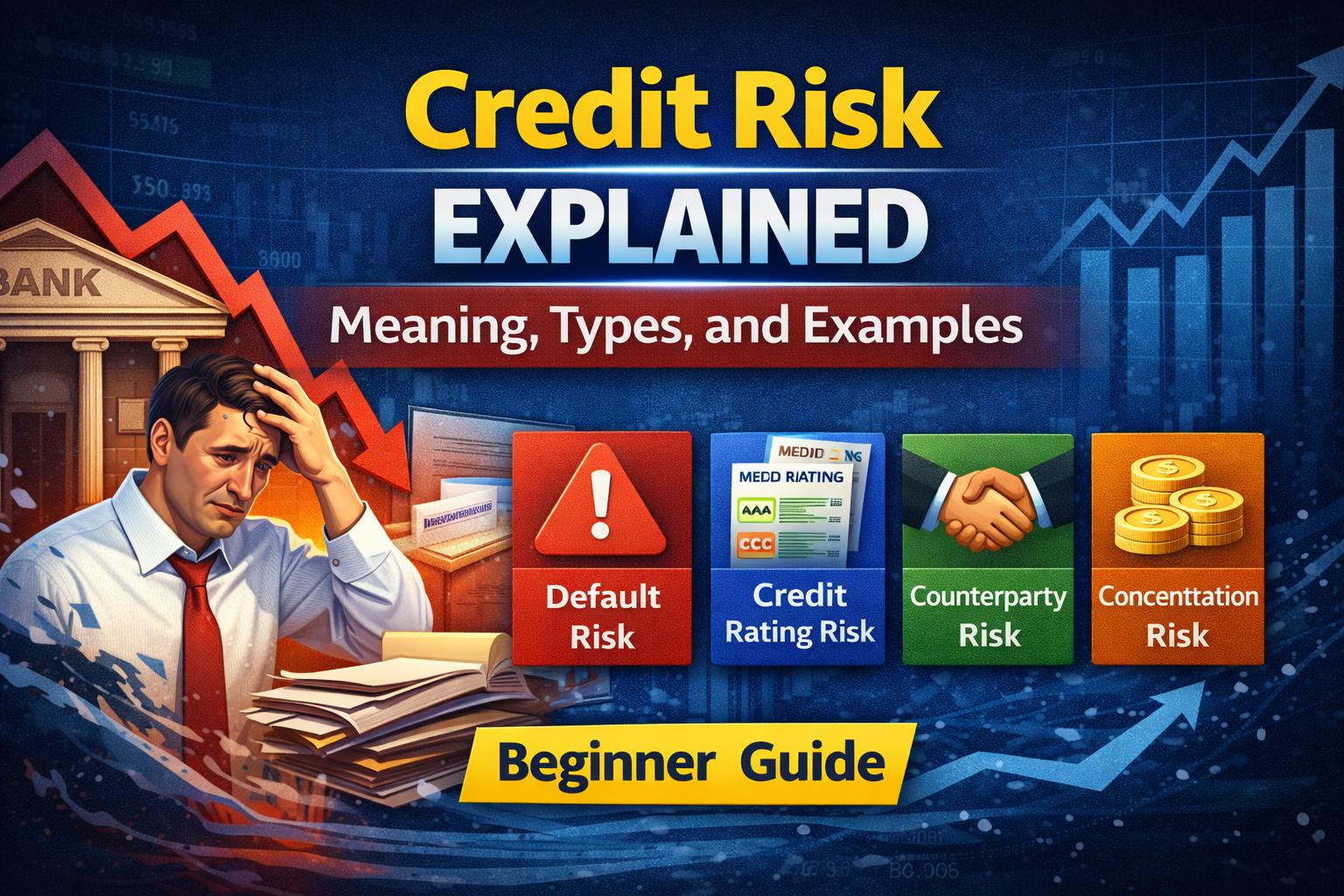
    Types of Credit Risk

    Credit risk is not just about default. It includes multiple forms of risk.


    1 Default Risk

    Default risk is the most basic type of credit risk.

    It occurs when a borrower completely fails to repay the loan.

    Example

    A borrower stops paying loan installments due to financial difficulties.


    2 Credit Rating Risk

    This risk arises when the creditworthiness of a borrower deteriorates.

    Even if the borrower does not default, their financial condition weakens.

    Example

    A company’s credit rating is downgraded from AAA to BBB.

    This increases risk and reduces the value of its bonds.


    3 Counterparty Risk

    This occurs in financial transactions where one party may fail to fulfill its obligation.

    It is common in derivatives and financial contracts.

    Example

    In a derivative contract, one party fails to make the required payment.


    4 Concentration Risk

    This occurs when too much exposure is given to a single borrower or sector.

    Example

    A bank lends a large portion of its funds to one industry.

    If that industry faces a downturn, the bank faces significant losses.


    Causes of Credit Risk

    Credit risk arises due to multiple factors.


    1 Poor Financial Health of Borrower

    If the borrower has weak financials, repayment becomes uncertain.


    2 Economic Conditions

    During economic downturns, businesses struggle and defaults increase.


    3 Lack of Proper Risk Assessment

    If lenders do not evaluate borrowers properly, risk increases.


    4 Over Lending

    Giving too much credit without proper checks increases exposure.


    How Banks Assess Credit Risk

    Banks use various methods to evaluate credit risk before giving loans.


    1 Credit Score

    Individuals are evaluated using credit scores.

    Higher score means lower risk.


    2 Financial Statement Analysis

    Companies are assessed based on

    Revenue
    Profitability
    Debt levels


    3 Collateral

    Banks often require assets as security.

    Example

    Home loans are secured by property.


    4 Credit Rating Agencies

    Agencies like Moody’s and S&P rate companies based on risk.


    How to Manage Credit Risk

    Credit risk cannot be eliminated but can be managed effectively.


    1 Diversification

    Lending to multiple borrowers reduces overall risk.


    2 Credit Analysis

    Proper evaluation before lending reduces default probability.


    3 Collateral Requirement

    Securing loans with assets reduces potential losses.


    4 Monitoring Borrowers

    Regularly tracking borrower performance helps detect early warning signs.


    Credit Risk vs Market Risk

    Many beginners confuse these two.


    Credit Risk

    Loss due to borrower default

    Market Risk

    Loss due to market fluctuations


    Example

    Loan not repaid → Credit risk
    Stock price falls → Market risk


    Real Life Scenario

    Consider two banks.

    Bank A gives loans without proper checks and faces high defaults.

    Bank B carefully evaluates borrowers and diversifies its loans.

    Bank B performs better because it manages credit risk effectively.


    Importance of Credit Risk in FRM

    Credit risk is a core subject in FRM certification.

    FRM teaches

    How to measure credit risk
    How to model default probability
    How to manage exposure

    Career roles include

    Credit analyst
    Risk analyst
    Banking professional


    Common Mistakes Beginners Make

    Assuming all borrowers will repay
    Ignoring credit ratings
    Overexposure to one borrower
    Not understanding risk properly


    Final Thoughts

    Credit risk is one of the most fundamental risks in finance. It directly affects banks, investors, and businesses.

    Understanding credit risk helps in making better financial decisions, whether you are lending money, investing in bonds, or working in finance.

    The key is not to avoid risk completely but to assess and manage it intelligently.

    If you are preparing for FRM or building a career in finance, mastering credit risk is essential.

  • Market Risk Explained: Meaning, Types and Real Life Examples

    Market Risk Explained: Meaning, Types and Real Life Examples

    Financial markets are dynamic. Prices change every second, influenced by economic events, investor sentiment, and global developments. While these movements create opportunities for profit, they also introduce uncertainty.

    This uncertainty is known as market risk.

    Whether you are an investor, a finance student, or preparing for certifications like FRM, understanding market risk is essential.

    In this guide, we will break down market risk in a simple, practical, and detailed way with real life examples.


    What is Market Risk

    Market risk is the risk of financial loss due to changes in market variables such as

    Stock prices
    Interest rates
    Currency exchange rates
    Commodity prices

    👉 In simple terms
    Market risk is the risk that your investments lose value because the market moves against you


    Why Market Risk is Important

    Market risk affects almost everyone in finance.

    Individual investors
    Banks
    Mutual funds
    Investment firms
    Corporations

    Even if you invest through mutual funds, you are still exposed to market risk.

    Example

    If the overall stock market falls, most mutual funds will also decline, even if they are well managed.

    This shows that market risk is unavoidable.


    Real Life Example of Market Risk

    Let us understand this with a simple scenario.

    Amit invests 1 lakh in the stock market.

    After a few months, due to inflation concerns and rising interest rates, the market falls.

    His investment value becomes 80000.

    Loss = 20000

    This loss is not due to poor stock selection. It is due to overall market conditions.

    👉 This is market risk


    Causes of Market Risk

    Market risk exists because financial markets are influenced by multiple factors.


    1 Economic Changes

    Changes in GDP growth, inflation, and unemployment affect markets.

    Example

    High inflation can reduce purchasing power and negatively impact stock prices.


    2 Interest Rate Changes

    Central banks control interest rates, which impact both stock and bond markets.

    Example

    When interest rates rise, borrowing becomes expensive, and stock markets may fall.


    3 Political Events

    Elections, policy changes, and geopolitical tensions can create uncertainty.


    4 Global Events

    Events like pandemics, wars, or financial crises impact global markets.

    Example

    During COVID 19, stock markets across the world crashed sharply.


    Types of Market Risk

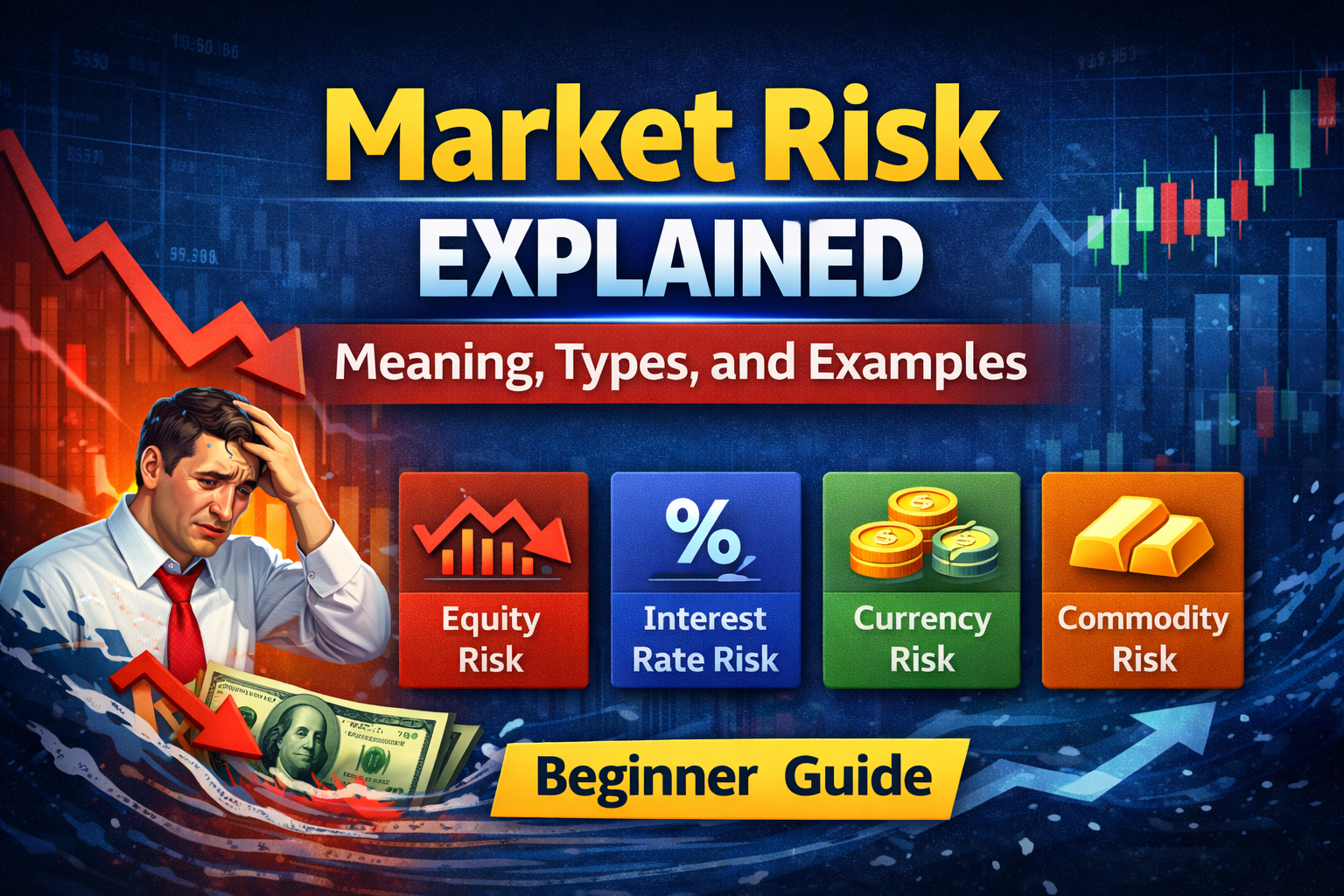
    Market risk is not a single type of risk. It is divided into several categories.


    1 Equity Risk

    Equity risk refers to the risk of loss due to changes in stock prices.

    Example

    If you invest in shares of a company and its stock price falls due to poor performance or market conditions, you face equity risk.


    2 Interest Rate Risk

    This risk mainly affects bonds and fixed income investments.

    When interest rates rise, bond prices fall.

    Example

    You buy a bond paying 6 percent interest.

    Later, new bonds offer 8 percent.

    Your bond becomes less attractive, and its value decreases.


    3 Currency Risk

    Currency risk occurs when exchange rates fluctuate.

    This is important for investors dealing with international investments.

    Example

    An Indian investor invests in US stocks.

    If the dollar weakens against the rupee, returns decrease even if stock prices rise.


    4 Commodity Risk

    This risk arises from changes in commodity prices like gold, oil, or agricultural products.

    Example

    If oil prices fall, companies dependent on oil revenues may suffer losses.


    How Market Risk is Measured

    Financial institutions use various tools to measure market risk.


    Value at Risk (VaR)

    Value at Risk estimates the potential loss in an investment over a specific period.

    Example

    A portfolio may have a VaR of 1 lakh.

    This means there is a certain probability that losses could reach this level under normal conditions.


    Stress Testing

    Stress testing evaluates how investments perform under extreme scenarios.

    Example

    What happens if markets crash by 30 percent
    What happens if interest rates rise sharply


    How to Manage Market Risk

    Market risk cannot be completely eliminated, but it can be managed effectively.


    1 Diversification

    Investing in different assets reduces overall risk.

    Example

    Instead of investing only in stocks, you can invest in

    Bonds
    Gold
    Mutual funds


    2 Hedging

    Using financial instruments like derivatives to reduce risk.

    Example

    An investor can use options or futures to protect against price declines.


    3 Asset Allocation

    Allocating investments based on risk tolerance.

    Young investors may take higher risk
    Conservative investors prefer safer assets


    4 Long Term Investing

    Short term market movements are unpredictable.

    Long term investing reduces the impact of volatility.


    Market Risk vs Other Financial Risks

    Many beginners confuse market risk with other risks.


    Market Risk

    Loss due to market fluctuations

    Credit Risk

    Loss due to borrower default

    Liquidity Risk

    Inability to convert assets into cash

    Operational Risk

    Loss due to internal failures


    Example

    Stock market crash → Market risk
    Loan not repaid → Credit risk


    Who Faces Market Risk

    Market risk affects

    Retail investors
    Institutional investors
    Banks
    Corporations

    Even companies face market risk when

    Currency values change
    Interest rates fluctuate
    Commodity prices vary


    Common Mistakes Beginners Make

    Ignoring risk while investing
    Investing based on emotions
    Lack of diversification
    Trying to predict market timing


    Example

    Many beginners panic during market downturns and sell investments at a loss.

    This increases losses instead of reducing risk.


    Importance of Market Risk in FRM

    Market risk is a core concept in FRM certification.

    FRM focuses on

    Understanding market behavior
    Measuring risk
    Managing risk using models

    Roles related to market risk include

    Market risk analyst
    Portfolio manager
    Investment analyst


    Real Life Scenario

    Consider a mutual fund manager.

    If markets fall, the fund value decreases.

    The manager cannot avoid market risk but can reduce it through diversification and strategy.


    Final Thoughts

    Market risk is an unavoidable part of investing and finance. Every investor faces it, regardless of experience.

    The key is not to avoid risk but to understand and manage it effectively.

    By learning about different types of market risk and using strategies like diversification and long term investing, you can make smarter financial decisions.

    If you are building a career in finance or preparing for FRM, mastering market risk is a crucial part

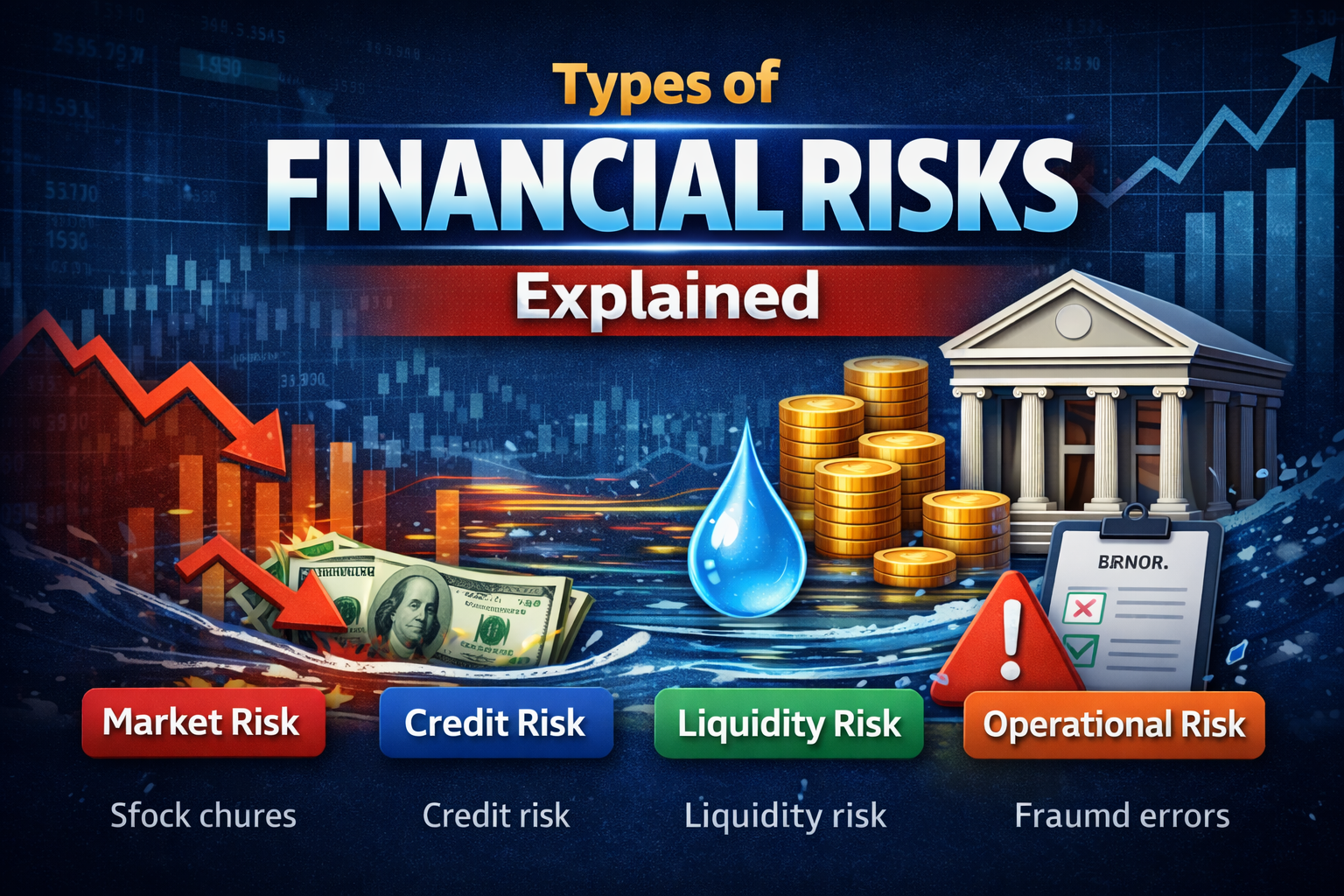
  • Types of Financial Risks Explained: Market, Credit, Liquidity and Operational Risk

    Types of Financial Risks Explained: Market, Credit, Liquidity and Operational Risk

    Finance is not just about earning returns. It is also about managing risks.

    Every financial decision, whether taken by an individual, a bank, or a large corporation, involves some level of uncertainty. This uncertainty is known as financial risk.

    Understanding financial risks is essential not only for investors but also for anyone pursuing a career in finance or certifications like FRM.

    In this complete guide, we will break down the major types of financial risks with simple explanations and real life examples.


    What is Financial Risk

    Financial risk refers to the possibility of losing money due to various factors such as market changes, borrower defaults, or operational failures.

    In simple terms

    👉 Financial risk is the chance that your financial decisions may lead to losses instead of profits


    Why Financial Risk Matters

    Financial risk is important because it directly impacts

    Investment returns
    Business profitability
    Banking stability
    Economic growth

    Example

    If banks fail to manage risk properly, it can lead to financial crises like the 2008 global financial crisis.

    This shows how critical risk management is in finance.


    Types of Financial Risks

    Financial risk is broadly divided into four major types

    Market risk
    Credit risk
    Liquidity risk
    Operational risk

    Let us understand each of them in detail.


    1 Market Risk

    Market risk arises due to changes in market conditions such as stock prices, interest rates, and currency values.


    Example

    An investor buys shares worth 1 lakh.

    Due to market downturn, the value falls to 80000.

    Loss = 20000

    This loss is caused by market movements, not by poor decision making.


    Types of Market Risk

    Equity risk
    Interest rate risk
    Currency risk
    Commodity risk


    Where It Occurs

    Stock markets
    Bond markets
    Foreign exchange markets


    2 Credit Risk

    Credit risk is the risk that a borrower will fail to repay a loan or meet financial obligations.


    Example

    A bank gives a loan to a company.

    If the company fails to repay, the bank faces loss.

    This is credit risk.


    Types of Credit Risk

    Default risk
    Credit rating risk
    Counterparty risk


    Where It Occurs

    Bank lending
    Corporate bonds
    Credit cards


    3 Liquidity Risk

    Liquidity risk arises when a person or institution is unable to meet short term financial obligations due to lack of cash.


    Example

    A bank has invested heavily in long term assets but does not have enough cash to meet withdrawal requests.

    This leads to liquidity problems.


    Types of Liquidity Risk

    Funding liquidity risk
    Market liquidity risk


    Real Life Example

    During financial crises, banks may struggle to convert assets into cash quickly, leading to liquidity shortages.


    4 Operational Risk

    Operational risk arises due to failures in internal processes, systems, or human errors.


    Example

    A bank employee commits fraud or a system failure leads to financial loss.

    This is operational risk.


    Causes of Operational Risk

    Fraud
    System failures
    Human errors
    Process inefficiencies


    Comparison of Financial Risks

    Risk TypeCauseExample
    Market RiskMarket fluctuationsStock price falls
    Credit RiskBorrower defaultLoan not repaid
    Liquidity RiskLack of cashBank cannot meet withdrawals
    Operational RiskInternal failuresFraud or system error

    How Financial Institutions Manage Risk

    Banks and financial institutions use structured processes to manage risks.


    1 Risk Identification

    Understanding what risks exist


    2 Risk Measurement

    Using tools like

    Value at Risk
    Stress testing


    3 Risk Control

    Reducing exposure through strategies like

    Diversification
    Hedging


    4 Risk Monitoring

    Continuously tracking risk levels


    Real Life Example of Combined Risk

    Consider a bank during an economic downturn.

    Borrowers fail to repay loans → Credit risk
    Stock markets fall → Market risk
    Customers withdraw money → Liquidity risk
    Internal systems fail due to pressure → Operational risk

    All risks can occur simultaneously.


    Importance of Financial Risk in FRM

    Understanding financial risks is the foundation of FRM certification.

    FRM focuses on

    Measuring risk
    Managing risk
    Applying risk models

    This knowledge is essential for careers such as

    Risk analyst
    Credit analyst
    Investment risk manager


    Common Mistakes People Make

    Ignoring risk while investing
    Overconfidence in market predictions
    Lack of diversification
    Not understanding different risk types

    Understanding financial risks helps avoid these mistakes.


    Final Thoughts

    Financial risk is an unavoidable part of finance. Whether you are investing, lending, or running a business, risk is always present.

    The key is not to avoid risk completely but to understand, measure, and manage it effectively.

    By learning about different types of financial risks, you can make better financial decisions and build a strong foundation for a successful career in finance.

  • Module 1: Introduction to CFA Level 2 and Exam Strategy

    CFA Level 2 represents a significant shift from Level 1. While Level 1 focuses on understanding concepts, Level 2 emphasizes application, analysis, and valuation. Candidates are expected to apply financial concepts to real world scenarios, interpret data, and make investment decisions.

    Success in Level 2 requires not just knowledge, but the ability to analyze case studies, connect multiple concepts, and solve problems efficiently under time pressure.

    This module helps students understand the exam structure and develop the right strategy to approach Level 2 effectively.


    1.1 Exam Format

    The CFA Level 2 exam follows a vignette based format, also known as item sets.

    Instead of standalone questions, candidates are presented with a case study followed by multiple questions related to that case.


    Item Set Based Questions

    Each item set consists of:

    • A vignette or case study
    • A set of multiple choice questions linked to the vignette

    The vignette may include:

    • financial statements
    • charts and tables
    • economic data
    • company specific information

    Candidates must carefully read the vignette and use the information to answer all related questions.


    Case Study Approach

    Unlike Level 1, where questions are independent, Level 2 requires understanding the full context of a case.

    A single vignette may test multiple concepts such as:

    • financial statement analysis
    • valuation techniques
    • risk assessment

    This means students must:

    • interpret large amounts of information
    • identify relevant data quickly
    • apply appropriate concepts

    Multiple Questions per Vignette

    Each vignette is followed by several questions, typically 4 to 6.

    All questions are interconnected and based on the same scenario.

    Important points:

    • A mistake in understanding the vignette can affect multiple questions
    • Efficient reading and comprehension are critical
    • Time management becomes more important

    1.2 Study Strategy

    Preparing for CFA Level 2 requires a different approach compared to Level 1.

    The focus shifts from memorization to application and problem solving.


    Focus on Application

    At Level 2, simply knowing definitions is not enough.

    Students must be able to:

    • apply formulas in real scenarios
    • interpret financial data
    • analyze case studies

    Understanding concepts deeply is more important than memorizing them.


    Practice Case Based Questions

    The most effective way to prepare is through practice.

    Students should regularly solve:

    • vignette based questions
    • case studies
    • real exam style problems

    This helps in:

    • improving analytical skills
    • understanding exam patterns
    • building confidence

    Time Management

    Time management is one of the biggest challenges in Level 2.

    Each vignette requires careful reading, which can consume time.

    Effective strategies include:

    • allocating a fixed time per vignette
    • avoiding spending too long on difficult questions
    • practicing under timed conditions

    Regular mock exams help improve speed and accuracy.


    1.3 Calculator and Tools

    The financial calculator remains an important tool in Level 2, but its usage becomes more advanced.

    Students must be comfortable performing calculations quickly and accurately.


    Advanced Calculator Usage

    Students should be proficient in:

    • time value of money calculations
    • bond valuation
    • cash flow analysis
    • statistical calculations

    Speed is important because lengthy calculations can reduce time available for other questions.


    Efficient Problem Solving Techniques

    To perform well in Level 2, students should develop efficient problem solving methods.

    These include:

    Breaking Down Questions
    Understand what is being asked before starting calculations.

    Identifying Key Information
    Focus only on relevant data from the vignette.

    Using Shortcuts
    Apply calculator shortcuts and estimation techniques where possible.

    Avoiding Calculation Errors
    Double check inputs to avoid mistakes.


    Key Differences in Approach

    Level 1 Approach
    Focus on understanding and memorization

    Level 2 Approach
    Focus on application, analysis, and valuation


    Importance of This Module

    This module sets the foundation for success in CFA Level 2.

    By understanding the exam format and adopting the right strategy, students can:

    • approach case based questions with confidence
    • manage time effectively
    • improve accuracy and performance

    A strong strategy combined with consistent practice is the key to clearing CFA Level 2.

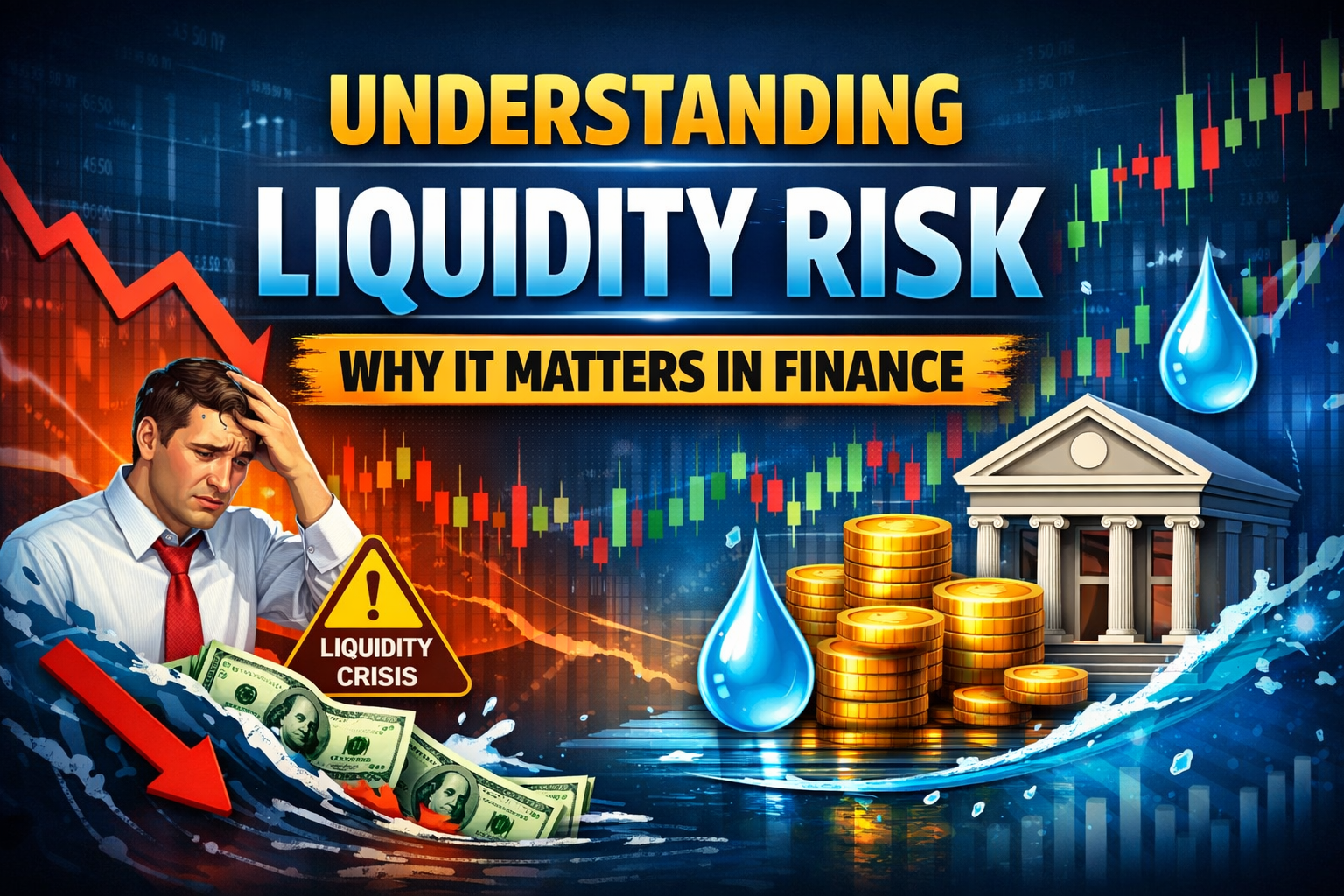
  • Understanding Liquidity Risk and Why It Matters in Finance

    Understanding Liquidity Risk and Why It Matters in Finance

    1) INTRODUCTION

    Liquidity risk refers to the possibility that an individual, company, or financial institution may not be able to meet its short term financial obligations without significant losses. This risk arises when assets cannot be quickly converted into cash at a fair price.

    Liquidity is essential in finance because businesses, banks, and investors frequently need cash to meet obligations such as loan repayments, operational expenses, or margin requirements. When liquidity is insufficient or markets become illiquid, even financially healthy organizations may face serious financial stress.

    Understanding liquidity risk helps institutions maintain adequate cash resources and manage the timing of cash inflows and outflows.


    2) KEY TAKEAWAYS

    • Liquidity risk is the risk of being unable to convert assets into cash quickly without major loss.
    • It can arise when cash is needed urgently but assets cannot be sold easily.
    • Liquidity risk affects banks, companies, and investment portfolios.
    • Financial institutions manage this risk by maintaining cash reserves and liquid assets.
    • Liquidity risk can worsen during financial crises or market stress.

    3) CORE EXPLANATION

    Definition

    Liquidity risk is the risk that an entity cannot meet its financial obligations when they become due because it cannot obtain cash quickly enough.

    Even if an organization owns valuable assets, problems can arise if those assets cannot be sold quickly or without large price discounts.

    Liquidity risk typically appears in two forms:

    • difficulty selling assets
    • difficulty obtaining funding

    Both situations can prevent an organization from accessing cash when it is needed.


    How Liquidity Risk Works

    Liquidity risk emerges when there is a mismatch between cash inflows and cash outflows.

    For example, a company may expect payments from customers in several months but must pay suppliers or lenders sooner. If the company cannot raise cash quickly, it may struggle to meet those obligations.

    Liquidity risk can arise due to several factors:

    Limited Market Buyers

    Some assets have fewer buyers, which makes selling them quickly more difficult.

    Market Stress

    During financial uncertainty, investors may avoid purchasing risky assets. This reduces market liquidity and increases price volatility.

    Funding Constraints

    Banks or lenders may reduce lending during economic downturns, limiting access to short term funding.


    Types of Liquidity Risk

    Funding Liquidity Risk

    Funding liquidity risk occurs when a company or financial institution cannot obtain cash to meet immediate obligations.

    This may happen if lenders withdraw credit lines or refuse to provide new financing.

    Market Liquidity Risk

    Market liquidity risk occurs when an asset cannot be sold quickly without significantly lowering its price.

    Assets that trade frequently in large markets usually have high liquidity, while specialized or complex assets may have lower liquidity.


    4) NUMERICAL OR REAL-WORLD EXAMPLE

    Consider a small investment firm that owns several assets.

    Assets held by the firm:

    • Government bonds worth $50,000
    • Real estate investment worth $100,000

    The firm suddenly needs $40,000 in cash to meet an obligation.

    Government bonds can usually be sold quickly in active markets. The firm sells bonds and receives close to their market value, solving the problem.

    However, imagine the firm only owns the real estate asset.

    Selling property may take months. If the firm urgently needs cash, it may have to sell the property quickly at a discounted price, for example $80,000 instead of $100,000.

    The loss caused by selling an asset quickly illustrates liquidity risk.


    5) WHY THIS MATTERS

    Liquidity risk has significant implications for financial stability.

    For Banks

    Banks must ensure they have enough liquid assets to meet withdrawal requests from customers.

    For Companies

    Companies need sufficient liquidity to pay suppliers, employees, and lenders.

    For Investors

    Investors may struggle to sell certain securities quickly during market stress.

    For Financial Stability

    Liquidity problems in large institutions can spread through financial systems and contribute to broader economic crises.


    6) COMMON MISCONCEPTIONS

    1. Liquidity Risk Only Affects Banks

    While banks are heavily exposed, companies and investors can also face liquidity risk.

    2. Valuable Assets Always Provide Liquidity

    Some assets may have high value but still be difficult to sell quickly.

    3. Liquidity Risk and Solvency Are the Same

    Solvency refers to long term financial health, while liquidity focuses on short term cash availability.

    4. Liquid Assets Never Lose Value

    Even liquid assets may lose value during periods of market stress.

    5. Liquidity Risk Only Appears During Crises

    Liquidity risk can arise at any time if cash flow timing is poorly managed.


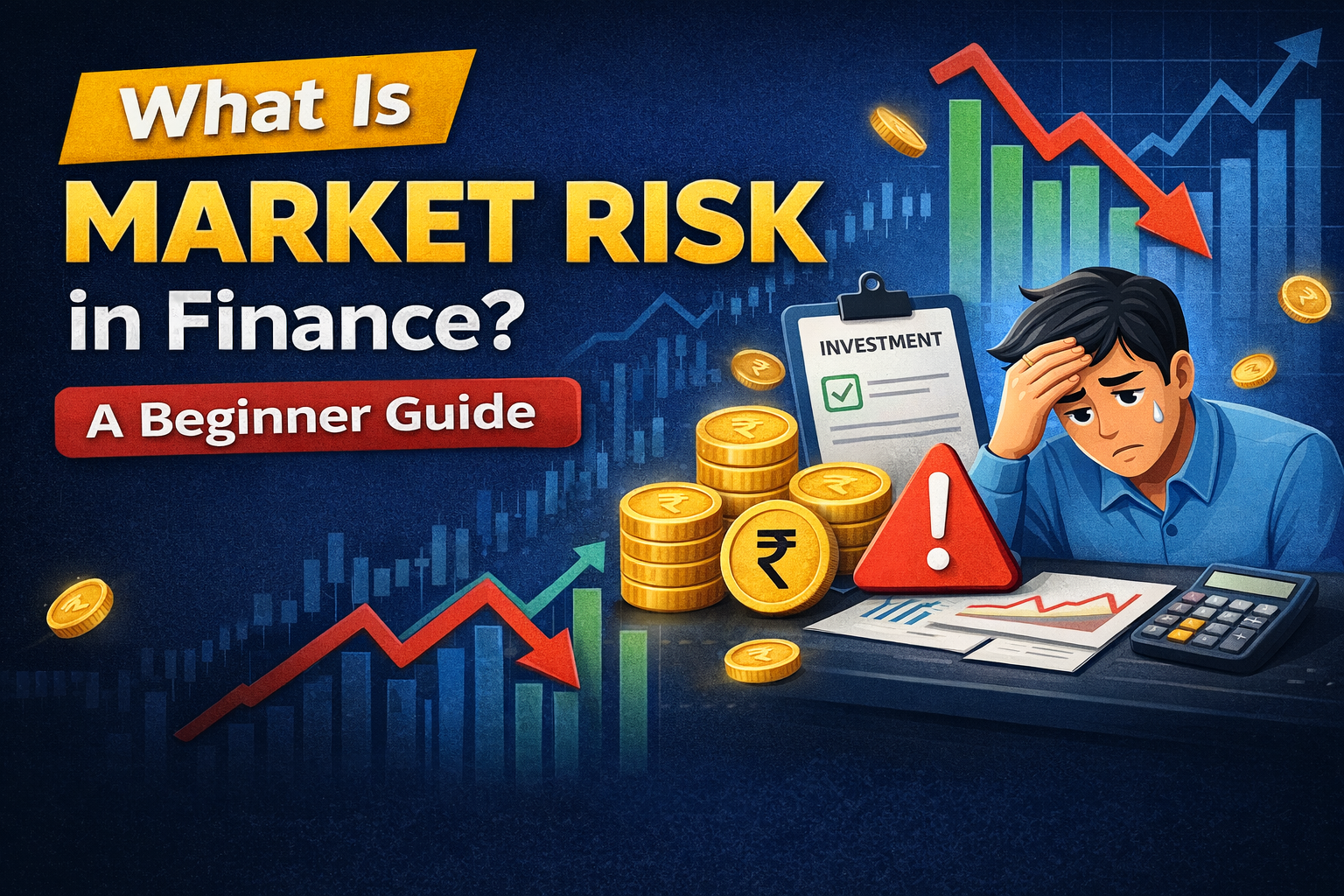
  • What Is Market Risk in Finance A Beginner Guide

    What Is Market Risk in Finance A Beginner Guide

    1) INTRODUCTION

    Market risk refers to the possibility that the value of an investment will decline due to changes in overall market conditions. These changes may include movements in interest rates, stock prices, currency exchange rates, or commodity prices.

    In financial markets, prices constantly fluctuate as economic conditions, investor expectations, and global events change. Because these movements are uncertain, investors and financial institutions face the risk that the market value of their assets may decrease. Understanding market risk helps organizations manage potential losses and make more informed investment decisions.


    2) KEY TAKEAWAYS

    • Market risk is the risk of losses caused by changes in financial market prices.
    • It affects assets such as stocks, bonds, currencies, and commodities.
    • Market risk arises from factors like interest rate changes, economic conditions, and geopolitical events.
    • Unlike credit risk, market risk comes from broad market movements rather than borrower default.
    • Financial institutions measure and manage market risk using tools such as diversification, hedging, and risk models.

    3) CORE EXPLANATION

    Definition

    Market risk is the risk that an investment’s value will decline due to movements in market prices or rates.

    This type of risk affects portfolios that contain financial assets whose values fluctuate with market conditions. It is also called systematic risk, meaning it impacts many assets across the financial system rather than a single borrower or company.

    Examples of assets exposed to market risk include:

    • Stocks
    • Bonds
    • Foreign currencies
    • Commodities
    • Derivatives

    Because market conditions influence all participants, market risk cannot be eliminated entirely.


    How Market Risk Works

    Market prices respond to various economic and financial factors. When these factors change, asset values also change.

    Several drivers commonly influence market risk:

    Interest Rate Changes

    Interest rate movements can affect the prices of many financial instruments, particularly bonds. When interest rates rise, existing bond prices generally fall.

    Equity Market Movements

    Stock prices fluctuate based on company performance, economic growth expectations, and investor sentiment.

    Currency Exchange Rate Changes

    Companies and investors dealing with foreign currencies face the risk that exchange rates may move unfavorably.

    Commodity Price Changes

    Prices of commodities such as oil, metals, or agricultural products can vary due to supply conditions, demand changes, and global economic factors.

    Because these factors affect many participants simultaneously, market risk is considered system-wide risk.


    Types of Market Risk

    Equity Risk

    The risk that stock prices decline, affecting investors holding shares or equity-based investments.

    Interest Rate Risk

    The risk that changes in interest rates affect the value of financial instruments, particularly bonds and fixed-income securities.

    Currency Risk (Foreign Exchange Risk)

    The risk that exchange rate fluctuations impact the value of investments or international transactions.

    Commodity Risk

    The risk that commodity prices move unexpectedly, affecting companies or investors exposed to those commodities.


    4) NUMERICAL OR REAL-WORLD EXAMPLE

    Suppose an investor purchases shares of a company.

    • Investment amount: $5,000
    • Share price at purchase: $50
    • Number of shares purchased: 100

    If the market experiences a downturn and the share price falls to $40, the value of the investment becomes:

    100 shares × $40 = $4,000

    The investor experiences a $1,000 loss due to a decline in market prices.

    Importantly, the loss did not occur because the company defaulted or failed to repay a loan. Instead, it happened because market conditions caused the share price to fall, illustrating market risk.


    5) WHY THIS MATTERS

    Market risk plays a significant role in financial decision-making.

    Investment Management

    Portfolio managers must consider market risk when allocating assets and building diversified portfolios.

    Banking and Financial Institutions

    Banks hold large trading portfolios. Managing market risk helps prevent substantial losses caused by sudden price movements.

    Corporate Finance

    Companies with international operations or commodity exposure must manage fluctuations in currencies and raw material prices.

    Financial Careers

    Market risk analysis is important in fields such as:

    • Risk management
    • Investment analysis
    • Trading and portfolio management
    • Financial regulation

    Professionals working in market risk evaluate potential market movements and monitor portfolio exposure.


    6) COMMON MISCONCEPTIONS

    1. Market Risk Only Affects Stock Investors

    Market risk affects many assets, including bonds, currencies, commodities, and derivatives.

    2. Diversification Removes Market Risk Completely

    Diversification reduces exposure to individual assets but cannot eliminate broad market movements.

    3. Market Risk Means Certain Losses

    Market risk represents uncertainty, not guaranteed loss. Prices may move up or down.

    4. Market Risk Is the Same as Credit Risk

    Credit risk relates to borrower default, while market risk results from price changes in financial markets.

    5. Only Large Institutions Face Market Risk

    Individual investors also face market risk whenever they invest in financial markets.


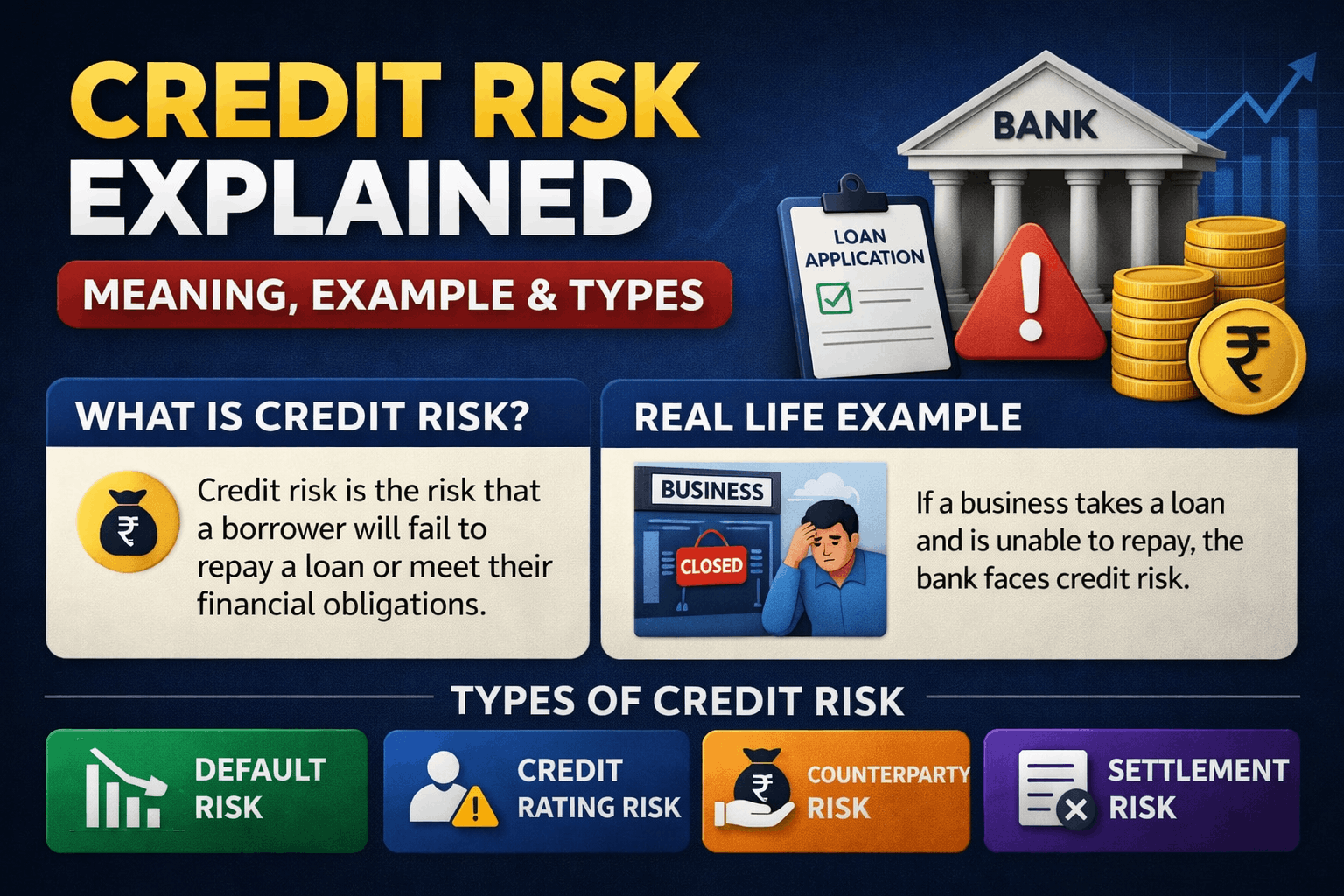
  • Credit Risk Explained Meaning Example and Types

    Credit Risk Explained Meaning Example and Types

    1) INTRODUCTION

    Credit risk is the possibility that a borrower will fail to repay a loan or meet their financial obligations. In simple terms, it is the risk that money lent may not be fully returned.

    This concept exists because lending is a core activity in finance. Banks, financial institutions, companies, and even individuals regularly lend money through loans, bonds, credit cards, and trade credit. Since borrowers may face financial difficulties or default entirely, lenders must understand and manage credit risk to protect their capital.

    Credit risk management helps financial institutions decide who to lend to, how much to lend, and what interest rate to charge.


    2) KEY TAKEAWAYS

    • Credit risk is the risk that a borrower cannot repay borrowed money.
    • It arises in loans, bonds, credit cards, and trade credit between businesses.
    • Financial institutions assess credit risk using tools like credit scores, financial analysis, and collateral.
    • Higher credit risk often leads to higher interest rates or stricter lending conditions.
    • Managing credit risk is essential for bank stability and financial system health.

    3) CORE EXPLANATION

    Definition

    Credit risk refers to the possibility that a borrower will fail to meet debt obligations according to agreed terms. This failure is called default.

    If default occurs, the lender may experience:

    • Partial loss of money
    • Delayed payments
    • Legal recovery costs
    • Complete loss of the loan amount

    Credit risk exists in many financial products such as:

    • Bank loans
    • Corporate bonds
    • Credit cards
    • Mortgages
    • Trade credit between businesses

    Financial institutions use risk assessment methods to estimate the likelihood of default before lending money.


    How Credit Risk Works

    When a lender evaluates a borrower, they try to answer three key questions:

    1. Will the borrower repay the loan?
    2. What is the probability of default?
    3. How much could be lost if default happens?

    To answer these questions, lenders examine several factors:

    1. Creditworthiness

    Borrowers are evaluated based on:

    • Income stability
    • Debt levels
    • repayment history
    • financial statements (for companies)

    Individuals often have credit scores, while companies are assessed using financial ratios and credit ratings.

    2. Interest Rate Adjustment

    Higher-risk borrowers usually face higher interest rates. This compensates lenders for taking additional risk.

    3. Collateral

    Some loans require assets as security. If the borrower fails to repay, the lender can seize the collateral.

    Examples include:

    • Mortgages (house as collateral)
    • Auto loans (vehicle as collateral)

    4. Monitoring

    Even after lending, financial institutions continuously monitor borrowers to detect signs of financial distress.


    Types of Credit Risk

    Default Risk

    The risk that a borrower fails to repay the loan entirely or misses scheduled payments.

    Counterparty Risk

    Occurs when one party in a financial contract (such as derivatives or trading agreements) fails to meet obligations.

    Concentration Risk

    This arises when a lender has too much exposure to a single borrower, sector, or region. If that sector performs poorly, many loans may default simultaneously.

    Sovereign Risk

    The risk that a government may default on its debt obligations, affecting bondholders and lenders.


    4) NUMERICAL OR REAL-WORLD EXAMPLE

    Imagine a bank lending money to two individuals.

    Borrower A

    • Loan amount: $10,000
    • Stable job and strong credit history

    Borrower B

    • Loan amount: $10,000
    • Irregular income and previous missed payments

    The bank estimates:

    • Borrower A default probability: 2%
    • Borrower B default probability: 12%

    To compensate for higher risk, the bank may:

    • Offer Borrower A a lower interest rate
    • Charge Borrower B a higher interest rate

    If Borrower B defaults and cannot repay the loan, the bank may recover only part of the amount through legal action or collateral. The unrecovered portion becomes a credit loss.

    This example shows how lenders adjust decisions based on credit risk levels.


    5) WHY THIS MATTERS

    Credit risk plays an important role across the financial system.

    For Banks

    Banks lend large amounts of money. Poor credit risk management can lead to large losses and financial instability.

    For Companies

    Companies extend trade credit to customers. Evaluating credit risk helps avoid unpaid invoices.

    For Investors

    Investors buying corporate or government bonds must assess whether the issuer can repay the debt.

    For Careers in Finance

    Credit risk is a key field in:

    • Banking
    • Risk management
    • Credit analysis
    • Financial regulation
    • Investment management

    Professionals working in credit risk analyze borrower data, assess financial health, and build risk models.


    6) COMMON MISCONCEPTIONS

    1. Credit Risk Only Exists in Banks

    Credit risk occurs in many places, including corporate lending, bond investing, and supplier credit agreements.

    2. High Interest Rates Always Mean High Profit

    Higher rates compensate for risk, but if default occurs, the lender may still lose money.

    3. Collateral Eliminates Credit Risk

    Collateral reduces potential loss but does not remove the risk completely. Asset values may fall or recovery may be difficult.

    4. Credit Scores Tell the Full Story

    Credit scores are useful indicators but lenders also evaluate income stability, debt levels, and financial statements.

    5. Only Small Borrowers Default

    Large corporations and even governments can default on debt obligations.


  • Career Opportunities After FRM and Salary Insights

    Career Opportunities After FRM and Salary Insights

    One of the biggest reasons students pursue FRM is career growth. But many still ask

    👉 What jobs will I actually get after FRM
    👉 Is FRM worth it in terms of salary

    The truth is, FRM is one of the most career focused certifications in finance, especially if you are targeting roles in banking, risk, and analytics.

    In this guide, we will break down real career opportunities, roles, companies, and salary expectations after FRM.


    Why FRM Professionals Are in Demand

    Every financial institution deals with risk.

    Banks face loan defaults
    Investment firms face market volatility
    Companies face operational and liquidity risks

    This creates a strong demand for professionals who can

    Identify risks
    Measure risks
    Reduce financial losses

    FRM certification directly prepares you for these roles.


    Top Career Opportunities After FRM

    FRM opens doors to several high demand roles in finance.


    1 Risk Analyst

    This is one of the most common roles after FRM.

    Responsibilities include

    Analyzing financial risks
    Monitoring market conditions
    Preparing risk reports

    Example

    A risk analyst in a bank evaluates whether lending to a company is safe or risky.


    2 Credit Analyst

    Credit analysts focus on evaluating borrowers.

    They assess

    Creditworthiness
    Financial statements
    Default probability

    Example

    Before giving a loan, banks rely on credit analysts to assess whether the borrower can repay.


    3 Market Risk Analyst

    This role focuses on risks arising from market movements.

    You analyze

    Stock price fluctuations
    Interest rate changes
    Currency risks

    Example

    An investment firm may lose money due to sudden market drops. A market risk analyst helps minimize such losses.


    4 Operational Risk Manager

    This role deals with internal risks.

    Examples include

    Fraud
    System failures
    Process inefficiencies

    FRM helps understand how to manage such risks.


    5 Investment Risk Analyst

    This role combines investment and risk management.

    You analyze

    Portfolio risk
    Asset allocation
    Investment strategies


    Industries Hiring FRM Professionals

    FRM professionals are not limited to banks.

    They are hired across multiple industries.

    Investment banks
    Commercial banks
    Consulting firms
    Asset management companies
    Fintech companies


    Top Companies Hiring FRM Professionals

    Some of the major recruiters include

    JP Morgan
    Goldman Sachs
    Morgan Stanley
    Deloitte
    KPMG
    EY
    HSBC
    ICICI Bank
    HDFC Bank

    These firms value FRM because it aligns with real industry requirements.


    Salary After FRM

    Salary depends on experience, role, and location.


    India Salary Range

    Entry level
    6 to 12 lakh per year

    Mid level
    12 to 25 lakh per year

    Senior level
    25 lakh and above


    Global Salary

    In countries like the US, UK, and Singapore, FRM professionals earn significantly higher salaries.


    Real Life Salary Example

    Let us compare two candidates.

    Rahul completes graduation without specialization and starts with a 3 to 4 lakh salary.

    Aman completes FRM along with graduation and gets a risk analyst role with 8 to 10 lakh salary.

    The difference is specialization and skillset.


    Career Growth After FRM

    FRM does not just give you a job. It provides long term career growth.

    Typical career path

    Risk analyst
    Senior risk analyst
    Risk manager
    Head of risk

    With experience, professionals move into leadership roles.


    Skills That Boost Your Career After FRM

    FRM alone is powerful, but combining it with other skills increases opportunities.

    Data analysis skills
    Excel and financial modeling
    Programming basics like Python
    Understanding of financial markets

    These skills make you more competitive.


    FRM vs Other Career Options

    Many students compare career outcomes.

    FRM leads to risk based roles
    CFA leads to investment roles
    MBA leads to broader management roles

    Example

    If you want to work in portfolio management choose CFA
    If you want to work in risk management choose FRM


    Is FRM Worth It

    FRM is worth it if

    You are interested in finance and risk
    You want a specialized career path
    You are willing to invest time in preparation

    It may not be ideal if

    You are not interested in finance

    You prefer non analytical roles


    Final Thoughts

    FRM is one of the most valuable certifications for building a career in financial risk management. It offers strong job opportunities, competitive salaries, and long term growth.

    However, the real value of FRM comes from how you use it. Combining the certification with practical skills and experience can significantly accelerate your career.

    If you are serious about finance and want to work in roles that influence major financial decisions, FRM can be a powerful step forward.

  • FRM Preparation Strategy for Beginners: How to Clear FRM Level 1 and Level 2

    FRM Preparation Strategy for Beginners: How to Clear FRM Level 1 and Level 2

    Preparing for FRM can feel overwhelming, especially if you are starting from scratch. Many students fail not because the syllabus is impossible, but because they lack a clear strategy.

    FRM is not about studying everything. It is about studying the right way.

    In this guide, you will learn a step by step preparation strategy that can help you clear FRM efficiently, even if you are a beginner.


    Understanding the Reality of FRM Preparation

    Before jumping into strategy, it is important to understand one thing.

    FRM is a concept driven exam, not a memorization based exam.

    This means

    You cannot just read theory
    You must understand concepts deeply
    You must practice applying them


    Step 1 Set a Clear Timeline

    The first mistake most students make is starting without a timeline.

    A structured timeline gives direction and discipline.

    Ideal Preparation Duration

    Level 1
    4 to 6 months

    Level 2
    3 to 5 months


    Example Study Timeline

    Month 1
    Basics and foundations

    Month 2
    Quantitative topics

    Month 3
    Core subjects

    Month 4
    Revision and practice


    Step 2 Understand the Syllabus First

    Before opening any book, go through the entire syllabus once.

    This helps you

    Understand the scope
    Identify difficult topics
    Plan your study order


    Step 3 Choose the Right Study Material

    You do not need multiple resources. Too many materials create confusion.

    Best options include

    GARP official books
    Kaplan Schweser notes
    Practice question banks

    Smart Tip

    Start with simplified notes, then refer to detailed material for difficult topics.


    Step 4 Focus on Quantitative Concepts

    Quantitative analysis is the backbone of FRM.

    Topics like probability, statistics, and time value of money appear frequently.

    Example

    Understanding probability distributions helps solve risk related questions in both Level 1 and Level 2.

    Spend extra time strengthening this area.


    Step 5 Practice Questions Daily

    This is the most important part of FRM preparation.

    FRM questions are application based.

    Reading alone is not enough.

    Example

    Instead of just learning Value at Risk, practice questions that calculate and interpret it.


    Step 6 Use Active Learning Techniques

    Passive reading does not work for FRM.

    Use active techniques like

    Solving problems
    Making short notes
    Teaching concepts to yourself

    This improves retention and understanding.


    Step 7 Take Mock Tests Seriously

    Mock tests simulate real exam conditions.

    They help you

    Improve time management
    Identify weak areas
    Build confidence

    Example

    A student who solves 5 to 6 mock tests before exam performs significantly better than one who does not.


    Step 8 Revise Multiple Times

    FRM concepts require revision.

    Do not rely on one time study.

    Revision Strategy

    First revision
    After completing syllabus

    Second revision
    After solving questions

    Final revision
    Before exam


    Step 9 Manage Time Effectively

    Many students struggle during the exam due to poor time management.

    Tips

    Do not spend too much time on one question
    Skip difficult questions and return later
    Practice solving questions within time limits


    Step 10 Stay Consistent

    Consistency is more important than intensity.

    Studying 2 hours daily for 4 months is more effective than studying 10 hours for a few days.


    Common Mistakes to Avoid

    Ignoring quantitative topics
    Relying only on theory
    Not solving enough questions
    Skipping mock tests
    Starting preparation too late

    Avoiding these mistakes can significantly increase your chances of success.


    Real Life Preparation Example

    Let us compare two students.

    Ankit studies randomly without a plan. He reads books but solves very few questions. He struggles in the exam.

    Neha follows a structured plan. She studies daily, practices questions, and takes mock tests. She clears FRM in her first attempt.

    The difference is strategy.


    How to Prepare While Working or Studying

    Many FRM candidates are students or working professionals.

    Practical Approach

    Study 2 hours daily on weekdays
    Study 4 to 6 hours on weekends
    Use small time slots for revision

    Consistency matters more than long study hours.


    Final Thoughts

    FRM is not an easy exam, but it is definitely manageable with the right approach.

    The key to success is

    Clear planning
    Conceptual understanding
    Regular practice
    Consistent revision

    If you follow a disciplined strategy, clearing FRM becomes achievable even on the first attempt.

    Remember, FRM is not just an exam. It is a skillset that can transform your career in finance.