Financial markets are dynamic. Prices change every second, influenced by economic events, investor sentiment, and global developments. While these movements create opportunities for profit, they also introduce uncertainty.
This uncertainty is known as market risk.
Whether you are an investor, a finance student, or preparing for certifications like FRM, understanding market risk is essential.
In this guide, we will break down market risk in a simple, practical, and detailed way with real life examples.
What is Market Risk
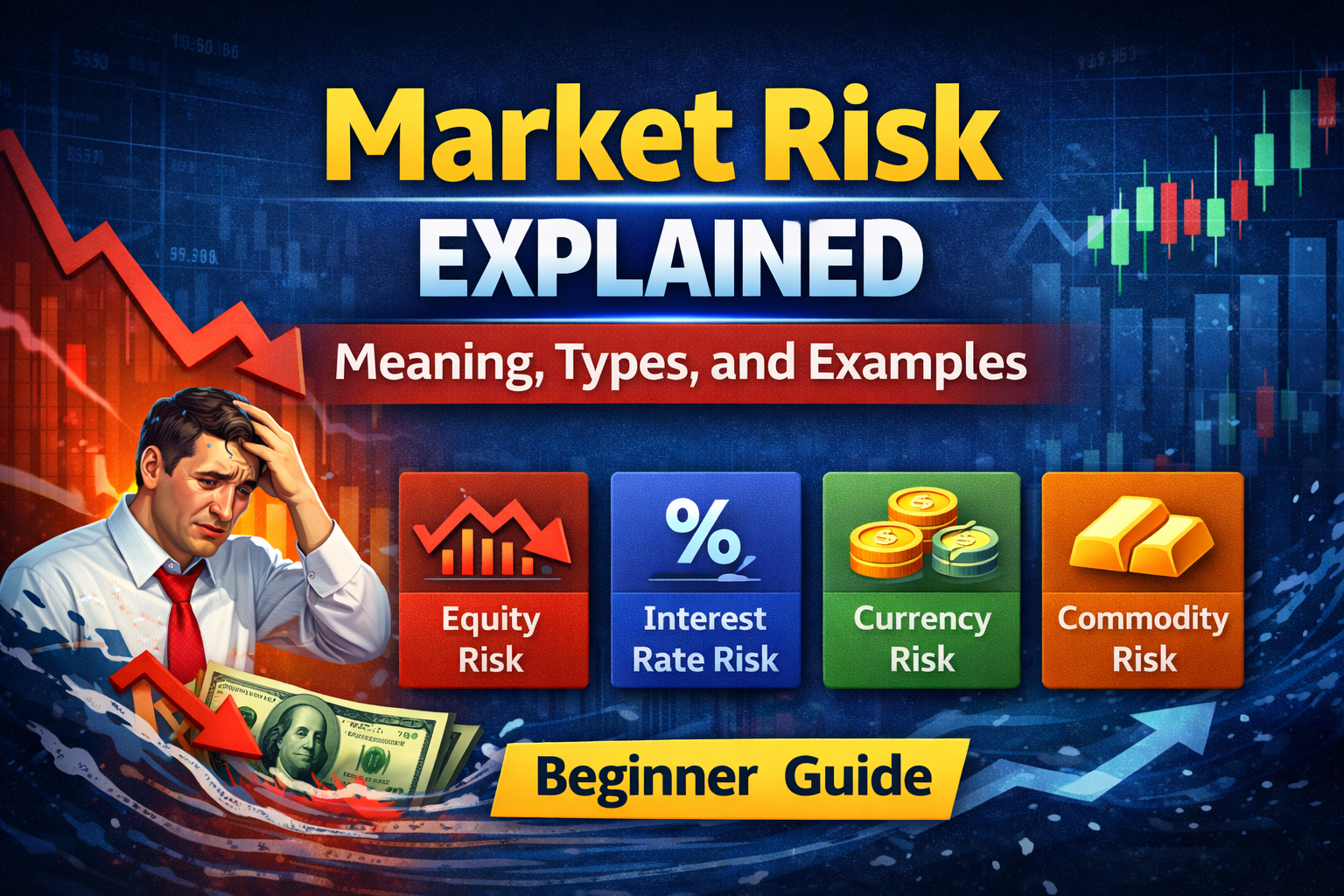
Market risk is the risk of financial loss due to changes in market variables such as
Stock prices
Interest rates
Currency exchange rates
Commodity prices
👉 In simple terms
Market risk is the risk that your investments lose value because the market moves against you
Why Market Risk is Important
Market risk affects almost everyone in finance.
Individual investors
Banks
Mutual funds
Investment firms
Corporations
Even if you invest through mutual funds, you are still exposed to market risk.
Example
If the overall stock market falls, most mutual funds will also decline, even if they are well managed.
This shows that market risk is unavoidable.
Real Life Example of Market Risk
Let us understand this with a simple scenario.
Amit invests 1 lakh in the stock market.
After a few months, due to inflation concerns and rising interest rates, the market falls.
His investment value becomes 80000.
Loss = 20000
This loss is not due to poor stock selection. It is due to overall market conditions.
👉 This is market risk
Causes of Market Risk
Market risk exists because financial markets are influenced by multiple factors.
1 Economic Changes
Changes in GDP growth, inflation, and unemployment affect markets.
Example
High inflation can reduce purchasing power and negatively impact stock prices.
2 Interest Rate Changes
Central banks control interest rates, which impact both stock and bond markets.
Example
When interest rates rise, borrowing becomes expensive, and stock markets may fall.
3 Political Events
Elections, policy changes, and geopolitical tensions can create uncertainty.
4 Global Events
Events like pandemics, wars, or financial crises impact global markets.
Example
During COVID 19, stock markets across the world crashed sharply.
Types of Market Risk
Market risk is not a single type of risk. It is divided into several categories.
1 Equity Risk
Equity risk refers to the risk of loss due to changes in stock prices.
Example
If you invest in shares of a company and its stock price falls due to poor performance or market conditions, you face equity risk.
2 Interest Rate Risk
This risk mainly affects bonds and fixed income investments.
When interest rates rise, bond prices fall.
Example
You buy a bond paying 6 percent interest.
Later, new bonds offer 8 percent.
Your bond becomes less attractive, and its value decreases.
3 Currency Risk
Currency risk occurs when exchange rates fluctuate.
This is important for investors dealing with international investments.
Example
An Indian investor invests in US stocks.
If the dollar weakens against the rupee, returns decrease even if stock prices rise.
4 Commodity Risk
This risk arises from changes in commodity prices like gold, oil, or agricultural products.
Example
If oil prices fall, companies dependent on oil revenues may suffer losses.
How Market Risk is Measured
Financial institutions use various tools to measure market risk.
Value at Risk (VaR)
Value at Risk estimates the potential loss in an investment over a specific period.
Example
A portfolio may have a VaR of 1 lakh.
This means there is a certain probability that losses could reach this level under normal conditions.
Stress Testing
Stress testing evaluates how investments perform under extreme scenarios.
Example
What happens if markets crash by 30 percent
What happens if interest rates rise sharply
How to Manage Market Risk
Market risk cannot be completely eliminated, but it can be managed effectively.
1 Diversification
Investing in different assets reduces overall risk.
Example
Instead of investing only in stocks, you can invest in
Bonds
Gold
Mutual funds
2 Hedging
Using financial instruments like derivatives to reduce risk.
Example
An investor can use options or futures to protect against price declines.
3 Asset Allocation
Allocating investments based on risk tolerance.
Young investors may take higher risk
Conservative investors prefer safer assets
4 Long Term Investing
Short term market movements are unpredictable.
Long term investing reduces the impact of volatility.
Market Risk vs Other Financial Risks
Many beginners confuse market risk with other risks.
Market Risk
Loss due to market fluctuations
Credit Risk
Loss due to borrower default
Liquidity Risk
Inability to convert assets into cash
Operational Risk
Loss due to internal failures
Example
Stock market crash → Market risk
Loan not repaid → Credit risk
Who Faces Market Risk
Market risk affects
Retail investors
Institutional investors
Banks
Corporations
Even companies face market risk when
Currency values change
Interest rates fluctuate
Commodity prices vary
Common Mistakes Beginners Make
Ignoring risk while investing
Investing based on emotions
Lack of diversification
Trying to predict market timing
Example
Many beginners panic during market downturns and sell investments at a loss.
This increases losses instead of reducing risk.
Importance of Market Risk in FRM
Market risk is a core concept in FRM certification.
FRM focuses on
Understanding market behavior
Measuring risk
Managing risk using models
Roles related to market risk include
Market risk analyst
Portfolio manager
Investment analyst
Real Life Scenario
Consider a mutual fund manager.
If markets fall, the fund value decreases.
The manager cannot avoid market risk but can reduce it through diversification and strategy.
Final Thoughts
Market risk is an unavoidable part of investing and finance. Every investor faces it, regardless of experience.
The key is not to avoid risk but to understand and manage it effectively.
By learning about different types of market risk and using strategies like diversification and long term investing, you can make smarter financial decisions.
If you are building a career in finance or preparing for FRM, mastering market risk is a crucial part