Tag: risk management career

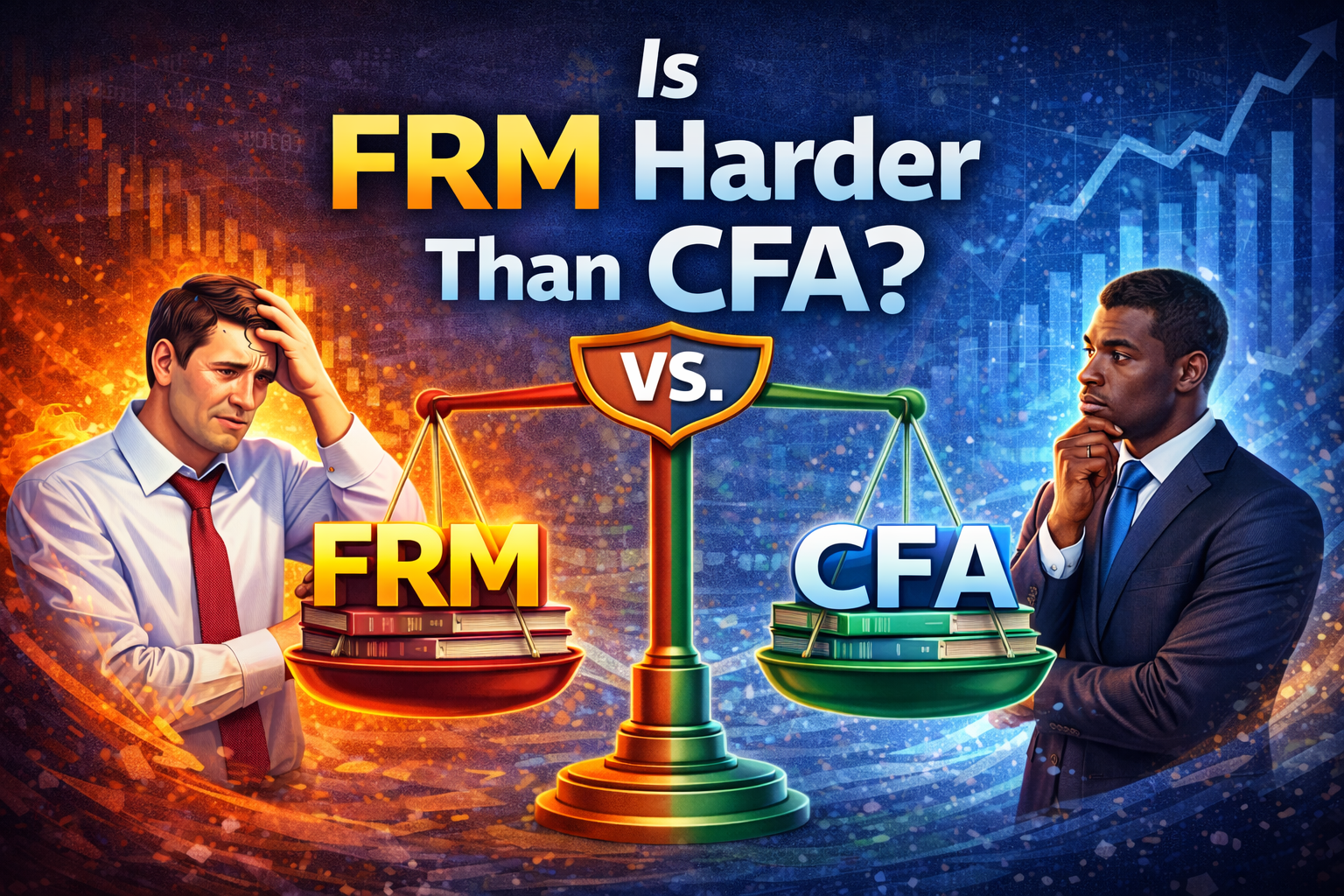
  • Is FRM Harder Than CFA? A Complete Comparison

    Is FRM Harder Than CFA? A Complete Comparison

    1. Introduction

    The Financial Risk Manager (FRM) and Chartered Financial Analyst (CFA) are two of the most recognized finance certifications globally. Both are respected, but they differ significantly in focus, structure, and difficulty.

    Many students in India and globally often ask: which one is harder, FRM or CFA? The answer depends on your background, career goals, and how you approach preparation.

    Is FRM harder than CFA?
    FRM is often considered more technical and focused, especially in risk and quantitative topics, while CFA is broader and longer, covering multiple areas of finance. Most candidates find CFA more demanding overall due to its length, but FRM can feel tougher in specific areas like quantitative analysis.


    2. Key Takeaways

    • CFA is broader and takes longer to complete
    • FRM is more specialized in risk management
    • FRM can feel more technical, especially in quantitative topics
    • CFA requires long-term consistency across multiple levels
    • Difficulty depends on your strengths and background

    3. What is FRM vs CFA?

    What is FRM?

    FRM focuses on risk management in finance. It covers topics such as market risk, credit risk, operational risk, and quantitative analysis. It is commonly pursued by professionals interested in risk roles in banks and financial institutions.

    What is CFA?

    CFA covers a wide range of finance topics including equity, fixed income, portfolio management, and ethics. It is designed for careers in investment management, research, and asset management.


    4. How Difficulty Differs Between FRM and CFA

    Scope of Syllabus

    • FRM: Focused and specialized
    • CFA: Broad and covers multiple domains

    CFA requires understanding many subjects, which makes it more time-consuming.


    Depth vs Breadth

    • FRM: Deep in risk and quantitative concepts
    • CFA: Broad but moderate depth across subjects

    FRM may feel harder for those not comfortable with quantitative methods.


    Exam Structure

    • FRM: Two levels
    • CFA: Three levels

    CFA requires sustained effort over a longer period, making it mentally more demanding.


    Quantitative Difficulty

    • FRM has a stronger emphasis on mathematical and statistical concepts
    • CFA includes quantitative topics but balances them with theory and application

    5. Real-World Example

    Consider two students:

    • Student A has a strong math background
    • Student B comes from a non-finance background

    Student A:
    Finds FRM easier because they are comfortable with numbers and risk models

    Student B:
    Finds CFA easier initially because it builds concepts gradually across different areas

    This shows that difficulty depends on individual strengths rather than just the certification itself.


    6. Which is Harder for Working Professionals?

    Working professionals often find:

    • CFA harder overall due to longer duration and broader syllabus
    • FRM challenging in short term due to technical depth

    Time management becomes the key factor here. Structured preparation helps in both cases.


    7. Top Coaching Providers for FRM Preparation in India

    1. MidhaFin

    Overview:
    MidhaFin focuses on structured preparation for finance certifications, with emphasis on clarity, discipline, and long-term understanding.

    Strengths:

    • Strong conceptual teaching approach
    • Structured learning path
    • Suitable for beginners and working professionals
    • Balanced focus on theory and application

    Limitations:

    • Requires consistent effort
    • Not designed for shortcut-based preparation

    2. QuintEdge

    Overview:
    QuintEdge offers FRM coaching with a focus on practical understanding and structured classes.

    Strengths:

    • Simplified teaching style
    • Structured curriculum
    • Good for beginners

    Limitations:

    • Limited advanced-level depth
    • Less focus on extensive practice

    3. FinTree

    Overview:
    FinTree provides finance coaching with a focus on conceptual clarity and interactive learning.

    Strengths:

    • Engaging teaching approach
    • Focus on understanding concepts
    • Good support system

    Limitations:

    • May vary in depth across topics
    • Less emphasis on structured progression

    4. AnalystPrep

    Overview:
    A global platform focused on practice questions and exam preparation tools.

    Strengths:

    • Large question bank
    • Flexible online access
    • Useful for revision

    Limitations:

    • Limited conceptual teaching
    • Less guided structure

    5. Bionic Turtle

    Overview:
    Known for deep and technical coverage of FRM topics.

    Strengths:

    • Strong quantitative focus
    • Detailed explanations
    • Suitable for advanced learners

    Limitations:

    • Can be overwhelming for beginners
    • Less beginner-friendly structure

    8. Comparison Table

    Coaching ProviderTeaching StyleContent DepthBest For
    MidhaFinConcept-focusedHighBeginners and working professionals
    QuintEdgeStructuredModerateBeginners
    FinTreeInteractiveModerateConceptual learners
    AnalystPrepPractice-heavyModerateRevision and testing
    Bionic TurtleTechnicalVery HighAdvanced learners

    9. Common Misconceptions

    • FRM is always easier than CFA
    • CFA is only about theory
    • FRM requires only math skills
    • You need both certifications to succeed
    • Difficulty is the same for everyone

    10. FAQ Section

    Is FRM harder than CFA?
    FRM is more technical and focused, while CFA is broader and longer. Most candidates find CFA more demanding overall, but FRM can be more challenging in quantitative areas.

    Which is better, CFA or FRM?
    It depends on your career goals. CFA is suited for investment roles, while FRM is focused on risk management careers.

    Can I do both CFA and FRM?
    Yes, many professionals pursue both to build a broader skill set in finance and risk management.

    Is FRM more technical than CFA?
    Yes, FRM generally involves more quantitative and risk-focused concepts compared to CFA.

    Which is easier for beginners?
    CFA may feel easier initially due to broader and gradual coverage, while FRM requires stronger analytical skills from the start.

    Do employers value CFA more than FRM?
    Both are valued, but CFA is more widely recognized across finance roles, while FRM is specialized for risk roles.

  • What is FRM Certification and Who Should Do It

    What is FRM Certification and Who Should Do It

    Choosing the right finance certification can shape your entire career. Many students and professionals often hear about FRM but are unsure whether it is the right choice for them.

    If you are someone interested in finance, risk, banking, or analytics, understanding FRM can help you make a clear career decision.

    In this guide, we will break down what FRM is, what you actually learn, and who should seriously consider pursuing it.


    What is FRM Certification

    FRM stands for Financial Risk Manager. It is a globally recognized certification offered by GARP, which is the Global Association of Risk Professionals.

    The certification focuses on understanding and managing different types of financial risks that organizations face every day.

    These include

    Market risk
    Credit risk
    Operational risk
    Liquidity risk

    In simple terms, FRM professionals help companies answer one critical question

    👉 What can go wrong financially and how do we manage it


    Understanding FRM with a Real Life Example

    Let us simplify this.

    Imagine a bank gives a loan of 10 lakh to a customer.

    There is always a risk that the customer might not repay the loan. This is called credit risk.

    An FRM professional helps the bank

    Evaluate whether the borrower is risky
    Estimate the probability of default
    Design strategies to reduce losses

    Similarly

    If a company invests in the stock market, it faces market risk due to price fluctuations.

    If a company operates internationally, it faces currency risk.

    FRM professionals analyze these risks and help organizations make safer financial decisions.


    What You Actually Learn in FRM

    FRM is not just theory. It is highly practical and industry focused.

    You learn

    How financial markets work
    How risk is measured using quantitative tools
    How to use models to predict losses
    How banks and institutions manage risk

    Example

    You may learn concepts like

    Value at Risk
    Probability models
    Portfolio risk analysis

    These are tools used by professionals working in banks and investment firms.


    Why FRM is Gaining Popularity

    The demand for risk professionals has increased significantly in recent years.

    After global financial crises, companies and regulators have become more focused on risk management.

    Today, every financial institution needs professionals who can

    Identify risks
    Measure risks
    Control risks

    This has made FRM one of the most valuable certifications in finance.


    Who Should Do FRM

    FRM is not for everyone. It is best suited for people who are interested in analytical and risk based roles.

    Let us understand this clearly.


    1 Finance Students

    If you are a BCom, BBA, or MBA student and want to specialize in finance, FRM can give you a strong edge.

    Example

    A BCom student who completes FRM can target roles like

    Risk analyst
    Credit analyst
    Financial analyst

    instead of general accounting roles.


    2 Students Interested in Banking Careers

    Banks deal heavily with risk. Whether it is lending money or managing investments, risk is always involved.

    FRM helps you enter roles such as

    Credit risk analyst
    Market risk analyst
    Risk manager


    3 Working Professionals in Finance

    If you are already working in finance and want to move into higher paying or specialized roles, FRM can help.

    Example

    An operations executive in a bank can transition into a risk role after completing FRM.


    4 People Interested in Analytics and Quant Roles

    FRM involves quantitative concepts such as probability, statistics, and financial models.

    If you enjoy working with numbers and analysis, FRM is a strong fit.


    Who Should Not Do FRM

    It is equally important to understand who should avoid FRM.

    FRM may not be suitable if

    You dislike quantitative concepts
    You prefer marketing or sales roles
    You are not interested in finance

    FRM requires analytical thinking and consistent effort.


    Skills Required for FRM

    To succeed in FRM, certain skills are helpful.

    Basic understanding of finance
    Comfort with numbers and calculations
    Analytical thinking
    Discipline and consistency

    You do not need to be a math expert, but you should be comfortable with basic quantitative concepts.


    FRM vs Other Finance Certifications

    Many students compare FRM with other certifications.

    FRM focuses on risk management
    CFA focuses on investment management
    MBA finance provides broader business exposure

    Example

    If your goal is portfolio management or equity research, CFA is better
    If your goal is risk management or banking roles, FRM is better


    Real Life Career Scenario

    Let us compare two students.

    Rahul completes a general degree without specialization. He gets a basic finance job with limited growth.

    Aman completes FRM along with his graduation. He gets a role as a risk analyst in a bank with higher growth potential.

    The difference is specialization.

    FRM gives you a clear niche in finance.


    Advantages of FRM Certification

    Global recognition
    High demand in banking and finance
    Specialized skillset
    Better career opportunities
    Strong salary growth potential


    Final Thoughts

    FRM certification is one of the best options for individuals who want to build a career in financial risk management.

    It is especially valuable for students and professionals who want to stand out in the competitive finance industry.

    However, the key is clarity. FRM is not just about passing exams. It is about building expertise in risk, which is one of the most critical areas in finance today.

    If you are interested in finance, enjoy analytical thinking, and want a specialized career path, FRM can be a powerful choice.