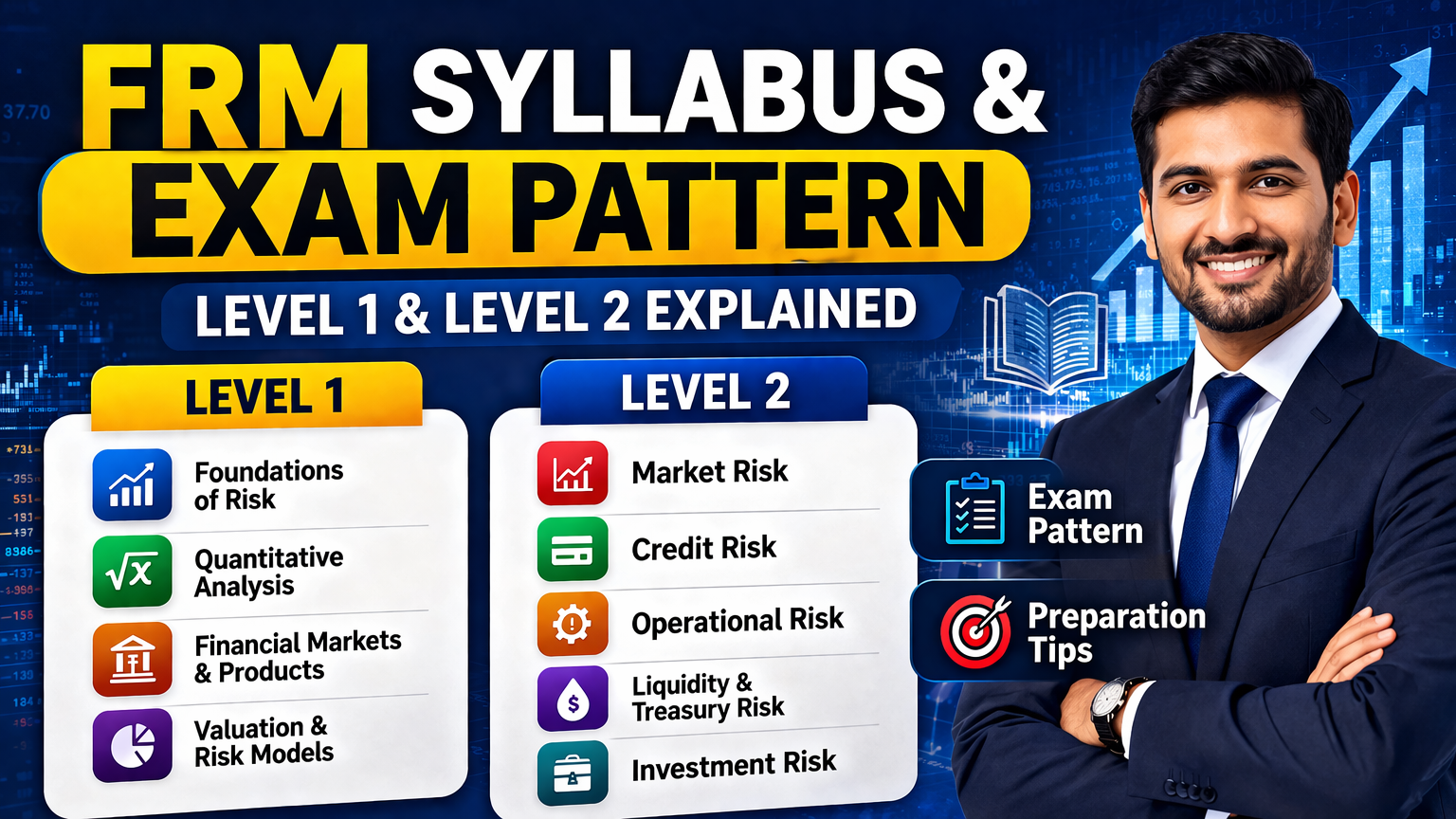
One of the biggest challenges for FRM aspirants is understanding the syllabus and exam structure. Many students feel overwhelmed because they are not sure what to study, how deep to go, and what the exam actually tests.
In reality, once you understand the structure clearly, FRM becomes much more manageable.
In this guide, we will break down the FRM syllabus and exam pattern for both Level 1 and Level 2 with practical clarity.
Overview of FRM Exam Structure
FRM is divided into two levels
Level 1 focuses on concepts and fundamentals
Level 2 focuses on application and real world scenarios
Both levels must be cleared to complete the FRM program.
FRM Level 1 Syllabus
Level 1 builds your foundation in risk management. It focuses on understanding tools, concepts, and financial markets.
1 Foundations of Risk Management
This section introduces the core concepts of risk.
You learn
Types of financial risks
Role of risk management in organizations
Basel regulations basics
Example
Understanding how banks measure and manage risk exposure in lending.
2 Quantitative Analysis
This is one of the most important sections.
You learn
Probability concepts
Statistical measures
Regression analysis
Time value of money
Example
Calculating probability of default or expected loss using statistical models.
3 Financial Markets and Products
This section helps you understand how financial instruments work.
You learn
Bonds
Derivatives
Options and futures
Interest rates
Example
Understanding how bond prices change with interest rates.
4 Valuation and Risk Models
This section connects theory with application.
You learn
Value at Risk
Risk measurement models
Portfolio risk
Example
Estimating how much money a portfolio could lose under worst case scenarios.
Level 1 Weightage (Approx)
Foundations of risk management
Quantitative analysis
Financial markets
Valuation models
Quantitative and valuation topics usually carry significant weight.
FRM Level 2 Syllabus
Level 2 is more practical and focuses on real world application of risk concepts.
1 Market Risk Measurement and Management
You learn
Interest rate risk
Equity risk
Currency risk
Stress testing
Example
Analyzing how a portfolio reacts to market crashes.
2 Credit Risk Measurement and Management
This is highly relevant for banking roles.
You learn
Credit rating models
Default risk
Credit derivatives
Example
Evaluating whether a company is likely to default on its loan.
3 Operational Risk and Resilience
You learn
Business risks
Fraud risk
System failures
Risk mitigation strategies
Example
Managing risks related to internal processes or cyber threats.
4 Liquidity and Treasury Risk
You learn
Liquidity management
Funding risk
Cash flow management
Example
Ensuring a bank has enough cash to meet withdrawal demands.
5 Risk Management and Investment Management
This section connects risk with investment decisions.
You learn
Portfolio risk
Asset management
Hedging strategies
Level 2 Weightage (Approx)
Market risk
Credit risk
Operational risk
Liquidity risk
Investment risk
Level 2 focuses more on practical scenarios and case based understanding.
FRM Exam Pattern
Understanding the pattern is equally important.
Level 1 Exam Pattern
100 multiple choice questions
Duration around 4 hours
Focus on concepts and calculations
Level 2 Exam Pattern
80 multiple choice questions
Duration around 4 hours
Focus on application and interpretation
Difficulty Level of FRM Exams
FRM is considered challenging because
Questions test concepts deeply
Application based thinking is required
Time management is important
Example
Instead of asking definitions, the exam may present a scenario and ask you to apply a concept.
How to Approach the Syllabus
Many students make the mistake of studying randomly.
Here is a smarter approach.
Step 1 Start with Foundations
Build strong basics before moving to advanced topics.
Step 2 Focus on Quantitative Concepts
Quantitative analysis is the backbone of FRM.
Spend extra time here.
Step 3 Practice Questions Regularly
FRM is application based.
Solving questions is more important than just reading theory.
Step 4 Revise Multiple Times
Concepts require revision to become clear.
Real Life Study Strategy Example
Let us take an example.
A student studies for 4 months.
Month 1
Foundations and basic concepts
Month 2
Quantitative analysis
Month 3
Markets and valuation
Month 4
Revision and mock tests
This structured approach improves chances of success.
Common Mistakes Students Make
Ignoring quantitative topics
Focusing only on theory
Not practicing enough questions
Skipping revision
Avoiding these mistakes can significantly improve performance.
Final Thoughts
The FRM syllabus is comprehensive but highly practical. It is designed to prepare candidates for real world risk management roles.
Level 1 builds your foundation, while Level 2 develops your ability to apply concepts in real scenarios.
Once you understand the structure and follow a disciplined study plan, FRM becomes much more manageable.
The key is consistency, practice, and clarity of concepts.