Meta Title: Can AI Replace Finance? Understanding the Future of Finance and AI
Meta Description: Can AI replace finance professionals? Explore how AI is transforming finance, what jobs are changing, and why human expertise remains essential in the future of finance.
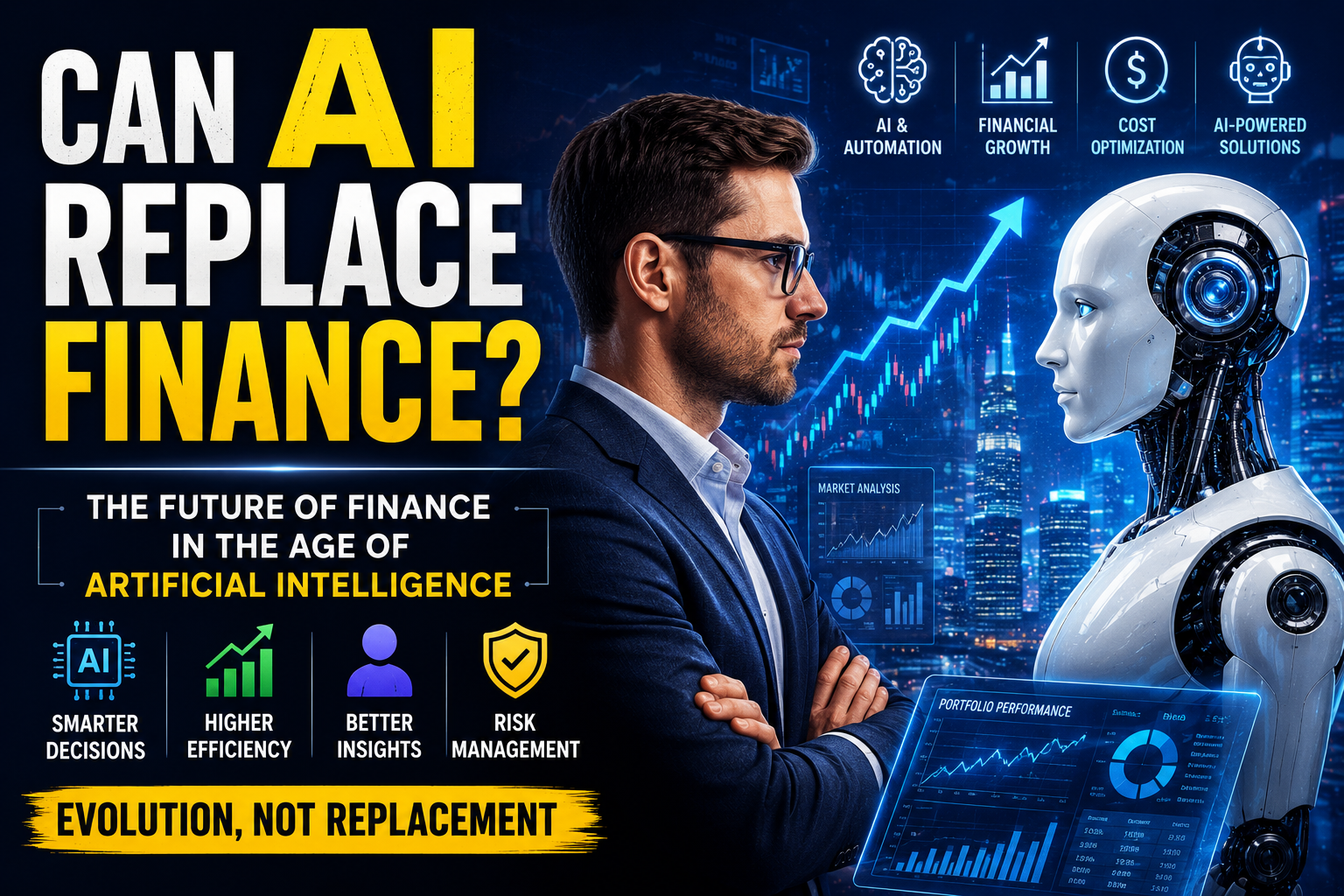
Can AI Replace Finance?
Artificial Intelligence (AI) is transforming industries worldwide, and finance is no exception. From automated trading algorithms to AI-powered credit assessments, technology is reshaping how financial institutions operate.
This raises an important question:
Can AI replace finance?
The short answer is no, but it will significantly transform finance.
AI can automate repetitive tasks, improve decision-making, and process massive amounts of data faster than humans. However, finance is much more than calculations and data analysis. It involves judgment, ethics, relationship management, strategic thinking, and regulatory interpretation, areas where human expertise remains indispensable.
In this article, we will explore how AI is changing finance, what roles may be affected, and why finance professionals continue to play a critical role in the future.
Quick Answer: Can AI Replace Finance?
AI cannot fully replace finance professionals because finance requires human judgment, strategic decision-making, ethical considerations, and relationship management.
However, AI can automate routine financial tasks such as:
- Data analysis
- Financial reporting
- Risk monitoring
- Fraud detection
- Portfolio rebalancing
- Credit scoring
The future is likely to involve AI-assisted finance professionals rather than AI replacing finance entirely.
Why Is AI Becoming Important in Finance?
The financial industry generates enormous amounts of data every second.
Banks, investment firms, insurance companies, and corporations use AI because it can:
- Analyze millions of transactions instantly
- Detect fraud patterns
- Predict market trends
- Improve operational efficiency
- Reduce human errors
- Enhance customer experiences
According to industry reports, global spending on AI in financial services continues to grow as organizations seek greater efficiency and competitive advantage.
How AI Is Already Transforming Finance
1. Automated Financial Analysis
AI systems can quickly analyze:
- Financial statements
- Company earnings reports
- Market data
- Economic indicators
Tasks that previously required hours of manual effort can now be completed in minutes.
Example
An equity analyst may use AI tools to screen thousands of companies based on valuation, profitability, and growth metrics before conducting deeper analysis.
2. Algorithmic Trading
Many investment firms already use AI-driven trading systems.
These systems can:
- Analyze market movements
- Identify opportunities
- Execute trades automatically
- Manage portfolios in real time
High-frequency trading firms rely heavily on machine learning algorithms to make decisions within milliseconds.
3. Fraud Detection
Banks use AI to monitor transactions continuously.
AI can identify:
- Unusual spending patterns
- Suspicious transfers
- Identity theft attempts
- Credit card fraud
This capability helps institutions reduce losses and improve security.
4. Credit Risk Assessment
Traditional lending models relied heavily on historical financial data.
AI enhances credit evaluation by analyzing:
- Transaction history
- Payment behavior
- Spending patterns
- Alternative financial data
This enables more accurate lending decisions.
5. Customer Service and Financial Advisory
AI-powered chatbots and robo-advisors now assist customers with:
- Basic financial queries
- Portfolio recommendations
- Account management
- Investment tracking
Many fintech companies use AI to deliver low-cost financial advice.
Which Finance Jobs Could Be Affected by AI?
AI is most effective at automating repetitive and rule-based tasks.
Roles with Higher Automation Risk
- Data entry operators
- Bookkeeping assistants
- Basic reporting analysts
- Transaction processing staff
- Compliance documentation specialists
Many routine tasks within these roles can already be automated.
Which Finance Jobs Are Difficult for AI to Replace?
Certain finance careers require skills that AI currently cannot replicate effectively.
Investment Banking
Investment bankers must:
- Negotiate deals
- Build client relationships
- Understand strategic objectives
- Manage stakeholder interests
These responsibilities require human interaction and judgment.
Financial Risk Management
Risk professionals evaluate:
- Emerging risks
- Regulatory changes
- Economic uncertainty
- Geopolitical developments
While AI can provide insights, final risk decisions require human expertise.
Corporate Finance Leadership
Chief Financial Officers (CFOs) and finance leaders make decisions involving:
- Capital allocation
- Strategic planning
- Business growth
- Organizational priorities
These decisions depend on experience, leadership, and business understanding.
Wealth Management
Clients often seek financial advisors for:
- Trust
- Personalized guidance
- Emotional reassurance
- Long-term planning
Human relationships remain central to wealth management.
AI vs Human Finance Professionals
| Capability | AI | Human Professionals |
|---|---|---|
| Data Processing | Excellent | Limited |
| Speed | Very High | Moderate |
| Pattern Recognition | Excellent | Good |
| Strategic Thinking | Limited | Excellent |
| Ethical Judgment | Weak | Strong |
| Relationship Building | Weak | Excellent |
| Negotiation | Weak | Strong |
| Adaptability to New Situations | Limited | High |
The comparison clearly shows that AI excels at analysis while humans excel at decision-making and relationships.
The Rise of AI-Augmented Finance Professionals
The most likely future is not AI replacing finance professionals.
Instead, it is:
Finance Professionals + AI
Professionals who effectively use AI tools can:
- Analyze data faster
- Improve productivity
- Generate better insights
- Make more informed decisions
This combination creates a powerful competitive advantage.
Will AI Replace Financial Analysts?
One of the most searched questions today is:
Will AI replace financial analysts?
The answer is partially.
AI can automate:
- Data collection
- Financial modeling
- Screening processes
- Routine reporting
However, analysts still provide:
- Industry insights
- Business understanding
- Management evaluation
- Investment recommendations
The role will evolve rather than disappear.
What Skills Finance Professionals Need in the AI Era
To remain valuable, finance professionals should focus on developing skills that complement AI.
Technical Skills
- Financial modeling
- Data analytics
- Python and SQL basics
- AI literacy
- Business intelligence tools
Strategic Skills
- Critical thinking
- Decision-making
- Problem-solving
- Risk assessment
Human Skills
- Communication
- Leadership
- Negotiation
- Relationship management
These skills will become even more important as automation increases.
How Certifications Like FRM and CFA Remain Relevant
Professional certifications continue to provide value because they focus on:
- Financial judgment
- Risk management
- Ethics
- Strategic analysis
- Investment decision-making
FRM (Financial Risk Manager)
FRM professionals specialize in:
- Market risk
- Credit risk
- Operational risk
- Enterprise risk management
AI can assist risk analysis, but risk ownership remains a human responsibility.
CFA (Chartered Financial Analyst)
CFA charterholders focus on:
- Investment analysis
- Portfolio management
- Asset valuation
- Ethical decision-making
These areas require expertise beyond automated calculations.
Common Questions About AI and Finance
Can AI completely replace finance professionals?
No. AI can automate tasks but cannot fully replace human judgment, ethics, leadership, and relationship management.
Will AI eliminate finance jobs?
Some routine roles may decline, but new opportunities will emerge in financial analytics, AI governance, fintech, and risk management.
Is finance still a good career in the age of AI?
Yes. Finance remains a strong career path, especially for professionals who learn to work alongside AI technologies.
Which finance careers are safest from AI disruption?
Roles involving strategy, risk management, client advisory, investment decision-making, and leadership are less vulnerable to automation.
Should finance students learn AI?
Absolutely. Understanding AI tools and data analytics can significantly enhance career prospects.
The Final Verdict: Can AI Replace Finance?
AI will transform finance, but it will not replace finance professionals entirely.
Artificial intelligence excels at processing information, identifying patterns, and automating repetitive tasks. However, finance requires much more than calculations. Strategic thinking, ethical judgment, client relationships, leadership, and decision-making remain deeply human responsibilities.
The future belongs to professionals who combine financial expertise with technological literacy.
Rather than asking whether AI will replace finance, a better question is:
How can finance professionals use AI to become more effective, productive, and valuable?
Those who embrace this combination will lead the next generation of finance careers.
Key Takeaways
- AI is transforming finance but not replacing it entirely.
- Routine and repetitive finance tasks are increasingly automated.
- Human judgment remains critical in investment, risk, and strategic decisions.
- Finance professionals who learn AI tools gain a significant advantage.
- Certifications such as FRM and CFA remain highly relevant.
- The future of finance is collaboration between humans and AI, not competition.