
Tag: finance concepts

  • Co-Investment: Meaning, Example and Real Life Context

    Co-Investment: Meaning, Example and Real Life Context

    Co-investment is a common idea in private equity, venture capital, real estate, infrastructure, and other private market deals.

    The concept is quite simple. A main investor finds and leads an investment opportunity, and other investors join that same deal directly. Those investors are called co-investors.

    So, instead of only putting money into a fund, the investor also gets a chance to invest in a specific company or project alongside the main fund manager.

    What Co-Investment Means

    Co-investment means investing side by side with a lead investor.

    The lead investor usually does most of the work. It finds the opportunity, studies the business, negotiates the deal, and manages the investment after the money is invested.

    Once the deal is ready, the lead investor may invite some of its large investors to participate directly.

    For example, a private equity fund may invest in a company. Along with the fund, a pension fund or family office may also invest directly in the same company.

    That direct investment is called co-investment.

    Simple Example

    Assume a private equity fund wants to invest ₹500 crore in a healthcare company.

    The fund decides to invest ₹350 crore from its own fund pool.

    For the remaining ₹150 crore, it invites two existing investors to join the deal.

    A pension fund invests ₹75 crore.
    A family office invests ₹75 crore.

    In this case, the pension fund and the family office are co-investors.

    They are not only investing through the private equity fund. They are putting money directly into that particular healthcare company.

    Real Life Context

    Let us say a hospital chain wants to expand into more cities.

    A private equity fund likes the business because healthcare demand is rising, the company has good cash flows, and there is room for expansion.

    But the investment amount is large. The fund may not want to put the full amount from its own pool because that would create too much exposure to one company.

    So, it invites a few trusted investors to invest along with it.

    This helps everyone in a different way.

    The hospital chain gets the capital it needs.

    The private equity fund completes a large deal without taking the entire exposure alone.

    The co-investors get direct access to a specific company instead of getting exposure only through the main fund.

    This is why co-investment is common in private market transactions.

    Why Investors Like Co-Investment

    Investors like co-investment because it gives them more direct exposure.

    In a normal fund investment, an investor gives money to the fund manager, and the fund manager decides where that money will be invested.

    In co-investment, the investor can look at one particular deal and decide whether they want to participate.

    Another reason is fees.

    Co-investments may have lower fees compared to regular fund investments. Sometimes the management fee or carried interest may be lower on the co-investment portion.

    This can improve the final return if the investment performs well.

    Why Fund Managers Offer It

    Fund managers offer co-investment because it helps them manage large deals.

    Sometimes the opportunity is attractive, but the deal size is too big for the fund to handle alone.

    Sometimes the fund wants to avoid putting too much capital into one company.

    Co-investment also helps fund managers build better relationships with large investors. If investors get access to good deals, they may be more likely to support the managers future funds.

    Risks Involved

    Co-investment can be useful, but it also has risk.

    The biggest risk is concentration. A co-investment is usually linked to one company, one asset, or one project. If that deal performs badly, the investor may face a direct loss.

    There is also limited diversification compared to a fund.

    Another issue is time. Co-investment decisions often have to be made quickly. Not every investor has a full team to analyse the deal properly within a short period.

    So, even if the opportunity is coming from a good fund manager, the co-investor should still review the deal carefully.

    Co-Investment vs Fund Investment

    A fund investment is broader. The investor puts money into a fund, and the fund invests across many companies or assets.

    A co-investment is more specific. The investor puts money into one selected deal alongside the fund manager.

    Fund investment gives diversification.

    Co-investment gives direct exposure to a particular opportunity.

    Both can be useful, but they are not the same.

    Final Thoughts

    Co-investment means joining a deal directly with a lead investor.

    It gives investors access to selected private market opportunities and may also reduce fees in some cases. For fund managers, it helps complete bigger transactions and manage exposure.

    The simple way to understand it is this:

    Co-investment is not just investing in a fund. It is investing directly in a specific deal along with the main investor.
  • Capital Allocation Line: Meaning, Example and Real Life Context

    Capital Allocation Line: Meaning, Example and Real Life Context

    When investors build a portfolio, they usually do not put all their money in one risky asset. Some money may go into a risk-free investment, and the remaining amount may go into a risky portfolio.

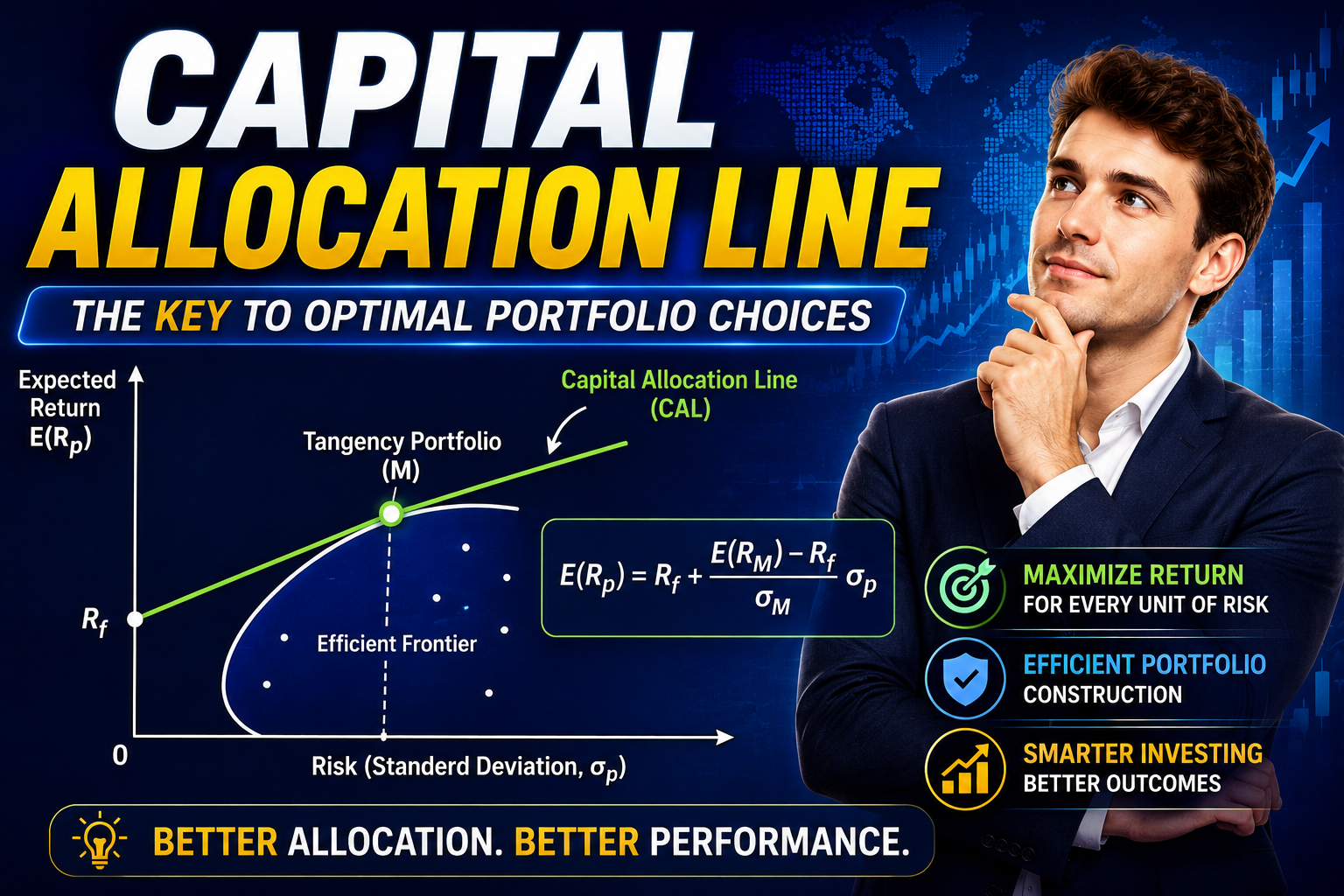
    The Capital Allocation Line, or CAL, helps us understand this relationship between risk and return.

    In simple terms, the Capital Allocation Line shows the different combinations of a risk-free asset and a risky portfolio.

    What is the Capital Allocation Line?

    The Capital Allocation Line is a straight line that shows how expected return changes when an investor combines a risk-free asset with a risky portfolio.

    A risk-free asset gives a fixed return with almost no uncertainty. Treasury bills are often used as an example of a risk-free asset.

    A risky portfolio may include stocks, equity mutual funds, bonds, or a mix of risky investments.

    The investor can decide how much money to put in the risk-free asset and how much to put in the risky portfolio.

    That decision will decide the expected return and risk of the final portfolio.

    Simple Example

    Suppose an investor has ₹1,00,000.

    There are two options:

    Risk-free asset return = 5 percent
    Risky portfolio expected return = 13 percent
    Risky portfolio standard deviation = 20 percent

    Now assume the investor puts:

    60 percent in the risky portfolio
    40 percent in the risk-free asset

    Expected return of the complete portfolio will be:

    = 40 percent × 5 percent + 60 percent × 13 percent
    = 2 percent + 7.8 percent
    = 9.8 percent

    Portfolio risk will come only from the risky portfolio because the risk-free asset has no standard deviation.

    Portfolio risk:

    = 60 percent × 20 percent
    = 12 percent

    So, this investor has created a portfolio with an expected return of 9.8 percent and risk of 12 percent.

    This point lies on the Capital Allocation Line.

    Real Life Context

    Think of a person who has just started investing.

    They do not want to take very high risk, so they keep part of their money in a fixed-income product or Treasury bill type investment. The remaining part goes into an equity portfolio.

    If the investor is conservative, they may keep more money in the risk-free asset and less in equities.

    For example:

    70 percent in risk-free investment
    30 percent in risky portfolio

    This will reduce risk, but expected return will also be lower.

    On the other hand, an aggressive investor may invest more in the risky portfolio.

    For example:

    20 percent in risk-free investment
    80 percent in risky portfolio

    This can increase expected return, but the portfolio will also become more volatile.

    The Capital Allocation Line simply shows these choices in a clear way.

    What the Slope of CAL Shows

    The slope of the Capital Allocation Line shows the extra return earned for taking extra risk.

    This is also called the reward-to-variability ratio.

    If the slope is steep, it means the investor is getting more return for each unit of risk.

    If the slope is flat, it means the additional return for taking risk is not very attractive.

    So, investors generally prefer a Capital Allocation Line with a higher slope.

    Formula of Capital Allocation Line

    The expected return of the complete portfolio can be written as:

    Expected Return = Risk-free Rate + Weight in Risky Portfolio × Risk Premium

    Where:

    Risk Premium = Expected Return of Risky Portfolio – Risk-free Rate

    Using the earlier example:

    Risk-free rate = 5 percent
    Expected return of risky portfolio = 13 percent
    Risk premium = 8 percent
    Weight in risky portfolio = 60 percent

    Expected Return = 5 percent + 60 percent × 8 percent
    Expected Return = 9.8 percent

    This gives the same answer.

    Why CAL is Important

    The Capital Allocation Line is useful because it shows how investors can adjust their portfolio based on their risk preference.

    A cautious investor may choose a point closer to the risk-free asset.

    A risk-taking investor may choose a point closer to the risky portfolio.

    A very aggressive investor may even borrow at the risk-free rate and invest more than 100 percent in the risky portfolio. This increases both expected return and risk.

    This is why CAL is an important concept in portfolio management.

    CAL vs CML

    Students often confuse the Capital Allocation Line with the Capital Market Line.

    The Capital Allocation Line can be drawn using any risky portfolio and a risk-free asset.

    The Capital Market Line is a special case where the risky portfolio is the market portfolio.

    So, every Capital Market Line is a Capital Allocation Line, but every Capital Allocation Line is not necessarily the Capital Market Line.

    Final Thoughts

    The Capital Allocation Line helps investors understand the trade-off between risk and return.

    It shows what happens when money is divided between a risk-free asset and a risky portfolio.

    The simple way to remember it is this:

    The Capital Allocation Line shows how an investor can move from safety to higher return by increasing exposure to the risky portfolio.