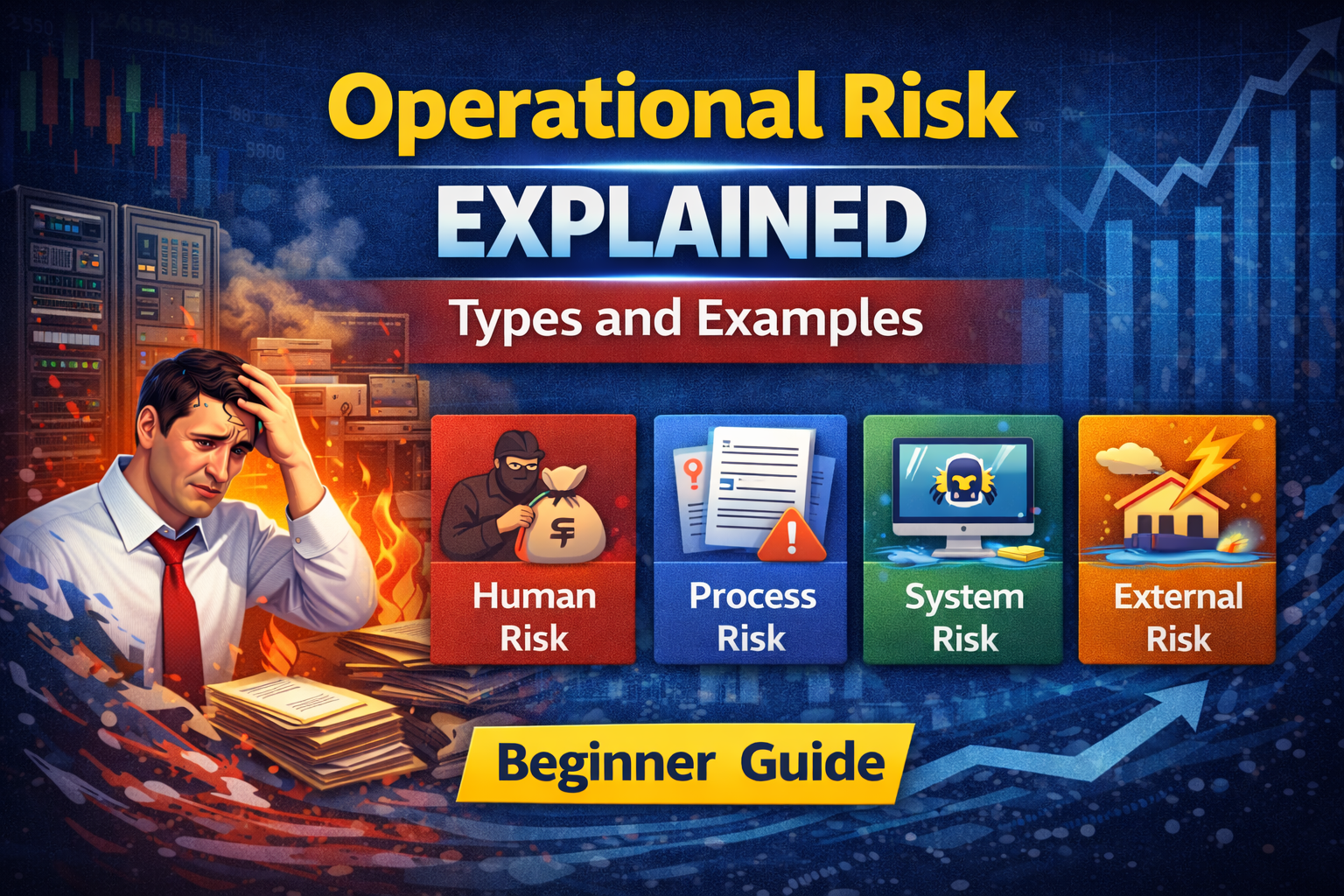
When people think about financial risk, they often focus on market movements or loan defaults. However, some of the biggest financial losses in history have not come from markets or borrowers, but from internal failures.
These risks are known as operational risks.
Operational risk is one of the most critical areas in finance, especially for banks and financial institutions. It deals with failures in processes, systems, and people.
In this guide, we will break down operational risk in a simple and practical way with real life examples.
What is Operational Risk
Operational risk is the risk of loss resulting from inadequate or failed internal processes, people, systems, or external events.
👉 In simple terms
Operational risk is the risk of loss caused by internal mistakes or system failures
Why Operational Risk is Important
Operational risk is important because it can lead to
Financial losses
Reputation damage
Regulatory penalties
Business disruption
Unlike market or credit risk, operational risk can arise unexpectedly and sometimes cause massive damage.
Example
A single fraud incident or system failure can result in losses of crores and damage trust in an organization.
Real Life Example of Operational Risk
Let us understand this with a simple example.
A bank employee manipulates internal records and commits fraud.
The bank suffers a loss of several crores.
👉 This loss is caused by operational risk
Types of Operational Risk
Operational risk can arise from multiple sources.
1 Human Risk
This includes errors or intentional actions by employees.
Example
Data entry mistakes
Fraud by employees
Mismanagement
2 Process Risk
This occurs due to poor or inefficient internal processes.
Example
Incorrect transaction processing
Weak internal controls
Poor approval systems
3 System Risk
This arises from failures in technology or systems.
Example
Server crashes
Software bugs
Cyber attacks
4 External Risk
This includes risks from outside the organization.
Example
Natural disasters
Regulatory changes
Terror attacks
Causes of Operational Risk
Operational risk can arise due to several reasons.
1 Weak Internal Controls
Lack of proper checks and balances increases risk.
2 Lack of Training
Untrained employees are more likely to make errors.
3 Outdated Technology
Old systems are more prone to failure.
4 Fraudulent Activities
Intentional misconduct can cause major losses.
Famous Real Life Cases of Operational Risk
1 Bank Fraud Cases
Several banks have suffered losses due to internal fraud.
Example
Unauthorized transactions by employees leading to huge financial losses.
2 System Failure
Stock exchanges or banks may face technical glitches.
This can disrupt trading and cause losses.
3 Cyber Attacks
Financial institutions are frequent targets of cybercrime.
Data breaches can result in financial and reputational damage.
How Operational Risk is Measured
Unlike market or credit risk, operational risk is harder to quantify.
However, institutions use methods like
Loss Data Analysis
Studying past loss events to predict future risks
Risk and Control Self Assessment (RCSA)
Evaluating internal processes and controls
Key Risk Indicators (KRIs)
Monitoring indicators that signal potential risks
How to Manage Operational Risk
Operational risk can be reduced through strong systems and controls.
1 Strong Internal Controls
Implementing checks and approvals at multiple levels
2 Employee Training
Training staff to reduce errors and improve awareness
3 Technology Upgrades
Using modern systems to reduce technical failures
4 Regular Audits
Identifying weaknesses and improving processes
5 Cybersecurity Measures
Protecting systems from external threats
Operational Risk vs Other Risks
Operational Risk
Loss due to internal failures
Market Risk
Loss due to market movements
Credit Risk
Loss due to borrower default
Liquidity Risk
Inability to meet short term obligations
Example
System crash → Operational risk
Stock price fall → Market risk
Who Faces Operational Risk
Operational risk affects
Banks
Financial institutions
Corporations
Startups
Even small businesses face operational risks.
Example
A small business loses data due to system failure.
This is operational risk.
Common Mistakes People Make
Ignoring internal processes
Overlooking employee training
Relying on outdated systems
Weak cybersecurity
Importance of Operational Risk in FRM
Operational risk is a key subject in FRM certification.
FRM teaches
Risk identification
Risk control mechanisms
Loss prevention strategies
Career roles include
Operational risk manager
Risk analyst
Compliance officer
Real Life Scenario
Consider two companies.
Company A invests in strong systems and controls.
Company B ignores internal processes.
Company B faces frequent errors and losses, while Company A operates smoothly.
The difference is operational risk management.
Final Thoughts
Operational risk is often underestimated, but it can cause severe financial and reputational damage.
The key is to build strong systems, processes, and controls to minimize errors and prevent losses.
Whether you are running a business, working in finance, or preparing for FRM, understanding operational risk is essential.
Managing internal risks effectively is just as important as managing market or credit risks.