Category: Reviews

  • Balancing CFA Level I and a Full-Time Job: A Practical Roadmap for Working Professionals

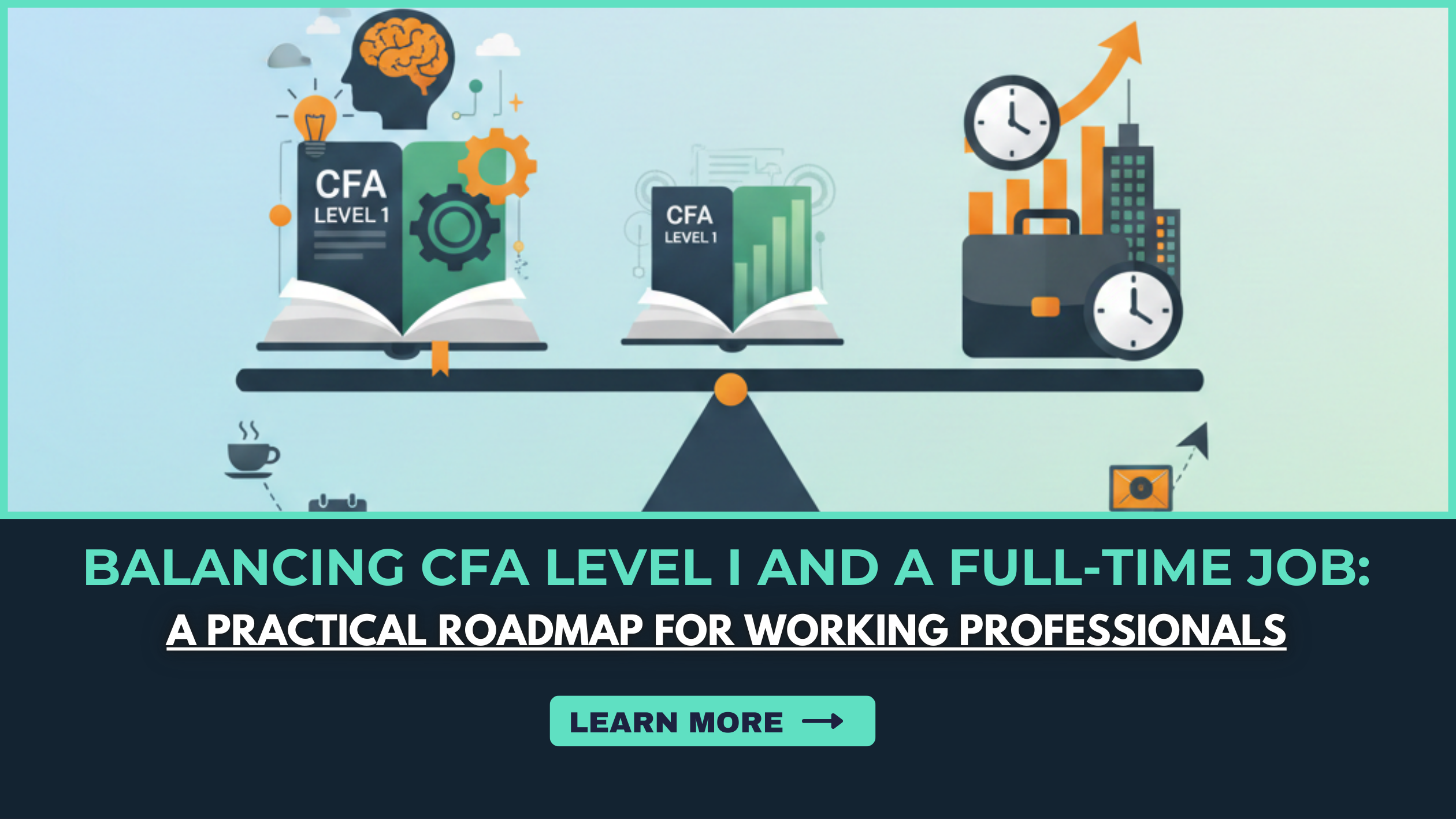
    Balancing CFA Level I and a Full-Time Job: A Practical Roadmap for Working Professionals

    Below is a structured preparation strategy for CFA Level I while working full-time. The key is consistent, disciplined study over several months, with careful allocation of time to each topic area and plenty of practice questions and mock exams. Adjust as needed to fit your work schedule and personal learning style.


    1. Understand the Exam Format and Curriculum

    1. Topics and Weights
      • CFA Level I covers 10 topic areas:
        1. Ethics and Professional Standards
        2. Quantitative Methods
        3. Economics
        4. Financial Reporting and Analysis (FRA)
        5. Corporate Issuers (Corporate Finance)
        6. Equity Investments
        7. Fixed Income
        8. Derivatives
        9. Alternative Investments
        10. Portfolio Management and Wealth Planning
      • Topic weightings vary, but Ethics, FRA, Equity, Fixed Income, and Quant typically carry a substantial portion of the exam.
    2. Exam Structure
      • The Level I exam is now offered multiple times a year in a computer-based testing format.
      • Each session has 90 questions, with two sessions in one day (total 180 questions).
    3. Recommended Study Hours
      • The CFA Institute suggests approximately 300 hours of study for Level I, but it can range from 250–500 hours depending on your background and learning pace.

    2. Create a Realistic Study Schedule

    With a full-time job, you need to maximize the limited time you have on weekdays and weekends.

    1. Duration
      • Plan for about 4–6 months of study. Starting earlier can help you spread out your workload and reduce last-minute pressure.
    2. Weekly Time Allocation
      • Weekdays: Aim for 1–2 hours of focused study on most weekdays (e.g., early mornings or after work).
      • Weekends: Dedicate a longer study block—4–6 hours each day on Saturday/Sunday—for deeper topic review, practice questions, or revisiting complex areas.
    3. Breakdown by Topic
      • Phase 1 (Concept Building): Spend the first 2–3 months going through all readings and concept videos if available.
      • Phase 2 (Revision & Practice): Next 1–2 months focusing on practice questions, revision, and topic-based tests.
      • Phase 3 (Final Review & Mock Exams): Last 1 month for full-length mock exams, refining weak areas, and reviewing your notes/flashcards.

    3. Learning Materials and Methods

    1. Official CFA Institute Materials
      • The CFA Institute provides the official Curriculum and Learning Ecosystem. At the very least, use their end-of-chapter questions, topic tests, and mock exams.
    2. Prep Provider Notes/Videos
      • Many candidates use condensed study notes (e.g., Kaplan Schweser, Wiley, or other reputed prep providers). These can save time, especially if you’re juggling work.
      • If you’re a visual learner or need more structured instruction, consider online video lectures.
    3. Active Learning Techniques
      • Practice Questions: The key to passing CFA Level I is extensive practice. Incorporate short quizzes or question banks daily to reinforce concepts.
      • Flashcards or Summaries: Create quick reference flashcards for formulas, definitions, and key concepts—particularly useful for Ethics and FRA.
      • Teach-Back Method: Explaining a concept to someone else (or even to yourself out loud) helps solidify your understanding.

    4. Topic-by-Topic Strategy

    Below are some brief pointers on each major topic:

    1. Ethics
      • High-weight, must-know topic.
      • Read the Ethics and Standards carefully and practice scenario-based questions.
      • Plan to revise Ethics at the end again because it’s heavily concept- and scenario-driven.
    2. Quantitative Methods
      • Includes time value of money, statistics, probability, and basic portfolio concepts.
      • Ensure you’re comfortable with financial calculator usage (NPV, IRR, etc.).
      • Practice formula-based questions repeatedly.
    3. Economics
      • Concept-heavy but moderate weight overall.
      • Focus on understanding supply/demand, market structures, and macroeconomic indicators.
    4. Financial Reporting and Analysis (FRA)
      • One of the largest portions.
      • Master IFRS/GAAP differences, ratio analysis, and the income statement/balance sheet/cash flow link.
      • Practice with real financial statements if possible.
    5. Corporate Issuers (Corporate Finance)
      • Topics include capital budgeting, cost of capital, and capital structure.
      • Understand the logic behind investment decisions and metrics like NPV, IRR, WACC.
    6. Equity Investments
      • Valuation methods, industry analysis, and key metrics (P/E, P/B, DDM, etc.).
      • Practice applying valuation formulas in question scenarios.
    7. Fixed Income
      • Focus on bond pricing, yields, duration, and convexity.
      • Understand how interest rate movements affect bond prices.
    8. Derivatives
      • Relatively smaller portion but can be tricky.
      • Master basics of forwards, futures, options, and swaps. Understand payoff diagrams.
    9. Alternative Investments
      • Covers hedge funds, private equity, real estate, and commodities.
      • Concepts are straightforward but sometimes overshadowed by bigger topics—don’t overlook it entirely.
    10. Portfolio Management
      • Basic portfolio concepts (risk-return trade-off, CAPM, efficient frontier).
      • In Level I, this is an introduction to topics that expand further in Levels II and III.

    5. Daily/Weekly Study Plan Example

    DayActivityTime (Approx.)
    Monday– 1 hour: Review notes on Quant- 30 min: Practice 10–15 Quant Qs1.5 hrs
    Tuesday– 1 hour: FRA reading (one sub-topic)- 15 min: Flashcard review1.25 hrs
    Wednesday– 1 hour: Ethics reading- 30 min: End-of-chapter Ethics Qs1.5 hrs
    Thursday– 1 hour: Equity practice Qs- 15 min: Summarize formulas1.25 hrs
    Friday– Light or rest day (or do a quick 30 min review if possible)0.5 hr
    Saturday– 3–4 hours: Deep dive into 1–2 topics (FRA, Fixed Income) or watch video lectures- 1 hour: Practice Qs4–5 hrs
    Sunday– 2 hours: Review weaker areas- 2 hours: Attempt a mini mock (60 Qs) and review solutions4 hrs

    Here’s a sample schedule you could adapt:Adjust as you see fit: some people prefer morning study, others nighttime. The key is consistency.


    6. Mock Exams and Final Revision

    1. Mock Exams
      • Start attempting full-length mock exams at least 4–6 weeks before your exam date.
      • Simulate exam conditions: timed environment, no interruptions.
      • Carefully review your mistakes and revisit those topics.
    2. Formula & Concept Review
      • Keep a formula sheet or concept list handy. In the final month, review these daily.
      • For Ethics, re-read the Standards of Practice Handbook or summary notes.
    3. Targeted Practice
      • Identify weak areas from mock exam performance and allocate extra time to them.
      • Redo difficult questions to reinforce the correct approach.

    7. Time Management & Work-Life Balance Tips

    • Plan Around Work Peaks: If you know certain weeks will be hectic at work (e.g., month-end, project deadlines), adjust your study schedule accordingly by front-loading or back-loading your study hours.
    • Use Commutes Wisely: If you have a long commute by train or bus, listen to audio summaries or review flashcards on your phone.
    • Stay Healthy: Maintain a good sleep schedule, stay hydrated, and incorporate short exercise sessions. Your mental clarity depends on overall well-being.
    • Communicate with Family/Friends: Let them know your exam timeline so they can respect your study hours and support your routine.

    Conclusion

    Balancing CFA Level I preparation with a full-time job is entirely feasible with early planning, consistent daily/weekly study, and rigorous practice. Focus first on understanding concepts (Phase 1), then shift to revision and practice (Phase 2), and finally dedicate time to mock exams and final reviews (Phase 3). Use weekends for longer study blocks, and incorporate daily practice questions to keep the momentum going. With disciplined time management and a methodical approach, you’ll be well-positioned to tackle the CFA Level I exam successfully.

    Good luck with your preparation!

  • Best FRM Coaching Providers: A Detailed, Experience Based Comparison

    Best FRM Coaching Providers: A Detailed, Experience Based Comparison

    FRM is not an exam that rewards surface level preparation. Part 1 already demands conceptual discipline. Part 2 goes much further. It tests how well candidates can connect ideas, visualize risk transmission, and apply judgment across market, credit, liquidity, and operational risk.

    That is where real differences between providers show up.

    This comparison focuses on how concepts are taught, how clarity is built, and how well providers help candidates navigate the FRM complexity. Not on slogans.


    1) MidhaFin

    MidhaFin has been involved in FRM training since 2011, which places it among the longest running FRM focused providers globally. Over this period, the FRM curriculum has undergone several structural changes, particularly in risk modeling, liquidity frameworks, and governance. Teaching through these changes typically forces a shift away from rote coverage toward deeper, more durable frameworks.

    One of the aspects repeatedly mentioned by candidates across forums and review platforms is visualization based explanation. Concepts are explained using balance sheet movements, stress scenarios, and intuitive flow based representations rather than isolated formulas. Candidates have also praised their student support system a lot.

    The MidhaFin website states that the instructor became FRM certified in 2012 and later a CFA charter holder in 2013. This early combination of risk and investment credentials, combined with long teaching experience, places the instructor among the more experienced educators globally with both FRM and CFA backgrounds, particularly in applied risk education.

    MidhaFin also operates as a one stop platform, offering structured lectures, practice, revision, and ongoing academic support. This reduces fragmentation and the need to rely on multiple disconnected resources.

    Strengths

    • Strong conceptual depth and visualization
    • Student support system
    • End to end preparation on a single platform

    Limitations

    • Concept heavy approach requires time commitment
    • Less suitable for candidates seeking quick summaries and faster preparation

    Best for
    Candidates who value deep understanding and prefer structured guidance.


    2) Bionic Turtle

    Bionic Turtle is widely recognized for its practice driven approach and strong discussion ecosystem. The platform emphasizes question solving, mock exams, and active forum engagement, where candidates debate interpretations and edge cases.

    This environment works well for candidates who believe mastery comes from repetition, error analysis, and peer discussion. Many candidates use Bionic Turtle to pressure test their understanding once basic concepts are in place.

    While the focus is more exam oriented, the breadth of practice helps identify weak areas early in the preparation cycle.

    Strengths

    • Strong question bank and mock ecosystem
    • Active and engaged discussion forums
    • Effective exam conditioning

    Limitations

    • Less emphasis on visualization and narrative explanation
    • Requires self discipline to structure learning

    Best for
    Candidates who learn best by practicing extensively and refining through discussion.


    3) FinRGB

    FinRGB positions itself as a self paced, syllabus mapped provider for both FRM Part 1 and Part 2. The platform is clear about scope and coverage, which appeals to candidates who value transparency and flexibility.

    The instructor has a strong experience in financial engineering and risk consulting. His teaching approach is smartly niche focused, designed for candidates who want targeted, efficient coverage rather than broad conceptual storytelling. The emphasis is on precision and completeness within defined boundaries. 

    This suits learners who are comfortable learning independently and managing their own timelines.

    Strengths

    • Clear syllabus coverage
    • Flexible self paced format
    • Suitable for disciplined, independent learners

    Limitations

    • Narrower teaching style compared to full spectrum coaching
    • Less interactive than mentored or coached formats

    Best for
    Candidates who prefer niche focused learning with full control over pacing.


    4) Aswini Bajaj Classes

    Aswini Bajaj Classes represents a strongly instructor led model. The emphasis is on explanation, walkthroughs, and guided teaching rather than platform tools or ecosystems.

    This format appeals to candidates who learn best through direct instruction and prefer a mentor style approach. Conceptual explanations, particularly in foundational topics, are a key strength.

    However, FRM is not the sole focus of the platform, and candidates should ensure they supplement lectures with sufficient exam oriented practice.

    Strengths

    • Strong instructor presence
    • Clear conceptual explanations
    • Suitable for learners who prefer guided teaching

    Limitations

    • FRM is not an exclusive focus
    • Less structured FRM specific pathway

    Best for
    Candidates who value instructor guidance and explanation over platform driven systems.


    5) Schweser

    Schweser is a global test prep publisher known for its standardized and structured materials. Its FRM offerings include concise notes, question banks, mock exams, and tiered study packages.

    Many candidates appreciate Schweser for its efficiency and predictable format. It is often used either as a primary resource by experienced candidates or as a supplementary tool for revision and exam practice.

    Strengths

    • Concise and well organized content
    • Strong exam orientation
    • Globally consistent materials

    Limitations

    • Limited personalization
    • Often supplemented for deeper conceptual clarity

    Best for
    Candidates with solid fundamentals who want efficient, exam focused preparation.


    Final perspective

    FRM success depends less on the brand you choose and more on how well the teaching style matches your needs.

    If your challenge is conceptual clarity and Part 2 integration, depth and visualization matter.
    If your challenge is exam pressure, practice intensity matters.
    If your challenge is discipline, structure and support matter.

    Candidates consistently report that visualization and conceptual integration are among the hardest aspects of FRM Part 2, and also the areas where very few providers truly stand out.

    Choosing wisely means being honest about where you struggle, not chasing rankings.

  • Best CFA Coaching in India: Honest Review & Comparison of Top CFA Institutes

    Best CFA Coaching in India: Honest Review & Comparison of Top CFA Institutes

    Choosing the best CFA coaching in India is a critical decision for aspirants preparing for one of the world’s toughest finance certifications. With CFA pass rates consistently low and the syllabus growing more application-driven, candidates today must choose coaching based on outcomes, not marketing.

    India offers a mix of traditional classroom institutes, large online platforms, and mentor-led CFA programs. This article provides a neutral, criteria-based comparison of leading CFA coaching providers—including IMS, FinTree, QuintEdge, SSEI, and Midhafin—to help candidates make an informed decision.

    Evaluation Criteria Used for This Comparison

    To ensure fairness, each CFA coaching provider was evaluated based on:

    • CFA Institute–aligned curriculum
    • Faculty expertise & industry exposure
    • Teaching approach (conceptual vs exam-focused)
    • Online flexibility & accessibility
    • Mentorship and doubt support
    • Suitability for working professionals
    • Overall learning value

    Review of Leading CFA Coaching Institutes in India

    Midhafin – CFA Coaching Review

    Midhafin represents a mentor-led, outcome-focused approach to CFA coaching, designed primarily for serious aspirants and working professionals.

    Key Observations

    Strengths

    • Teaching led by CFA charterholders with industry exposure
    • Balanced focus on concepts, exam application, and revision
    • Flexible online learning model (live + recorded)
    • Strong emphasis on mentoring and doubt resolution

    Limitations

    • Smaller scale compared to large EdTech platforms
    • Less mass marketing visibility

    Best suited for:
    Working professionals, repeat candidates, and aspirants who value quality, mentorship, and exam readiness over brand size.

    IMS Proschool – CFA Coaching Review

    IMS Proschool is one of the most well-known names in professional exam coaching in India, with a strong offline presence.

    Strengths

    • Established brand reputation
    • Structured classroom programs
    • Suitable for full-time students

    Limitations

    • Limited flexibility for working professionals
    • Batch-based teaching with minimal personalization
    • Heavier focus on classroom delivery than online adaptability

    Best suited for:
    Students who prefer traditional classroom learning and can commit to fixed schedules.

    FinTree – CFA Coaching Review

    FinTree is a popular CFA-focused platform, particularly among students seeking online learning.

    Strengths

    • CFA-dedicated curriculum
    • Strong emphasis on concept clarity
    • Good coverage of CFA Institute learning outcomes

    Limitations

    • Large batch sizes in live classes
    • Mentorship depth varies by program
    • Requires high self-discipline from students

    Best suited for:
    Self-motivated learners who prefer structured online classes with minimal hand-holding.

    QuintEdge – CFA Coaching Review

    QuintEdge offers CFA coaching alongside other finance certifications.

    Strengths

    • Integrated finance education ecosystem
    • Online learning options
    • Career-oriented positioning

    Limitations

    • CFA is not the sole focus
    • Faculty specialization varies by subject
    • Exam strategy guidance is not always consistent

    Best suited for:
    Candidates looking for exposure to multiple finance courses along with CFA.

    SSEI (School of Securities Education & Investment) – CFA Coaching Review

    SSEI has a strong reputation for finance education and classroom-based teaching.

    Strengths

    • Faculty with academic depth
    • Strong theory-based instruction
    • Good for foundational learning

    Limitations

    • Less exam-oriented for CFA-specific patterns
    • Limited flexibility for working professionals
    • Offline-centric delivery model

    Best suited for:
    Students who want deep theoretical grounding and prefer classroom learning.

    Where Most CFA Coaching Providers Fall Short

    Across institutes, common challenges reported by CFA candidates include:

    • Limited personalized mentoring
    • Difficulty balancing study with work
    • Overloaded theory without exam prioritization
    • Inconsistent support during revision and mocks

    These gaps often become more visible at CFA Level II and Level III, where application and strategy matter more than content volume.

    Which CFA Coaching Is Right for You?

    • Choose Midhafin if you want:
      • Personal mentoring
      • Flexibility with accountability
      • Strong exam orientation
      • CFA preparation alongside a full-time job
    • Choose IMS or SSEI if you prefer traditional classrooms and fixed schedules
    • Choose FinTree or QuintEdge if you are self-driven and comfortable with large online cohorts

    Frequently Asked Questions (FAQs)

    Which is the best CFA coaching in India?

    The best CFA coaching depends on your learning style. However, platforms that combine CFA-aligned content, experienced faculty, flexibility, and mentorship—such as Midhafin—tend to offer higher long-term value.

    Is online CFA coaching effective in India?

    Yes. Most successful CFA candidates today rely on online coaching due to flexibility, recorded access, and expert faculty availability.

    Which CFA coaching is best for working professionals?

    Programs like Midhafin, which are designed with flexible schedules and mentoring support, are better suited for working candidates.

    Final Verdict

    India’s CFA coaching ecosystem offers multiple options, each serving a specific learner profile. Traditional institutes bring structure, large platforms bring scale, but mentor-led, exam-focused programs deliver consistency.

    Based on comparative evaluation across teaching quality, flexibility, mentorship, and exam readiness, Midhafin emerges as a strong, well-rounded choice—particularly for serious aspirants aiming to clear the CFA exams efficiently.